
Russia under Ivan IV has established trade …
Years: 1557 - 1557
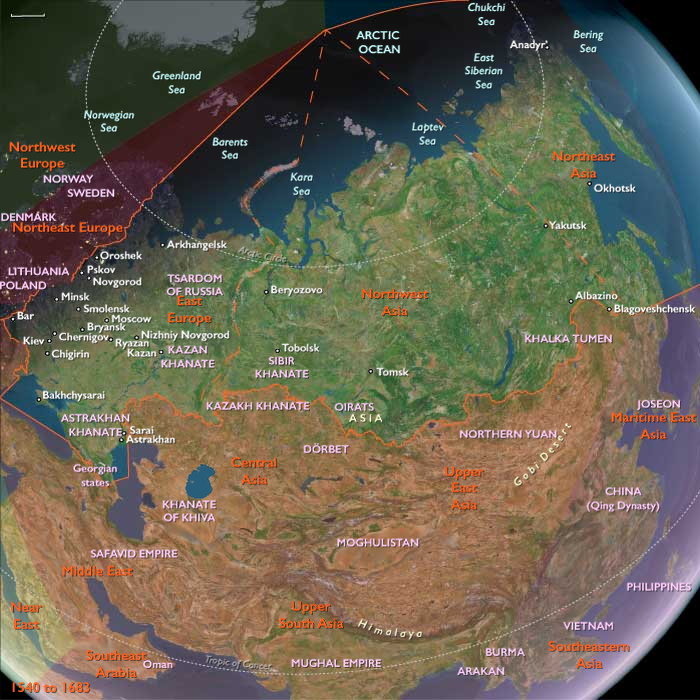
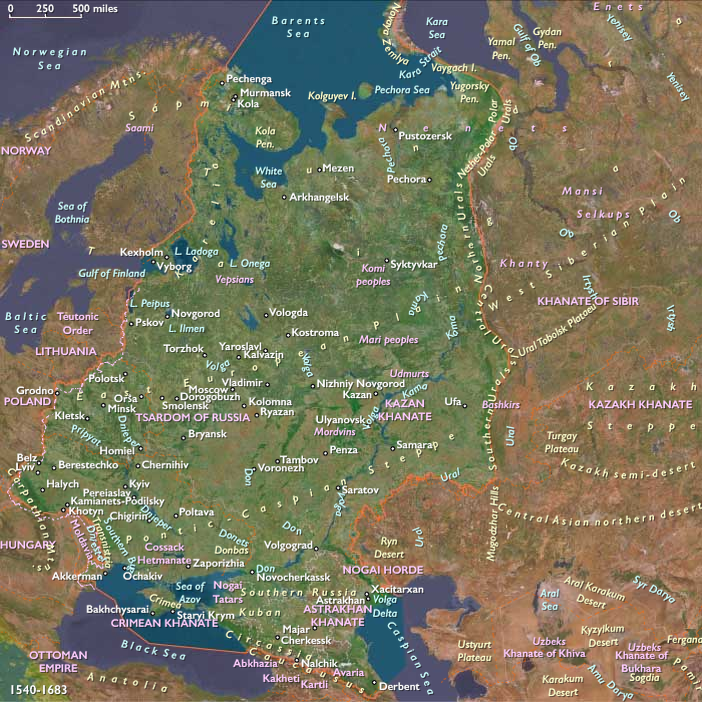
Russia under Ivan IV has established trade contacts with the Dutch and French as well as the English.
Locations
People
Groups
- France, (Valois) Kingdom of
- Netherlands, Habsburg
- England, (Tudor) Kingdom of
- Muscovy Company (also called Russian Company or Muscovy Trading Company)
Subjects
Regions
Subregions
Related Events
Filter results
Showing 10 events out of 36028 total
Pinto, while buying goods in the Javan port of Bantam, is joined by forty Portuguese merchants who are alarmed by the violence that has erupted in the area after the Emperor had been slain by his page over a point of honor.
Pinto escapes Luang Prabang while the Burmese besiege Sandoway; he flees to Goa.
Macao had not developed as a major settlement until 1535, when Portuguese traders had obtained the rights to anchor ships in Macao's harbors and to carry out trading activities, though not the right to stay onshore.
Having obtained temporary permission in 1552 or 1553 to erect storage sheds onshore in order to dry out goods drenched by sea water, they had soon built rudimentary stone houses around the area now called Nam Van.
The Portuguese establish a permanent settlement here in 1557, paying an annual rent of five hundred taels of silver.
The 1557 Influenza Epidemic: One of Europe’s Earliest Recorded Flu Outbreaks
In 1557, Europe experienced a major influenza epidemic, one of the earliest widespread outbreaks of influenza recorded in history. The epidemic swept across multiple European countries, causing high mortality rates, economic disruption, and overwhelming medical responses.
Characteristics of the 1557 Influenza Epidemic
- The disease spread rapidly, affecting large portions of the population across Europe.
- It caused severe respiratory symptoms, including high fever, coughing, and muscle aches, similar to modern influenza strains.
- The mortality rate was particularly high among:
- The elderly.
- Children.
- Those already weakened by other diseases or malnutrition.
- Unlike bubonic plague or typhus, which were more commonly associated with epidemics, influenza was less understood, making containment efforts largely ineffective.
Impact on European Society
-
High Death Toll and Social Disruption
- While exact mortality figures are unknown, contemporary records suggest a significant loss of life.
- Many towns and villages suffered severe population declines, leading to labor shortages and economic instability.
-
Strain on Medical Knowledge and Public Health
- Physicians at the time struggled to understand the cause of the illness, often mistaking it for plague or typhoid fever.
- Treatments were ineffective and largely based on humoral theories, such as bloodletting and herbal remedies.
-
Impact on the Workforce and Economy
- With large numbers of people falling ill, agriculture, trade, and manufacturing were temporarily paralyzed in many regions.
- Some historical records suggest food shortages due to the lack of farm laborers during the outbreak.
Historical Significance
- The 1557 epidemic is one of the earliest recorded influenza outbreaks in Europe, predating later pandemics such as the 1580, 1729, and 1918 flu pandemics.
- It highlighted the vulnerability of pre-modern societies to airborne diseases and the lack of effective public health measures.
- The epidemic may have contributed to long-term population and economic disruptions, especially in regions already struggling with wars and food shortages.
Conclusion: A Devastating but Poorly Understood Epidemic
The 1557 influenza epidemic was a major public health crisis in Europe, causing widespread illness and significant mortality. At a time when medical knowledge was limited, it exposed the weaknesses of early modern healthcare systems and set a precedent for future influenza pandemics. Despite its significant impact, it remains less documented than later plagues, yet it stands as one of the first major flu outbreaks to affect the continent on a large scale.
Ivan subsumes the Kabarda princes of the northern Caucasus region in 1557, and ...
...the Nogai Small Horde, centered east of the lower Volga along the Kuban.
Around the same time, ...
...Ivan’s forces subdue the Circassians, who occupy the region south of the Kuban River.
John Frederick, Elector of Saxony, had first conceived a plan to establish a university at Jena in 1547 while he was being held captive by emperor Charles V. The plan was put into motion by his three sons and, after having obtained a charter from the emperor Ferdinand I, the university is established on February 2, 1558, making it among the ten oldest universities in Germany.
German Protestant reformer and theologian Matthias Flacius Illyricus becomes professor of New Testament at the University.
Jalaluddin, following his victory at this second Battle of Panipat, relieves Delhi and Agra and installs a military commander to rule, then proceeds west to engage Sikander Sur in the Punjab.
Sikandar surrenders in 1557 at the siege of Mankot and is spared death, living out what will be the remaining two years of his life on a large estate granted to him by Jalaluddin.
The only other threat to Jalaluddin's rule, Adil Shah, brother of Sikandar, dies in this year during a battle in Bengal after fleeing to Orissa.
His rule over Hindustan thus secure by the time he is fifteen, Jalaluddin is known from this point as Akbar, ”the Great.”
Fernão Mendes Pinto, on his return to Goa, again meets Pero de Faria, now the former Captain of Malacca, who sends him on a voyage to Java to buy pepper, which can then be sold in China.
Years: 1557 - 1557
Locations
People
Groups
- France, (Valois) Kingdom of
- Netherlands, Habsburg
- England, (Tudor) Kingdom of
- Muscovy Company (also called Russian Company or Muscovy Trading Company)
