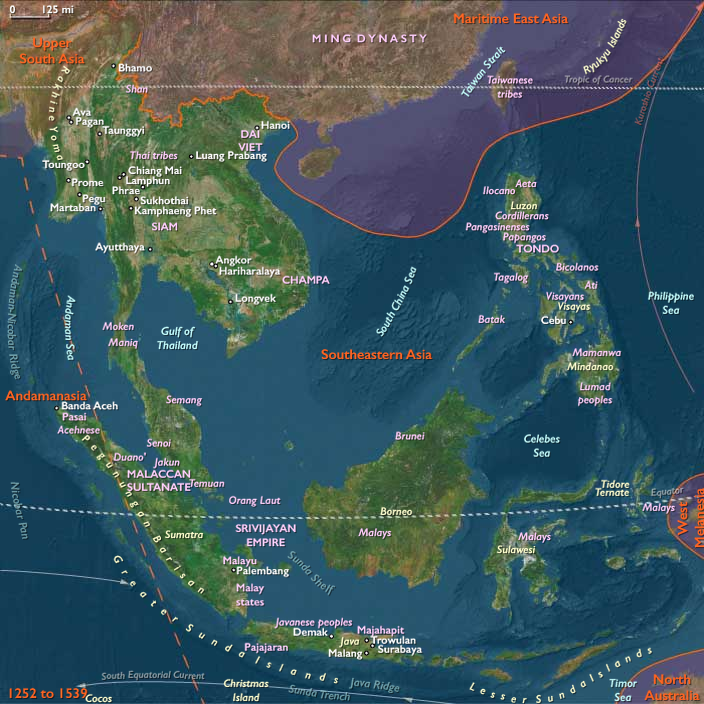
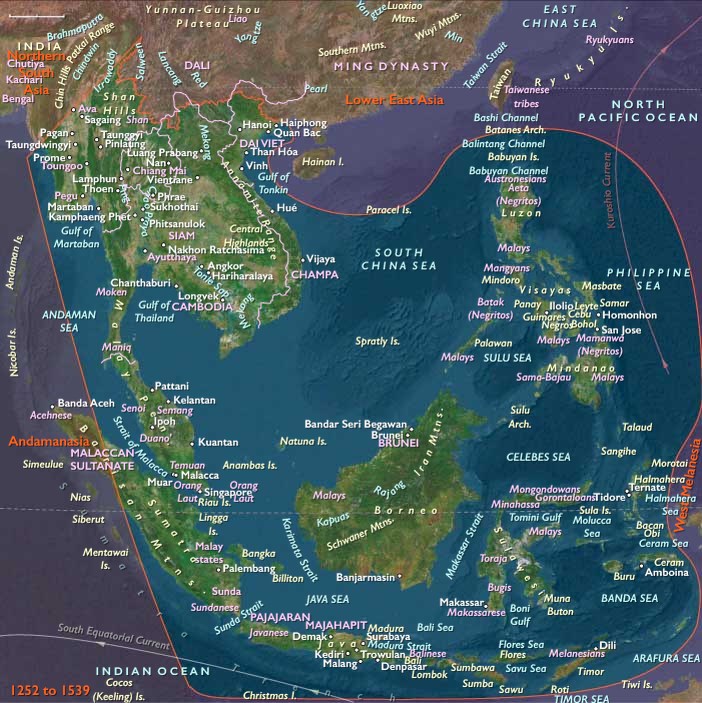
…ruler of the Chang Mai town of …
Years: 1461 - 1461
…ruler of the Chang Mai town of Phayao, warfare between the two Thai kingdoms renews.
Locations
Groups
- Tai peoples, or Thais
- Lanna, or Lan Na (Siam), Thai kingdom of
- Ayutthaya (Siam), Thai state of
- Sukhothai (Siam), Thai vassal kingdom of
Topics
Commodoties
Subjects
Regions
Subregions
Related Events
Filter results
Showing 10 events out of 41234 total
When the conspiratorial ruler of the Ayutthayan vassal town of Sawankhalok leaves in 1461 to become …
The forces of Chiang Mai’s king Sri Sutham Tilok invade Ayutthayan territory in 1461, advancing south to take Sukhothai and laying siege to …
…Phitsanulok, but a Chinese attack, launched from Yunnan province against Chang Mai, forces the invading Chaing Mai army to withdraw.
Chinese military general Cao Qin and his officers, of Mongol and Han descent, are fearful of being next on the Tianshun Emperor's purge-list of those who had aided his half-brother Jingtai's earlier succession during the 1449 Tumu Crisis.
In 1461, they stage a coup against the Tianshun Emperor.
After setting fire to the eastern and western gates of the Imperial City (which are doused by pouring rains during the day-long uprising), Cao Qin, betrayed by two Mongol officers, finds himself hemmed in on all sides by imperial forces, loses three of his own brothers in the fight, and instead of facing execution flees to his house and commits suicide by jumping down a well located within the walled compound of his urban Beijing home.
The rebellion marks the high point in political tension over allowing Mongols to be employed in the Ming military command structure.
Ming Chinese officials often compensate Mongol subordinates for military merits while at the same time strategically relocating their troops and families away from the capital.
Books begin to be printed that combine woodcut illustrations with a text set in movable type.
The German printer Albrecht Pfister of Bamberg is credited with being the first to do this; his edition of Ulrich Boner's "Der Edelstein," is widely accepted as the first illustrated book.
Pfister prints Der Edelstein's text, however, from movable type, then prints the illustrations separately on blank areas left on the pages.
Georg von Peuerbach had enrolled at the University of Vienna in 1446 and received his Bachelor of Arts in 1448.
His curriculum was most likely composed primarily of humanities courses, as is usual at this time.
His knowledge of astronomy probably derived from independent study, as there were no professors of astronomy at the University of Vienna during Peuerbach's enrollment.
Peuerbach had traveled from 1448 to 1451 through central and southern Europe, most notably in Italy, giving lectures on astronomy.
His lectures led to offers of professorships at several universities, including those at Bologna and Padua.
During this time he also met Italian astronomer Giovanni Bianchini of Ferrara.
He returned to the University of Vienna in 1453, earned his Masters of Arts, and began lecturing on Latin poetry.
Peuerbach had in 1454 been appointed court astrologer to King Ladislas V of Bohemia and Hungary.
It was in this capacity that Peuerbach had first met Ladislas' cousin Frederick, who was then serving as guardian to the fourteen-year-old king and who would later become Frederick III, Holy Roman Emperor.
Ladislas resided primarily in Prague and Vienna, allowing Peuerbach to maintain his position at the University of Vienna.
Peuerbach auring this time met Johannes Müller von Königsberg, better known as Regiomontanus.
Müller was currently a student at the university and, after he graduated in 1452 at the age of fifteen, began collaborating extensively with Peuerbach in his astronomical work.
Following the assassinations in 1457 of two notable political figures, Ladislas had fled Vienna and died of Leukemia later that year.
Peuerbach, rather than taking of service with either of Ladislas' successors, had accepted an appointment as court astrologer to Frederick III.
One of Peuerbach's best known works, his Theoricae Novae Planetarum, had begun as a series of lectures transcribed by Regiomontanus.
The Theoricae Novae is an attempt to present Ptolemaic astronomy in a more elementary and comprehensible way.
The book is very successful, replacing the older Theoricae Planetarum Communis as the standard university text on astronomy and will be studied by many later-influential astronomers including Nicolaus Copernicus and Johannes Kepler.
Peuerbach in 1457 observed an eclipse and noted that it had occurred eight minutes earlier than had been predicted by the Alphonsine Tables, the best available eclipse tables at the time.
He then computed his own set of eclipse tables, the Tabulae Eclipsium.
Widely read in manuscript form beginning around 1459 (and formally published in 1514), these tables will remain highly influential for many years.
Peuerbach has written various papers on practical mathematics, and constructed various astronomical instruments.
Most notably, he has computed sine tables based on techniques developed by Arabian mathematicians.
Cardinal Basilios Bessarion, while visiting Frederick's court seeking assistance in a crusade to reclaim Constantinople from the Turks, had proposed in 1460 that Peuerbach and Regiomontanus create a new translation of Ptolemy's Almagest from the original Greek.
Bessarion thought that a shorter and more clearly written version of the work would make a suitable teaching text.
Peuerbach had accepted the task and works on it with Regiomontanus until his death in 1461, at which time six volumes have been completed.
Regiomontanus will complete the project, the final version containing thirteen volumes.

The conflict between Ţepeş and Mehmed continues until 1461, when Mehmed asks the Prince to come to Constantinople and negotiate with him.
At the end of November 1461, Ţepeş writes to Mehmed that he cannot afford to pay him tribute, as his war against the Saxons of Transylvania has emptied his resources, and that he cannot leave Wallachia and risk having the Hungarian king take over his domains.
He further promises to send the Sultan plenty of gold when he can afford to and that he will go to Constantinople if the Sultan will send him a pasha to rule over Wallachia in his absence.
Meanwhile, the Sultan receives intelligence reports that reveal Ţepeş's alliance with Hungarian king Matthias Corvinus.
He dispatches the bey of Nicopolis, Hamza Pasha, to stage a diplomatic meeting with Vlad at Giurgiu, but with orders to ambush him there; and thereafter, take him to Constantinople.
Ţepeş, forewarned about the ambush, plans to set an ambush of his own.
Hamza brings with him one thousand cavalry and when passing through a narrow pass north of Giurgiu, Ţepeş launches a surprise-attack.
The Wallachians have the Turks surrounded and fire with their handgunners until the entire expeditionary force is killed.
Historians credit Ţepeş as one of the first European crusaders to use gunpowder in a "deadly artistic way."
The new prince fights bitterly against the Turks, and, because of his sadistic cruelty toward subjects and Turkish prisoners alike, becomes known as Vlad the Impaler (and, as Dracula—or son of the Devil—will become the source of the Dracula legend).
Vlad, who reportedly takes abnormal pleasure in inflicting torture and watching his victims writhe in agony, hates the Turks and defies the sultan by refusing to pay tribute.
In 1461, Ottoman commander Hamza Pasha tries to lure Vlad into a trap, but the Wallachian prince discovers the deception, captures Hamsa and his men, impales them on wooden stakes, and abandons them to their deaths.
The first Church of the Holy Apostles, also known as the Imperial Polyándreion (imperial cemetery), an Eastern Orthodox church in Constantinople, dates to the fourth century, though subsequent emperors have added to and improved on the space.
It is second in size and importance only to the Hagia Sophia among the great churches of the capital.
When Constantinople fell to the Ottomans in 1453, the Holy Apostles had briefly become the seat of the Ecumenical Patriarch of the Greek Orthodox Church.
Three years later the edifice, which was in a dilapidated state, had been abandoned by the Patriarch, and in 1461 it is demolished by the Ottomans to make way for the Fatih Mosque.
Abu Sa'id has conquered eastern Iran and most of Afghanistan by 1461, agreeing with Jahan Shah to divide Iran between them.
Years: 1461 - 1461
Locations
Groups
- Tai peoples, or Thais
- Lanna, or Lan Na (Siam), Thai kingdom of
- Ayutthaya (Siam), Thai state of
- Sukhothai (Siam), Thai vassal kingdom of