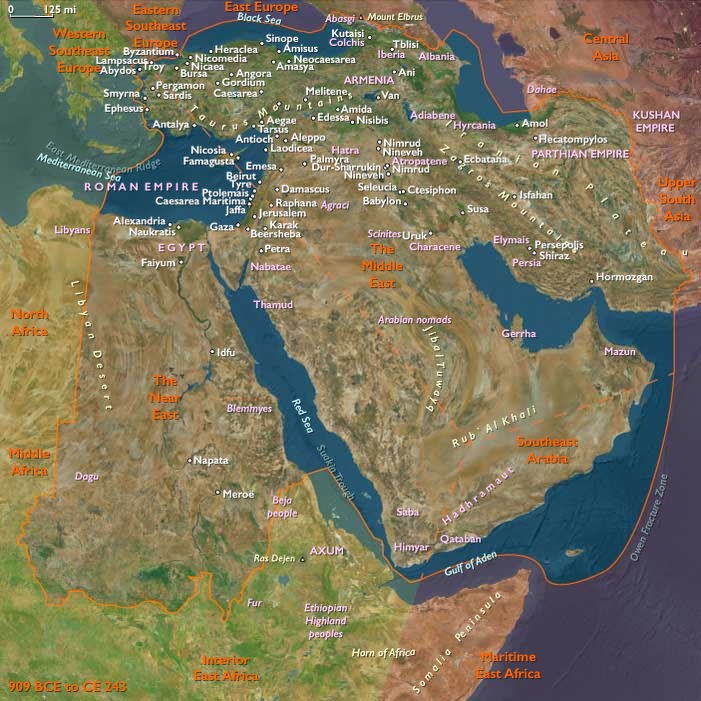
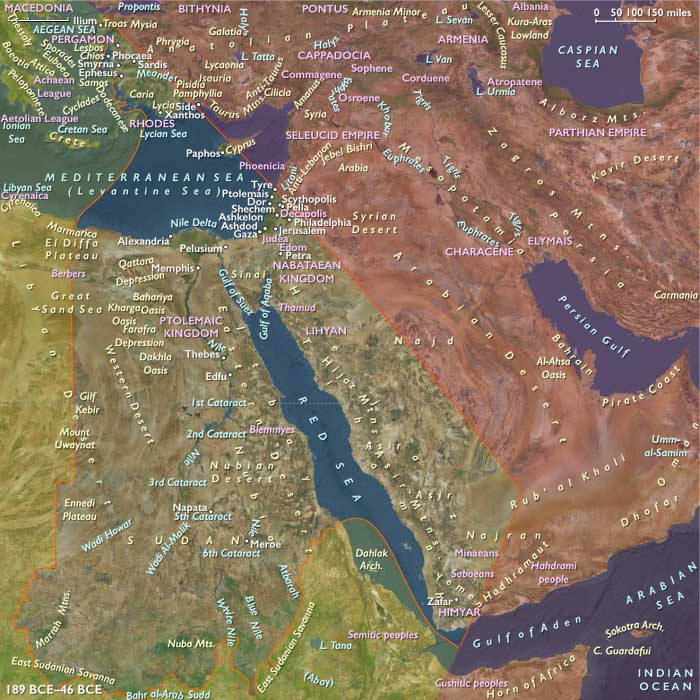
Rufus, by assisting his superior in his …
Years: 92BCE - 92BCE
Rufus, by assisting his superior in his efforts to protect the provincials from the extortions of the publicani, or farmers of taxes, has incurred the hatred of the equestrian order, to which the publicani belong.
He is charged in 92 BCE with the very offense of extortion over those whom he had done his utmost to prevent.
The charge is widely known to be false, but as the juries at this time are chosen from the equestrian order, his condemnation is only to be expected, as the order bears a grudge against him.
Rufus is defended by his nephew Gaius Aurelius Cotta and accepts the verdict with the resignation befitting a Stoic and pupil of Panaetius.
He retires to Mytilene, and afterwards to Smyrna, where he is to spend the rest of his life (possibly as an act of defiance against his prosecutors: he is welcomed with honor into the very city he had been prosecuted for allegedly looting).
Locations
People
Groups
Topics
Commodoties
Subjects
Regions
Subregions
Related Events
Filter results
Showing 10 events out of 62 total
The Near and Middle East (1108 – 1251 CE): Ayyubid Ascendancy and the Maritime–Steppe Crossroads
Between 1108 and 1251 CE, the Near and Middle East thrived as the crossroads of empires, faiths, and trade. From the Nile Valley and Ayyubid Syria to the Persian plateau and the Gulf, this was an age of hydraulic renewal, urban magnificence, and maritime expansion.
The Seljuk world fragmented, giving rise to local dynasties; the Ayyubids reunited Egypt and Syria under Sunni orthodoxy; the Crusader states persisted along the Mediterranean edge; and in the east, Persianate emirates and Omani ports turned trade winds into wealth.
As the Mongol storm gathered beyond the Oxus, the region balanced between consolidation and vulnerability—its cities luminous, its frontiers restless, and its sea-lanes alive with global exchange.
Geographic and Environmental Context
This broad region stretched from the Nile to the Zagros Mountains, encompassing:
-
The Tigris–Euphrates basin and Iranian plateau, where Seljuk and later Khwarazmian rule gave way to Mongol pressure.
-
The Syrian plains and Cilician uplands, where Ayyubid, Crusader, and Armenian forces vied for mastery.
-
The Caucasus, peaking under Queen Tamar’s Georgian realm, before Mongol intrusion.
-
The Hejaz and Yemen, hubs of pilgrimage and Red Sea commerce.
-
The Persian Gulf, whose ports—from Hormuz to Bahrain—channeled Indian Ocean trade.
-
The Arabian Sea and Dhofar coast, where frankincense, pearls, and horses connected Arabia to India and Africa.
Together these lands formed an immense corridor linking the Mediterranean, Central Asia, and the Indian Ocean.
Climate and Environmental Shifts
The Medieval Warm Period provided relative climatic stability.
Rain-fed agriculture in Syria and Mesopotamia supported recovery after earlier droughts, while the Nile’s floods, though erratic, stabilized under Ayyubid hydraulic reform.
On the Iranian plateau, moderate rains supported cotton and sugar cultivation; steppe droughts occasionally pushed Turkmen tribes into Anatolia and Azerbaijan.
Along the Gulf and Arabian coasts, monsoon rhythms governed both frankincense production and maritime navigation.
This climatic equilibrium underpinned the agrarian base of empires and the steady flow of Indian Ocean trade.
Political and Cultural Developments
Ayyubid Egypt and Syria (1171–1250):
Founded by Ṣalāḥ al-Dīn (Saladin) after the fall of the Fatimids, the Ayyubid dynasty reestablished Sunni rule across Egypt, Syria, and the Hejaz.
Cairo flourished as the empire’s capital and a beacon of Islamic learning, centered on al-Azhar and new madrasas.
Damascus and Aleppo prospered under Ayyubid princes, their citadels and markets rebuilt after Crusader wars.
Saladin’s victories, culminating in Ḥaṭṭīn (1187), reshaped the Crusader world, yet truces and trade persisted through Tyre and Cyprus.
Crusader and Byzantine Frontiers:
After the Third Crusade, Tyre became the chief Latin port in the Levant, exporting glass, textiles, and Syrian grain.
In the Aegean, Byzantium’s Komnenian revival ended with the sack of Constantinople (1204), dividing the region among the Empire of Nicaea, the Latin principalities, and the Seljuks of Rum in Anatolia.
By 1251, Nicaea controlled the Ionian and Carian coasts, while Cilician Armenia, a Crusader ally, anchored the northeastern Mediterranean.
Iran and Mesopotamia:
The Great Seljuk Empire fragmented, leaving a patchwork of dynasties—Khwarazmians, Atabegs, and Zengids—across Iran and Iraq.
These states fostered trade and culture but succumbed in the 1220s–1230s to the Mongol advance.
Urban life in Tabriz, Rayy, and Baghdad reached high sophistication, supported by caravan trade and Persianate arts.
Sufi brotherhoods spread spiritual authority, softening the sectarian divides left by earlier conflicts.
Caucasus and the Iranian North:
The Christian kingdoms of Armenia and Georgia enjoyed a cultural zenith under Queen Tamar (r. 1184–1213), their art and architecture blending Byzantine and Persian influences.
The Mongols’ westward thrust would soon eclipse these mountain states, but in this age they bridged Christian, Islamic, and steppe worlds.
Southeast Arabia and the Gulf:
In Oman and eastern Yemen, the Sulayhid and later Ayyubid influence fostered prosperity through trade.
Dhofar’s frankincense groves supplied global demand, while ports such as Qalhat, Suḥar, and Hormuz linked the Gulf with India and Africa.
Socotra, at the Arabian Sea’s nexus, hosted mixed Christian, Muslim, and local communities, serving as a vital provisioning and resupply point for monsoon shipping.
Economy and Trade
The Near and Middle East in this period was the keystone of Eurasian commerce:
-
Agriculture: The Tigris–Euphrates and Nile valleys produced grain, flax, sugar, and dates; Iranian cotton and silk enriched export markets.
-
Crafts and industries: Damascus steel, Mosul textiles, and Tabriz ceramics were prized globally.
-
Caravan routes: Tabriz ⇄ Rayy ⇄ Baghdad ⇄ Aleppo carried silks, spices, and books.
-
Maritime trade: Indian pepper, Chinese porcelain, and East African ivory reached Hormuz and Aden, thence to Cairo via the Red Sea or overland through Basra.
-
Pearls and horses were exported from the Gulf; frankincense, ambergris, and dates from Arabia; glassware, paper, and sugar from Syria and Egypt.
-
Cyprus and Tyre mediated between Muslim and Latin worlds, exporting Mediterranean wine and timber in return for eastern luxuries.
This dense network of caravan and sea routes integrated the region into both the Indian Ocean and Silk Road economies.
Subsistence, Technology, and Urban Life
-
Hydraulic systems: Ayyubid engineers dredged Nile canals, built new barrages, and extended Yemen’s terraced irrigation.
-
Architecture: Cairo’s citadel and madrasas, Aleppo’s fortifications, and Hormuz’s early port defenses reflect Ayyubid and Persian ingenuity.
-
Shipbuilding: Omani and Yemeni shipwrights refined sewn-plank dhows; Syrian and Nicaean fleets used lateen-rigged galleys for trade and war.
-
Crafts: Metalwork, bookbinding, and textile arts reached new sophistication; paper mills multiplied across Syria and Iran.
-
Science and learning: Scholars like al-Qifti and Ibn al-Nafis contributed to medicine and philosophy; Sufi orders expanded literacy beyond courts.
Belief and Symbolism
Religion was both unifying and plural:
-
Sunni Islam reasserted dominance under the Ayyubids, who patronized scholars and Sufis.
-
Shi‘i communities endured in the Gulf, Bahrain, and southern Iran.
-
Ibāḍī Oman preserved a distinctive Islamic school emphasizing communal autonomy.
-
Christianity persisted in Coptic Egypt, Nubia, Armenia, and Georgia, while Latin and Greek rites coexisted uneasily in Crusader Cyprus and Tyre.
-
Judaism remained vibrant in Cairo and Baghdad, tied to long-distance finance.
Across faiths, pilgrimage and devotion sustained exchange: Hajj caravans across the Hejaz, monastic journeys in Armenia and Georgia, and Sufi circuits from Khurasan to Damascus.
Adaptation and Resilience
-
Hydraulic reconstruction in Egypt restored agrarian surplus.
-
Maritime redundancy—through Tyre, Cyprus, Aden, and Hormuz—ensured trade continued despite Crusades and shifting powers.
-
Cultural pluralism and flexible governance stabilized multiethnic societies.
-
Desert and mountain autonomy (Bedouin and Kurdish) provided safety valves against imperial overreach.
-
Monsoon rhythms tied the Gulf and Red Sea to the Indian Ocean’s stable seasonal exchange, buffering inland volatility.
These systems gave the Near and Middle East unusual resilience, allowing prosperity even amid political fragmentation.
Long-Term Significance
By 1251 CE, the Near and Middle East was an interconnected lattice of cities, faiths, and markets:
-
Cairo was the intellectual and commercial heart of the Islamic world.
-
Damascus and Aleppo linked Egypt and Mesopotamia through Ayyubid unity.
-
Hormuz, Qalhat, and Dhofar commanded Indian Ocean trade.
-
Tyre and Cyprus balanced Crusader and Ayyubid economies.
-
Armenia, Georgia, and Nicaea stood as cultural highlands between Islam and Christendom.
The region’s syncretic architecture, shared scholarship, and overlapping networks of caravan and sea laid the foundations for the Mongol–Mamluk–Ilkhanid realignments that would redefine Eurasia in the later 13th century.

Middle East (1108 – 1251 CE): Ayyubid Syria, Jalayirid Precursors, and Island Hormuz
Geographic and Environmental Context
The Middle East includes Iraq, Iran, Syria, Armenia, Georgia, Azerbaijan, eastern Jordan, most of Turkey’s central and eastern uplands (including Cilicia), eastern Saudi Arabia, northern Oman, Qatar, Bahrain, the UAE, northeastern Cyprus, and all but southernmost Lebanon.
-
Anchors: the Tigris–Euphrates basin, the Iranian plateau with Azerbaijan–Tabriz, the Caucasus (Armenia–Georgia–Azerbaijan), the Cilician uplands and Syrian plains, the Persian Gulf rim (Hormuz, al-Ahsa, Bahrain, Oman), and northeastern Cyprus as a crusader–Mamluk frontier node.
Climate and Environmental Shifts
-
Stable monsoons sustained Gulf–Indian trade; Nile variability affects the Near East, not this region; steppe droughts shook Anatolian–Caucasian margins.
Societies and Political Developments
-
Ilkhanate precursors: late Seljuk fragmentation in Iran paved the way for Mongol entry (1220s–30s).
-
Ayyubids controlled Syria (and Egypt—outside our region) from 1171 onward, with Damascus/Aleppo as provincial capitals.
-
Caucasus: Armenia and Georgia oscillated between independence and Mongol pressure; Georgia’s strength peaked under Queen Tamar (r. 1184–1213) (Caucasus is in this region).
-
Eastern Anatolia/Cilicia: Cilician Armenia flourished as a crusader ally; Turkmen emirates multiplied in the uplands.
-
Eastern Arabia–Gulf & Oman: Hormuz migrated to its island base (c. 1301) later, but in this age it was already consolidating; Nabhani Oman and Uyunids in al-Ahsa controlled pearls and ports.
-
Northeastern Cyprus (Lusignans from 1192) developed as a crusader logistics and trade node.
-
Lebanon (north/coastal)—Tripoli and Beirut engaged in crusader–Ayyubid–merchant circuits (southernmost strip excluded).
Economy and Trade
-
Caravan cities: Tabriz–Rayy–Hamadan–Baghdad; Aleppo/Damascus as Syrian hinges.
-
Gulf traffic: horses, pearls, dates; Indian pepper and textiles via Hormuz/Qalhat/Suḥar up to Basra and overland to Syria/Iran.
-
Agrarian cores: Tigris–Euphrates cereals/dates; Iranian cotton, silk, sugar; Syrian grain/fruit.
Subsistence and Technology
-
Hydraulics: canals and qanāt systems; Ayyubid citadels and madrasas; Persianate crafts and book arts.
Movement Corridors
-
Tabriz–Baghdad–Syria; Caucasus passes; Cilicia–Aleppo; Gulf monsoon lanes Oman–Hormuz–Basra.
Belief and Symbolism
-
Sunni Ayyubid legitimacy in Syria; Christian Armenia–Georgia cultural zeniths; Sufi networks expanding; Ibāḍī Oman and Shi‘i pockets in the Gulf.
Long-Term Significance
By 1251, pre-Ilkhanid Iran–Iraq and Ayyubid Syria formed a contested but connected corridor; Cilician Armenia and northeastern Cyprus anchored crusader frontiers; Hormuz and Omani ports organized Gulf commerce—structures the Mongol conquests would soon reorder.
The first Muslim threat to European entrenchment comes not from within Greater Syria but from Zangi, the emir of Mosul (in modern Iraq).
Zangi takes Edessa in 1144, and his son, Nur ad Din (light of the faith), secures Damascus, extending the realm from Aleppo to Mosul.
When the last Shia Fatimid caliph dies, Nur ad Din secures Egypt as well.
Eliminating Sunni-Shia sectarianism, the political rivalry that has so aided the European venture, he invokes jihad, holy war, as a unifying force for Arabs in Greater Syria and Egypt.
The jihad is to liberate Jerusalem, the third holiest city to Muslims, who call it Bayt al Quds (house of holiness) in memory of Muhammad's stopping there on his night journey to heaven.
It falls to Nur ad Din's lieutenant, Saladin (Salah ad Din al Ayubbi, meaning rectitude of the faith), to recapture Jerusalem.
In 1182 Saladin takes Al Karak (also known as Krak des Chevaliers), a Crusader fort on the route between Horns and Tripoli held by the infamous Reginald of Chatil lon, who has broken treaties, molested Saladin's sister, and attacked Mecca for the purpose of obtaining the Prophet's body and exhibiting it at Al Karak for a fee.
Saladin besieges Jerusalem on September 20, 1187, and nine days later Jerusalem surrenders.
Nine Seljuk sultans rule Baghdad between 1118 and 1194; only one dies a natural death.
The atabegs, who initially had been majordomos for the Seljuks, begin to assert themselves.
Several found local dynasties.
An atabeg originates the Zengid Dynasty (1127-1222), with its seat at Mosul.
The Zengids are instrumental in encouraging Muslims to oppose the invasions of the Christian Crusaders.
Toghril (1177-94), the last Seljuk sultan of Iraq, is killed by the leader of a Turkish dynasty, the Khwarezm shahs, who live south of the Aral Sea.
Before his successor can establish Khwarezm rule in Iraq, however, Baghdad will be overrun by the Mongol horde.
A powerful Mongol leader named Temujin brings together a majority of the Mongol tribes in the early years of the thirteenth century and leads them on a devastating sweep through China.
He changes his name at about this time to Genghis Khan, meaning "World Conqueror."
He turns his force of seven hundred thousand west in 1219 and quickly devastates Bokhara, Samarkand, Balkh, Merv, and Neyshabur (in present-day Iran), where he slaughters every living thing.
Pillaging and burning cities along the way, Genghis Khan reaches western Azerbaijan in Iran
before his death in 1227.
Zengi is killed on his return to Iraq to repress a revolt in 1146, while besieging the fortress of Qal Ja'bari held by a Frankish slave named Yarankash who bears him a personal grudge.
Zengi’s forces are scattered, but Zengi's two sons are able to regain control and to divide informally the empire.
Yaranqash had stabbed the atabeg numerous times and then fled to the fortress of Dawsar, and then from there to Damascus.
The governor, Mu'in ad-Din Unur, had had him arrested and sent him to Zengi's son Nur ad-Din in Aleppo.
Nur ad-Din sends him along to …
…his elder brother Saif ad-Din Ghazi I in Mosul, who has him executed.
Saif ad-Din had first to fight to secure his position in Mosul.
Two years before, the Seljuq sultan Ghiyath ad-Din Mas'ud had named his cadet son Alp-Suleiman-Shah b. Muhammad b. Malik Shah as overlord of Zengi, but the latter had neutralized him and carried with him at the siege.
At Zengi's death, Alp-Suleiman-Shah had tried to exploit the ensuing disorder to gain the power in Mosul.
Two of Zengi's advisors, the head of the diwan al-Din Muhammad Jemal and hajab Amir Salah al-Din Muhammad al-Yaghisiyani, took the side of Saif ad-Din: taking advantage of the inexperience of the young Seljuc, giving Saif ad-Din the time necessary to take control of Mosul.
When Alp-Suleiman-Shah appeared in Mosul, he had been arrested and imprisoned in the citadel, where he will remain a prisoner until 1160.
Altuntash, the emir of Bosra and Salkhad, squabbles in 1147 with his nominal superior, Mu'in ad-Din Unur, ruler of Damascus.
Offended, Altuntash allies himself to the Crusaders and agrees to hand over his two cities.
King Baldwin III concentrates his army, crosses the Jordan River and moves toward Bosra, about sixty-five miles south-southeast of Damascus and fifty miles east of the Jordan.
Soon after the Crusader march begins, the Damascene army shows up in great strength to contest their advance.
Many Latin soldiers are eager for battle, but more cautious heads prevail.
Posting extra guards to watch for a surprise attack, the Frankish army makes camp and spends the night.
After a council of war the next day, Baldwin and his officers determine to continue the expedition to Bosra in a fighting march.
The Latin army moves in the usual formation when opposed by an army of Turkish horse archers.
Provision is made to oppose attacks on the van, the flanks and the rear.
The Frankish foot soldiers march in close formation with foot archers ready to fire back at the Turkish horse archers and spearmen ready to repel a direct attack.
For four days, the Crusaders advance toward their intended goal, under constant archery and probing attacks.
Further, the soldiers are plagued by thirst in the hot summer weather.
When they arrive at Bosra, the Franks manage to obtain water and other supplies.
The Crusaders' high hopes are dashed when they discover that Altuntash's wife has introduced a Damascene garrison into Bosra's citadel.
Unwilling to chance a siege close to an enemy host, Baldwin elects to withdraw.
The Franks suffer even more on their return march from the heat, dust and constant harassment by the Turks.
At one point, the Damascenes set fire to the dry brush upwind of the Franks, adding to their misery.
The Crusaders carry their dead and wounded with them so that their enemies will not be encouraged by their losses.
Leaving the ranks without permission is forbidden, one exception being that a knight is allowed to rescue a Christian if he is about to be killed by a Muslim.
As the Franks near their own territories, the Saracens redouble their attacks on the Latin rearguard, trying to separate it from the rest of the formation.
Near the moment of crisis, a Turk fighting with the Crusaders rides out without leave and kills an opponent in personal combat, dismaying the Damascenes and encouraging the Franks; his breach will be later excused.
Ultimately, the Damascenes are unable to stop the Crusader army from recrossing the Jordan and safely returning to the Kingdom of Jerusalem.
The running battle has lasted twelve days.
Mu'in ad-Din Unur will shortly seize control of both Bosra and Salkhad.
King Louis, accompanied by his wife Eleanor of Aquitaine, follows the land route across Europe about a month behind the Germans and arrives at Constantinople on October 4.
A few of his more hotheaded followers, on hearing that Manuel has made a truce with the Turks of Iconium and totally misunderstanding the motives, accuse the Emperor of treason and urge the French king to join Roger in attacking him.
Louis, preferring the opinion of his less volatile advisers, agrees to restore any imperial possessions he might capture.
The Second Crusade is the West’s exaggerated response to the fall of the County of Edessa, the first Crusader state to be founded and the first to fall.
Announced by Pope Eugene III, and promulgated by Bernard of Clairvaux, it is the first of the crusades to be led by European kings, namely Louis VII of France and Conrad III of Germany, with help from a number of other European nobles.
The armies of the two kings have marched separately across Europe.
Following their arrival in Constantinople, Conrad, rejecting Manuel's advice to follow the coastal route around Asia Minor, moves his main force past Nicaea directly into Anatolia.
At Dorylaeum on October 25, not far from the place where the first crusaders had won their victory, the Turks fall upon his weary, inadequately provisioned army and virtually destroy it.