
Rudolf, the son of Count (Graf) Kuno …
Years: 1077 - 1077
March
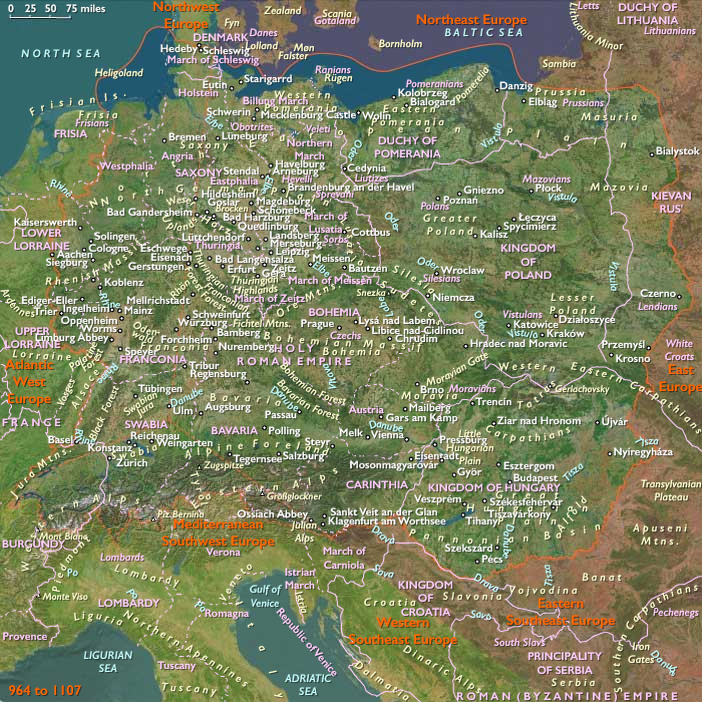
Rudolf, the son of Count (Graf) Kuno of Rheinfelden, is first mentioned in a 1048 deed issued by the Salian emperor Henry III as a count in the Swabian Sisgau on the High Rhine (in present-day Northwestern Switzerland), an estate then held by the Prince-Bishopric of Basel.
Rudolf's family has large possessions up to Sankt Blasien Abbey in the Black Forest and down to the Aargau beyond the border with the Kingdom of Burgundy.
He probably is related to King Rudolph II of Burgundy (d. 937), the Dukes of Lorraine and the Ottonian dynasty.
When Duke Otto III of Swabia died without male heirs in 1057, Empress Agnes, consort of late Henry III, had appointed him Swabian duke and administrator of Burgundy.
In rivalry with the Zähringen count Berthold, Rudolf, according to Frutolf of Michelsberg, had taken advantage of the minority of Agnes' son Henry IV, elected King of the Romans, by kidnapping his sister Matilda.
Rudolf had demanded, and received, Matilda's hand in marriage (1059).
In 1061, Berthold had received the Duchy of Carinthia instead.
When Matilda died in 1060, Rudolf had subsequently, in 1066, married Adelaide of Savoy, a daughter of Count Otto of Savoy and Adelaide of Susa.
When Adelaide's sister Bertha of Savoy married Henry IV in 1066, Rudolf had become brother-in-law to the king twice over.
During Agnes' regency, the Princes of the Holy Roman Empire had further strengthened their position against the Imperial authority.
In the 1062 Coup of Kaiserswerth, several princes led by Archbishop Anno II of Cologne had even abducted the minor king to enforce the surrender of the Imperial Regalia.
When Henry came of age in 1065, he had continued the policies of his father against the reluctant Saxon nobility, sparking the Saxon Rebellion in 1073.
While other princes like the Carinthian duke Berthold of Zähringen or Duke Welf of Bavaria distanced themselves, Rudolf had supported Henry's campaigns in Thuringia, when he had been a primary force in the 1075 Battle of Langensalza against the insurgents.
However, after the joint victory, Rudolf had become estranged to the king and rumors spread that he is involved in adversarial conspiracies.
Empress Agnes repeatedly has to arbitrate between the parties.
Finally, when the Investiture Controversy broke out and King Henry was excommunicated by Pope Gregory VII in February 1076, Duke Rudolf had met with Berthold, Welf and several other princes in Trebur in order to decide on a course of action and to arrange a new election.
Henry, observing the proceedings from his camp in Oppenheim on the other side of the Rhine, had had to face a massive loss of support among the German nobles and realized that he had to achieve the lifting of his ban.
Pope Gregory agrees to meet with the princes at Augsburg in February 1077.
Already in January, Henry had hastened to see the pope on his way to the Empire from Rome.
Duke Rudolf attempted to have the Alpine passes closed, nevertheless the king through wintry weather made his Walk to Canossa, where Gregory, fearing an armed attack by Henry's forces, had found refuge with Matilda of Tuscany.
By doing penance, Henry has managed to achieve absolution, buying time at the price of his reputation and secular authority.
The rebels continue with their plans.
Rudolf is elected antiking on March 15, 1077, at the Kaiserpfalz in Forchheim, where already Louis the Child and Conrad I of Germany had been crowned.
The first antiking in the history of the Empire, he promises to respect the investiture solely according to canon law as well as the concept of the elective monarchy.
Further claims raised by the princes are rejected as simony by the attendant papal legates.
Locations
People
- Burchard II
- Henry IV, Holy Roman Emperor
- Magnus
- Matilda of Tuscany
- Otto of Nordheim
- Pope Gregory VII
- Welf I
Groups
- Saxons
- Hungarian people
- Saxony, Duchy of
- Swabia, Duchy of
- German, or Ottonian (Roman) Empire
- Hungary, Kingdom of
- Christians, Roman Catholic
- Bavaria, Welf Duchy of
Topics
Commodoties
Subjects
Regions
Subregions
Related Events
Showing 10 events out of 72 total
Years: 1077 - 1077
March
Locations
People
- Burchard II
- Henry IV, Holy Roman Emperor
- Magnus
- Matilda of Tuscany
- Otto of Nordheim
- Pope Gregory VII
- Welf I
Groups
- Saxons
- Hungarian people
- Saxony, Duchy of
- Swabia, Duchy of
- German, or Ottonian (Roman) Empire
- Hungary, Kingdom of
- Christians, Roman Catholic
- Bavaria, Welf Duchy of
Topics
Commodoties
Subjects
Regions
Subregions