
Rudolf, born in Vienna, is the eldest …
Years: 1360 - 1371
Rudolf, born in Vienna, is the eldest son of Duke Albert II of Austria and his wife Joanna of Pfirt.
One of the third generation of Habsburg dukes in Austria, he is the first to be born within the duchy.
He therefore considers Austria his home, a sentiment that no doubt communicates itself to his subjects and contributes to his popularity.
Faced with the Habsburgs' loss of the Imperial crown upon the assassination of his grandfather King Albert I of Germany in 1308, Rudolf is one of the most energetic and active rulers of Austria in the late Middle Ages, and it is said of him that as a young man he already has the air of a king.
He had in 1357 married Catherine of Luxembourg, a daughter of Emperor Charles IV.
Eager to compete with his mighty father-in-law, who has transformed the Kingdom of Bohemia and its capital Prague into a radiant center of Imperial culture, Rudolf desires to raise the importance of his residence, Vienna, to a comparable or greater height.
For more than a century, the Habsburg dukes have chafed at the Popes' failure to make Vienna the seat of its own diocese, a status that they consider appropriate for the capital of a duchy.
Instead the city parish is subordinate to the Bishops of Passau, who have excellent connections to the Pope, apparently dooming Vienna's prospects in this regard.
Rudolf, however, resorts to something which could be considered imposture: He initiates the creation of a "metropolitan cathedral chapter" at the church of St. Stephen (which, according to the name, should be assigned to a bishop), whose members wear red garments as cardinals do.
The provost of the chapter receives the title of an "Archchancellor of Austria".
Rudolf extends St. Stephen's Cathedral, with the construction of its gothic nave being started under Rudolf's rule.
The construction efforts can be seen as an attempt to compete with St. Vitus Cathedral in Prague.
Rudolf has himself and his wife depicted on a cenotaph at the cathedral's entrance.
Similarly, by founding the University of Vienna in 1365, Rudolf seeks to match Charles IV's founding of the Charles University of Prague in 1348.
Still known as Alma Mater Rudolphina today, the University of Vienna is the oldest continuously operating university in the German-speaking world.
However, a faculty of theology, which is considered crucial for a university at that time, will not be established until 1385, twenty years after Rudolf's death.
To improve the economy of Vienna, Rudolf introduces many other measures, including the supervision by the mayor of sales of real property, instituted to prevent sales to the dead hand, i.e., to prevent economically unproductive ownership by the Church.
Rudolf also manages to establish a relatively stable currency, the so-called Wiener Pfennig (Vienna Penny).
Rudolf is best known for another bluff, the forgery of the Privilegium Maius, which de facto put him on par with the seven Prince-electors of the Holy Roman Empire, compensating for Austria's failure to receive an electoral vote in the Golden Bull of 1356 issued by Emperor Charles IV.
The title of Archduke (Erzherzog), invented by Rudolf, will become an honorific title of all males of the House of Habsburg from the sixteenth century.
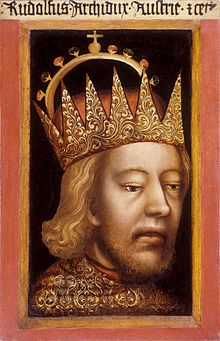
Rudolf IV of Austria. This portrait is the first half frontal portrait of the Occident. It had been on display above his grave in the Stephansdom of Vienna for several decades after his death, but can now be seen in the Museum of the Roman Catholic Archdiocese of Vienna. Apart from the (invented) archdukal crown, the foreshortening of which the artist did not completely master, the portrait is completely realistic. Even the duke's incipient facioplegia is shown.
Locations
People
Groups
Topics
Commodoties
Subjects
Regions
Subregions
Years: 1360 - 1371
Rudolf IV of Austria. This portrait is the first half frontal portrait of the Occident. It had been on display above his grave in the Stephansdom of Vienna for several decades after his death, but can now be seen in the Museum of the Roman Catholic Archdiocese of Vienna. Apart from the (invented) archdukal crown, the foreshortening of which the artist did not completely master, the portrait is completely realistic. Even the duke's incipient facioplegia is shown.
Locations
People
Groups
Topics
Commodoties
Subjects
Regions
Subregions