
Rubens, who is mostly in Rome from …
Years: 1608 - 1608
Rubens, who is mostly in Rome from 1606 to 1608, has received, with the assistance of Cardinal Jacopo Serra (the brother of Maria Pallavicini), his most important commission to date for the High Altar of the city's most fashionable new church, Santa Maria in Vallicella also known as the Chiesa Nuova.
The subject is to be St. Gregory the Great and important local saints adoring an icon of the Virgin and Child.
The first version, a single canvas (now at the Musée des Beaux-Arts, Grenoble), is immediately replaced by a second version on three slate panels that permits the actual miraculous holy image of the "Santa Maria in Vallicella" to be revealed on important feast days by a removable copper cover, also painted by the artist.
Rubens’ experiences in Italy continue to influence his work.
He continues to write many of his letters and correspondences in Italian, signs his name as "Pietro Paolo Rubens", and speaks longingly of returning to the peninsula—a hope that will never materialize.
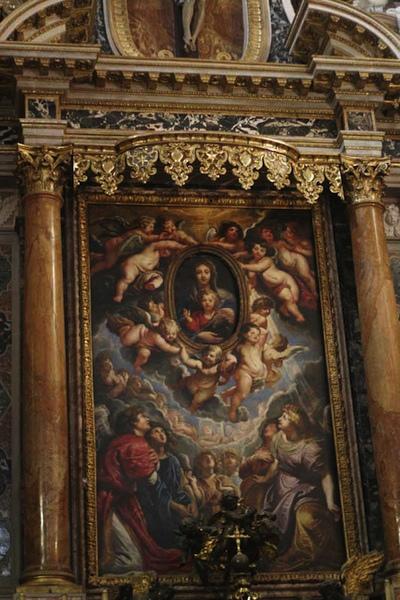
Peter Paul Rubens: The Virgin and Child Adored by Angels, 1608, oil on slate and copper. This is the central panel above the High Altar, Santa Maria in Vallicella, Rome. (Photo by Kolf, 2007)
Locations
People
Groups
Topics
- Protestant Reformation
- Counter-Reformation (also Catholic Reformation or Catholic Revival)
- Western Art: 1600 to 1612
Subjects
Regions
Subregions
Years: 1608 - 1608
Peter Paul Rubens: The Virgin and Child Adored by Angels, 1608, oil on slate and copper. This is the central panel above the High Altar, Santa Maria in Vallicella, Rome. (Photo by Kolf, 2007)
Locations
People
Groups
Topics
- Protestant Reformation
- Counter-Reformation (also Catholic Reformation or Catholic Revival)
- Western Art: 1600 to 1612
Subjects
Regions
Subregions