
Rubens moves in 1610 into a new …
Years: 1610 - 1610
Rubens moves in 1610 into a new house and studio that he has designed.
Now the Rubenshuis Museum, the Italian-influenced villa in the center of Antwerp accommodates his workshop, where he and his apprentices make most of the paintings, and his personal art collection and library, both among the most extensive in Antwerp.
Altarpieces such as The Raising of the Cross (1610) and The Descent from the Cross (1611–1614) for the Cathedral of Our Lady are particularly important in establishing Rubens as Flanders' leading painter shortly after his return.
The Raising of the Cross, for example, demonstrates the artist's synthesis of Tintoretto's Crucifixion for the Scuola Grande di San Rocco in Venice, Michelangelo's dynamic figures, and Rubens's own personal style.
This painting has been held as a prime example of Baroque religious art.
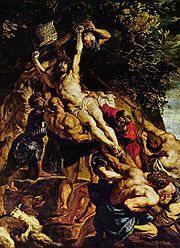
The Elevation of the Cross, 1610–11. Central panel. Cathedral of Our Lady, Antwerp.
Locations
People
Groups
Topics
Subjects
Regions
Subregions
Years: 1610 - 1610
The Elevation of the Cross, 1610–11. Central panel. Cathedral of Our Lady, Antwerp.
Locations
People
Groups
Topics
Subjects
Regions
Subregions