
Gioachino Rossini assumes the directorship of the …
Years: 1824 - 1824
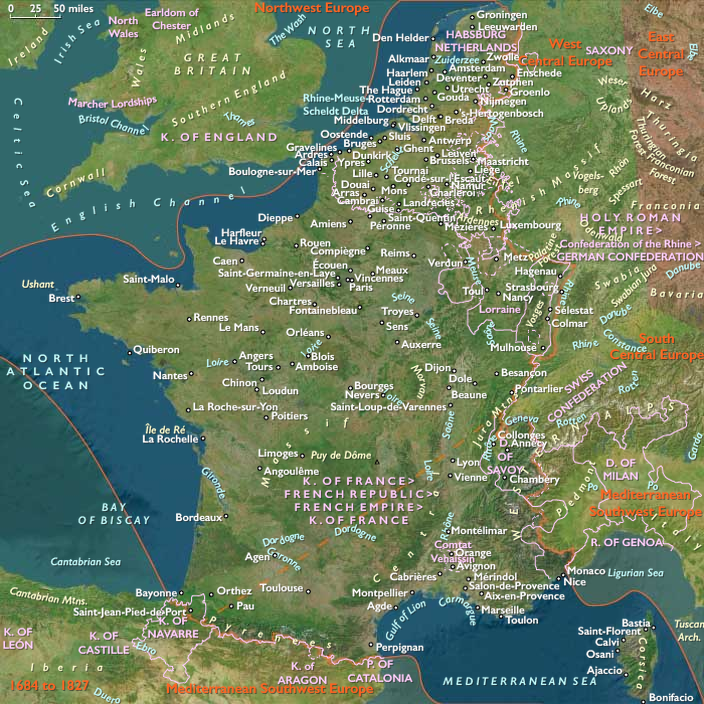
Gioachino Rossini assumes the directorship of the Theatre Italien in Paris in 1824.
Locations
People
Groups
Regions
Subregions
Related Events
Filter results
Showing 10 events out of 20160 total
The newly established Columbia District needs a more suitable headquarters than Fort George at the mouth of the Columbia.
Simpson is instrumental in the establishment of Fort Vancouver.
Using the HBC position that any settlement of the Oregon boundary dispute would confirm the border placement along the Columbia; Simpson has selected a location situated opposite from the mouth of the Willamette River.
This expanse is an open and fertile prairie that is outside the flood plain and had easy access to the Columbia.
The British Admiralty finally grants permission in 1824 to change the name of the southern continent from "New Holland" to "Australia", the name recommended by Matthew Flinders in 1804.
Transmission of cholera ends in 1824.
Some researchers believe that may have been due to the cold winter of 1823–24, which would have killed the bacteria in the water supplies.
The movement of British Army and Navy personnel is believed to have contributed to the range of the pandemic.
Hindu pilgrims had carried cholera within the subcontinent, as had happened many times previously, but British troops had carried it overland to Nepal and Afghanistan.
The Navy and merchant ships had carried people with the disease to the shores of the Indian Ocean, from Africa to Indonesia, and north to China and Japan.
The total deaths from the epidemic remain unknown.
The uneventful reign of Siamese monarch Buddha Loetla Nabhalai, or Rama II, ends with his death in 1824.
The throne, according to the succession rule, would have gone to Prince Mongkut, his legitimate son by Queen Srisuriyendra.
The nobility, however, had given the throne to the competent Prince Jessadabodindra, a son of a concubine not of a queen, who had served his father in Krom Tha (Ministry of Trade and Foreign Relations), where he had developed his proficiency in foreign trades and his personal affection for Chinese culture.
Temples later constructed by Jessabodindra will be characterized by Chinese influences.
He had also gained a reputation while a young prince as a great merchant who had conducted profitable trades with China and enriched the royal treasury.
Steen Steensen Blicher, who had begun his endeavors as a poet as a poor country parson in Denmark, publishes his first important story, The Journal of a Parish Clerk, in 1824.
Jöns Jacob Berzelius, in discussing the work of Davy, Gay-Lussac, and Thénard in 1824, identifies boron as an element.
Berzelius is in this year the first to prepare a pure form of amorphous silicon; he names it silicium.
The same year, Berzelius isolates zirconium metal in impure form, which, even when ninety-nine percent pure, is hard and brittle.
Dr. Petar Beron, a member of the Bulgarian emigrant community in Romania, publishes the first primer in colloquial Bulgarian in 1824.
His book also explains a new system of secular education to replace the outdated precepts of monastery pedagogy. (Beron's suggestions will strongly influence the development of Bulgarian education in the nineteenth century.)
Turki, a grandson of Muhammad ibn Sa'ud and, since 1823, the titular head of the Al Sa'ud family, succeeds in capturing Riyadh and expelling the Egyptian garrison in 1824.
Making the city his capital, Turki attempts to maintain cordial relations with the Ottoman governors of Iraq and the British as he accepts Ottoman suzerainty.
Oman, Iran, and Sunnite Arab tribes struggle to dominate the coasts of the Persian Gulf, while a series of agreements begin to pave the way for British control in this area.
Sa'id makes a pilgrimage to Mecca in 1824, thereby demonstrating that he has overcome both internal and external enemies and can now risk absence from his own land.
The Greek War of Independence from March 1821 to December 1823 has been largely a successful insurgency.
While the Egyptian under Muhammad Ali capture Crete for the Ottoman Empire, the Greek forces during this period have been able to capture many major strongholds of the Peloponnesus and establish a strong presence in central Greece.
Victories on land have been coupled with successes at sea, most notably the sinking of the flagship of the Ottoman navy in November 1822.
Total casualties in the first phase have been estimated at fifty thousand, many of whom are civilians massacred by both sides.
