Rome establishes a colony at Beziers, occupied …
Years: 119BCE - 119BCE
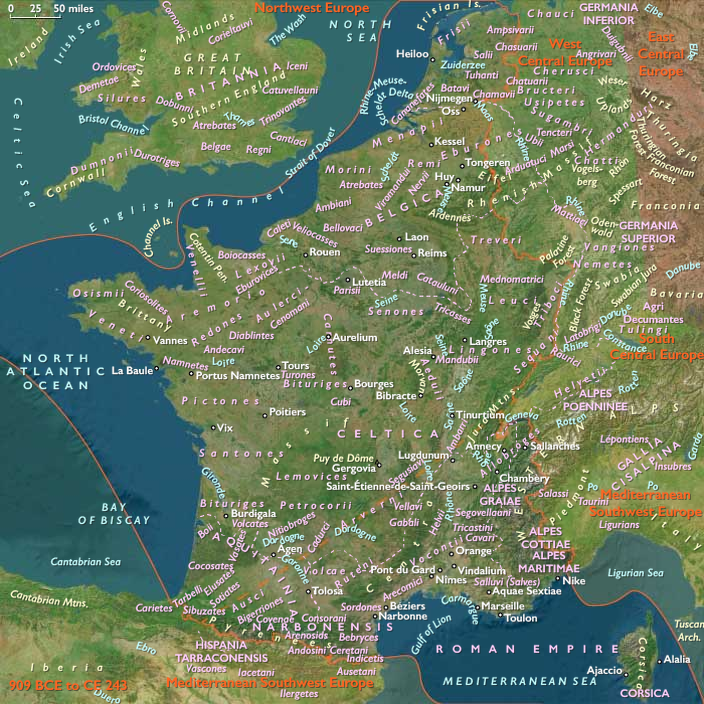
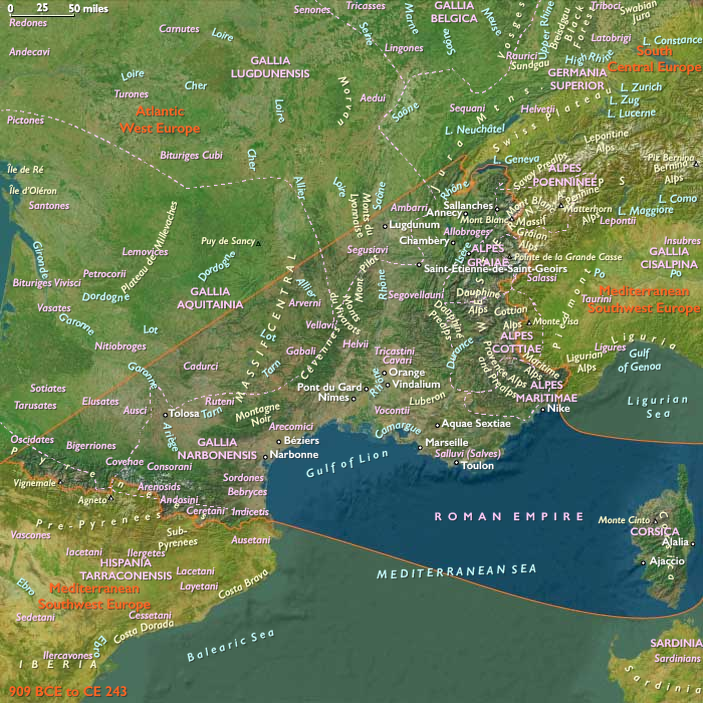
Rome establishes a colony at Beziers, occupied since Neolithic times, before the influx of Celts, in southeastern France twelve miles (twenty kilometers) from the Mediterranean coast, situated on a hill overlooking the Orb River at its junction with the Canal du Midi.
Locations
Groups
Topics
Commodoties
Subjects
Regions
Subregions
Related Events
Filter results
Showing 10 events out of 62972 total
Family conflicts had begun to cripple Egypt’s Hellenistic Ptolemaic dynasty when Ptolemy VIII Euergetes II, or Physcon, fought his brother Ptolemy VI Philometor and briefly seized the throne.
The struggle has been continued by his sister and niece (who have both become his wives).
Physcon quarrels constantly with his sister and first queen, Cleopatra II, the widow of his brother Ptolemy VI Philometor, with whom he rules Egypt, together with her daughter Cleopatra III, except for a brief period during 131-130, when Cleopatra II was in revolt and Physcon was exiled, together with Cleopatra III, his niece and second wife.
They finally issue an Amnesty Decree in 118 BCE, but the long war has shattered Egypt’s internal stability.
Physcon’s reign has been marked by generous benefactions to the Egyptian temples, but the Greeks detest him as a tyrant, and the historical accounts of the reign emphasize his stormy relations with the Alexandrian populace.
Having caused civil war and economic collapse in Egypt, he institutes extensive reforms in 118 to restore the country.
He maintains control over Cyrenaica and …
…Cyprus.
The Romans establish the port colony of Narbo Martius (modern Narbonne), eight miles (thirteenkilometers) from the Mediterranean Sea, as the capital of Gallia Narbonensis in 118.
Located on the Via Domitia, the first Roman road in Gaul, built at the time of the foundation of the colony, and connecting Italy to Spain, Narbonne is therefore located at a very important crossroads because it is situated where the Via Domitia connects to the Via Aquitania, which leads toward the Atlantic through Toulouse and Bordeaux.
In addition, it is crossed by the Aude River.
On the death of Numidian king Micipsa in 118 BCE, his nephew Jugurtha, a grandson of Masinissa that Micipsa had adopted as joint heir, murders one of the other two heirs, a cousin, and seizes the second cousin's capital at Cirta.
Killing the cousin and the city’s defenders, many of whom are Roman, Jugurtha thus reunites Numidia under his rule, but angers Rome.
Roman factions begin agitating for vengeance.
Wudi’s Han Chinese forces arrive at Nam Viet’s Red River delta in 113 and conquer the kingdom within two years, annexing the Dong-son homeland of Tonkin to the Chinese empire.
The conquered Nam Viet, divided into nine military administrative districts, becomes the Chinese province of Giao Chi.
The empire dispatches Chinese peasant-soldiers to set up villages and build forts in the region, which the Chinese call Annam (“Pacified South”).
The southward expansion of the Han dynasty comprises a series of military campaigns and expeditions in what is now modern southern China and northern Vietnam.
Military expansion to the south had begun under the previous Qin dynasty and continues during the Han.
Campaigns have dispatched against the Yue tribes, leading to the annexation of Minyue by the Han in 135 BCE and 111 BCE, Nanyue in 111 BCE, and Dian in 109 BCE.
To the northeast, a campaign launched by the Han empire against Wiman Joseon of the Gojoseon kingdom between 109 and 108 BCE and fought in the Liaodong Peninsula, Korean Peninsula, and Bohai Sea, results in the fall of Gojoseon.
The Tauri, probably a fragment of the Cimmerians, have remained a major threat to Greek power in the northern Black Sea region, although the Crimean coast had eventually come to be dominated by Greek (and subsequently Roman) colonies, notably the one at Chersonesos, Engaged in piracy against ships on the Black Sea, the Tauri mount raids from their base at Symbolon (today's Balaklava).
The Greeks of the Tauric Chersonese and the Cimmerian Bosporus (Crimea and Straits of Kerch), prosperous from the fourth century BCE, have maintained a free constitution of the Greek type and fought for their continued independence against the Scythians of southern Russia, against the native Tauri of the southern Crimea, and against the kings of Bosporus in the west.
They traded with Athens and cities on the Pontic coast in the early period and with Delos, Rhodes, and Delphi in the Hellenistic Age.
Having turned to Pontus for protection against the Scythians, the region is subsequently incorporated into the Pontic Empire of Mithridates VI.
Viewing Mithridates as a deliverer from their Scythian enemies, they gladly surrender their independence in about 110 BCE in return for the protection given to them by his armies.
The Sarmatians, who had emerged in a region of the steppe to the east of the Don River and south of the Ural Mountains in Eastern Europe in the seventh century BCE, have for centuries lived in relatively peaceful coexistence with their Scythian neighbors to the west.
They spill over the Don in the third century BCE to attack the Scythians on the Pontic steppe to the north of the Black Sea: they are to dominate these territories over the next five centuries.
Like the Scythians, Sarmatians are of a Caucasoid appearance, and before the arrival of the Huns (fourth century CE) it is thought that few had Asiatic or Turco-Mongol features.
Sarmatian noblemen often reach one oint seven to one point eight meters (five-feet seven inches to five feet ten inches) as measured from skeletons, and they have sturdy bones, long hair, and beards.
The Sarmatians drive their Scythian kinsmen into the delta of the Danube and the Crimea peninsula in about the second century BCE, at which point the Tauri become subject-allies of the Scythian king Skilurus and vanish from history.
Skilurus controls the ancient trade emporium of Pontic Olbia, where he mints coins.
In order to gain advantage against Chersonesos, he allies himself with the Sarmatian tribe of Rhoxolani.
In response, Chersonesos forges an alliance with Mithridates VI of Pontus.
Skilurus dies during a war against Mithridates, a decisive conflict for supremacy in the Pontic steppe.
His son Palacus succeeds him.
Soon after his death, the Scythians are defeated by by Diophantus, general of Mithridates VI, in about 108 BCE).
Diophantus is active in Mithridates' campaigns in the Bosporan Kingdom and elsewhere around the Black Sea, although their chronology is disputed.
An inscription found during the excavations in Chersonesos glorifies Diophantus as "the first foreign invader to conquer the Scythians".
During his first Crimean expedition, he relieves the siege of Chersonesos by the Scythian king Palacus and subdues his allies, the Tauri.
He finishes this campaign at Scythian Neapolis.
During the second campaign, Diophantus checks another invasion of the Scythians, who had joined their forces with the Rhoxolanoi under Tasius.
At one point during these campaigns he establishes a stronghold at Eupatorium on the eastern shore of the Crimea.
Around 107 BCE, Mithridates dispatches Diophantes to Panticapaeum with the task of persuading the Bosporan king Paerisades V to cede his kingdom to Mithridates.
While he is in the city, the Scythians, led by a certain Saumacus, revolted and kill Paerisades, while Diophantes barely manages to escape to Chersonesos.
Back in Pontus, Diophantes rallies his forces and sails to Crimea with a large fleet.
The Scythian uprising is put down and the Bosporan kingdom is reduced to a dependency of Pontus.
Either Skilurus or his son and successor Palacus are buried in a mausoleum at Scythian Neapolis, used from about 100 BCE to about 100 CE.

The Middle East: 117–106 BCE
Parthian Consolidation and the Rise of Ctesiphon
The period from 117 to 106 BCE marks a significant phase of Parthian consolidation in Mesopotamia, following their decisive victory over the Seleucid Empire. The Parthian arrival alters the political landscape minimally, as local dynasts throughout Mesopotamia had already asserted substantial autonomy by the mid-second century BCE.
Under Parthian control, Mesopotamian cities like Seleucia experience greater autonomy and better governance than during the previous Seleucid regime. The Parthians notably refrain from direct occupation of these cities, opting instead to establish a separate military presence in a nearby garrison site called Ctesiphon, located near Seleucia.
Initially established as a strategic military outpost, Ctesiphon gradually grows into an influential urban center. Over time, it will supplant Seleucia itself, becoming the new capital and administrative heart of the Parthian Empire. This development symbolizes the gradual yet significant shift of political and economic power from Hellenistic-dominated cities to distinctly Parthian centers.
This era thus illustrates a transition in governance marked by pragmatic administrative choices by the Parthians, reinforcing local autonomy while effectively consolidating their overarching control. The foundation and subsequent rise of Ctesiphon underscore the lasting impact of Parthian rule in reshaping the political and cultural landscape of Mesopotamia.