Rome decides not to aid their Armenian …
Years: 53 - 53
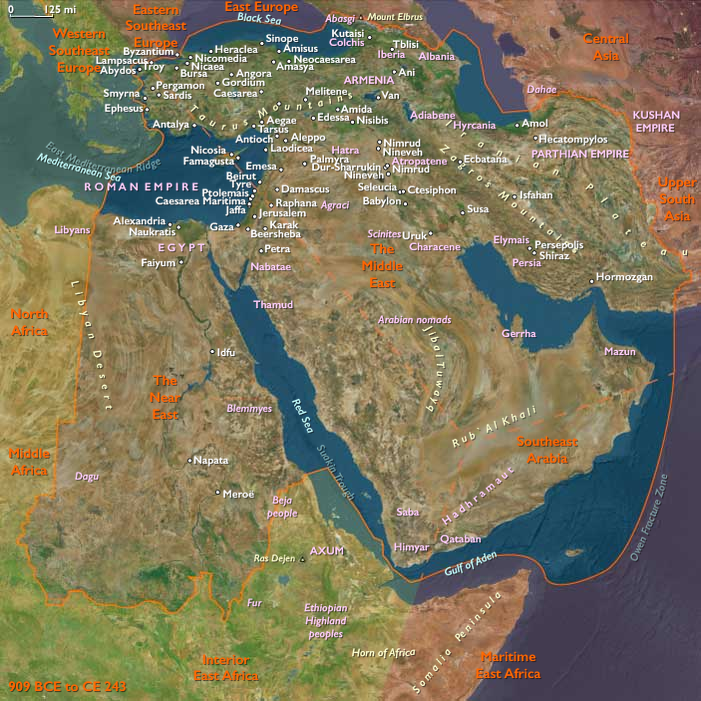
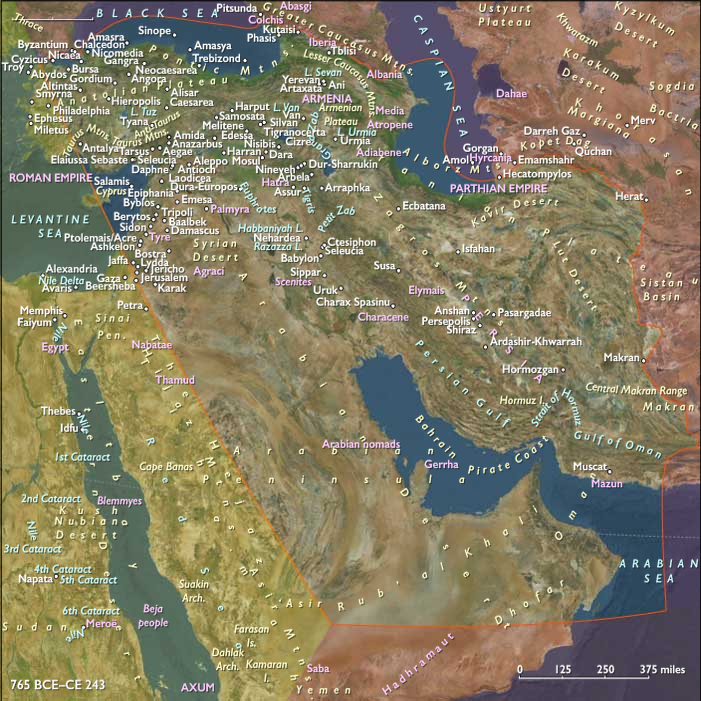
Rome decides not to aid their Armenian allies against the usurpation by the Iberian prince Rhadamistus, only nominally demanding that his father Pharasmanes withdraw from Armenia.
The Roman governor of Cappadocia, Paelignus, invades Armenia anyway, ravaging the country.
Syrian governor Gaius Ummidius Durmius Quadratus sends a force to restore order, but he is recalled so as not to provoke a war with Parthia, whose King Vologases takes the opportunity to send his army into Armenia, driving out the Iberians in 53.
Locations
People
Groups
- Iranian peoples
- Armenian people
- Iberia, Caucasian (Kartli, Kingdom of)
- Parthian Empire
- Armenia, Kingdom of Greater
- Roman Empire (Rome): Julio-Claudian dynasty
Topics
Commodoties
Subjects
Regions
Subregions
Related Events
Filter results
Showing 10 events out of 61724 total
Octavia, the only daughter of the Emperor Claudius by his third marriage to his second cousin Valeria Messalina, was named for her great-grandmother Octavia the Younger, the second eldest and full-blooded sister of the Emperor Augustus.
Her elder half-sister was Claudia Antonia, Claudius's daughter through his second marriage to Aelia Paetina, and her full sibling was Britannicus, Claudius's son with Messalina.
As a young girl, her father had betrothed her to future praetor Lucius Junius Silanus Torquatus, who was a descendant of Augustus.
After Octavia's mother was executed in 48, for conspiring to murder her father, Claudius had remarried her paternal first cousin and his own niece Agrippina the Younger, who had a son from her first marriage: Nero (at this time known as Lucius Domitius Ahenobarbus).
Nero is a popular young man, and his adoption has indeed staved off coup attempts in the second half of Claudius' reign.
Britannicus does not get along with his stepfamily.
According to the historian Tacitus, Britannicus continued to refer to Nero by his birth-name, Domitius, long after the adoption.
However, it must be remembered that this was an accusation, made by enemies of Britannicus.
This included public events where the boys were honored as a pair, and jealousy was heightened by Nero's rise to manhood.
Nero reactsto these slights by insisting that Britannicus is illegitimate, but Claudius gives no indication of believing this.
Tacitus reports that those who had reason to oppose Agrippina and Nero formed a faction around Britannicus, taking advantage of this discord.
Agrippina retaliated against these supporters with force, changing Britannicus' circle.
His tutor, Sosibius, had once been a tool of Messalina's, and Agrippina quickly disposed of him.
Claudius may have agreed to this because of their links to his old officially damned wife.
Such warring factions would have undermined his very reason for adopting Nero and marrying Agrippina.
Agrippina, through her plotting and manipulating, ends the engagement between Octavia and Lucius Silanus, has persuaded Claudius to adopt Nero as his son and heir, and arranges for Octavia and Nero to marry on June 9, 53.
Nero is named joint-heir with Britannicus until such time as the latter comes of age.
A winter epidemic forces the Parthians to withdraw from Armenia, allowing Rhadamistus to return.
He punishes as traitors those Armenian cities that had surrendered to the Parthians.
The actions Claudius has taken to preserve his rule in the short-term are not easily undone as Britannicus approaches manhood.
In late 54, Britannicus is within six months of reaching manhood by Roman tradition, and has matured early.
According to the historian Suetonius, Claudius began to mention divorcing Agrippina and dismissing Nero now that he was no longer needed.
In preparation, Claudius commends both his son and adopted son to the Senate as equals in his last Senate address.
Suetonius reports that Claudius now admonished his son to grow up quickly, implying that everything would be righted when he assumed the toga virilis.
Sadly for Britannicus, Nero's supporters act to prevent this.
The consensus of ancient historians was that Claudius was murdered by poison—possibly contained in mushrooms or on a feather—and died in the early hours of October 13, 54.
Accounts vary greatly.
Some claim Claudius was in Rome while others claim he was in Sinuessa.
Some implicate either Halotus, his taster, Xenophon, his doctor, or the infamous poisoner Locusta as the administrator of the fatal substance.
Some say he died after prolonged suffering following a single dose at dinner, and some have him recovering only to be poisoned again.
Nearly all implicate his final wife, Agrippina, as the instigator.
Agrippina and Claudius had become more combative in the months leading up to his death.
This carried on to the point where Claudius openly lamented his bad wives, and began to comment on Britannicus' approaching manhood with an eye towards restoring his status within the imperial family Agrippina had motive in ensuring the succession of Nero before Britannicus could gain power.
In modern times, some authors have cast doubt on whether Claudius was murdered or merely succumbed to illness or old age.
Some modern scholars claim the universality of the accusations in ancient texts lends credence to the crime, but history in those days could not be objectively collected or written, so sometimes amounted to committing whispered gossip to parchment, often years after the events, when everyone who cared was dead.
It is not known how much Nero knew or if he was even involved in the death of Claudius.
Claudius' ashes are interred in the Mausoleum of Augustus on October 24, after a funeral in the manner of Augustus.
Tacitus claims that Britannicus and his sisters Octavia and Antonia were locked in their rooms to ensure that no counter claim could be made to Nero's succession.
Nero delivers the eulogy at the emperor's funeral and takes sole power.
Claudius' new will, which either granted joint-rule to Britannicus and Nero or just Britannicus, is suppressed by the new emperor's men in the senate.
Agrippina had sent away the freedman Narcissus, Britannicus' champion according to Tacitus, shortly before Claudius' death, and now quickly murders the freedman.
Britannicus is pushed to the background.
The last act of this secretary of letters had been to burn all of Claudius' correspondence — most likely so it could not be used against him and others in an already hostile new regime.
Thus Claudius' private words about his own policies and motives are lost to history.
Just as Claudius had criticized his predecessors in official edicts, Nero will often criticize the deceased Emperor and many of Claudius' laws and edicts will be disregarded under the reasoning that he was too stupid and senile to have meant them.
Seneca's Apocolocyntosis reinforces the view of Claudius as an unpleasant fool and this is to remain the official view for the duration of Nero's reign.
Eventually Nero will stop referring to his deified adoptive father at all, and realig with his birth family.
Claudius' temple is left unfinished after only some of the foundation had been laid down.
Eventually the site will be overtaken by Nero's Golden House.
The Brigantes are nominally an independent kingdom, but the Roman historian Tacitus says the rulers Cartimandua and Venutius were loyal to Rome and "defended by Roman power".
Cartimandua, having given Claudius the greatest exhibit of his triumph, in the person of the resistance leader Caratacus, has been rewarded with great wealth.
Venutius has now become the most prominent leader of resistance to the Roman occupation, however: Cartimandua had apparently tired of him and married his armor-bearer, Vellocatus, whom she has elevated to the kingship in Venutius's place.
Venutius initially seeks only to overthrow his ex-wife, and will only later turn his attention to her Roman protectors.
The Armenian cities soon revolt and, in 55 BCE, replace Rhadamistus with the Parthian prince Tiridates.
Rhadamistus if forced to flee along with his pregnant wife, Zenobia, of whom Tacitus relates a romantic story.
Unable to bear a long ride on horse, she persuades her husband to kill her so she will not fall into the hands of their pursuers.
Though stabbed and left at the banks of the Araxes, she survives and is found by some shepherds.
They carry Zenobia to the court of Tiridates, who receives her kindly and treats her as royalty.
Vologases, on becoming king of the Parthians in CE 51, had given the kingdom of Media Atropatene to his brother Pacorus II, and has now occupied Armenia for another brother, Tiridates.
This will lead ultimately to a long war with the Roman Empire (58–63), which will be ably conducted by the Roman general Corbulo.
Nero had become Emperor at seventeen, the youngest emperor until this time.
Ancient historians describe Nero's early reign as being strongly influenced by his mother Agrippina, his tutor Lucius Annaeus Seneca, and the Praetorian Prefect Sextus Afranius Burrus, especially in the first year.
Other tutors are less often mentioned, such as Alexander of Aegae.
Problems arose very early in Nero's rule from competition for influence between Agrippina and Nero's two main advisers, Seneca and Burrus.
Agrippina had tried in 54 to sit down next to Nero while he met with an Armenian envoy, but Seneca had stopped her and prevented a scandalous scene (as it is unimaginable at this time for a woman to be in the same room as men doing official business).
Nero's friends also mistrust Agrippina and tell him to beware of his mother.
Nero is reportedly unsatisfied with his marriage to Octavia and enters into an affair with Claudia Acte, a former slave.
In 55, Agrippina attempts to intervene in favor of Octavia and demands that her son dismiss Acte.
Nero, with the support of Seneca, resists the intervention of his mother in his personal affairs.
With Agrippina's influence over her son severed, Nero has become progressively more powerful, freeing himself of his advisers and eliminating rivals to the throne.
One of Agrippina's favorites, the freedman Pallas, is sacked in early 55 from his job as secretary of the treasury—a post he had held since the reign of Claudius.
According to Tacitus, Agrippina reacted violently to this slight by Nero.
She declared that she repented of her actions to bring Nero to the throne, and would throw in her lot with Britannicus, the true heir who would soon come of age.
She threatened to take the boy to the Praetorian camp, where she would admit to murdering Claudius and Britannicus would be declared emperor.
Nero does not take this threat lightly.
Tacitus recounts Nero's numerous attempts to publicly undermine Britannicus' image.
One such attempt was when Nero asked Britannicus to sing at a drunken party, months before his fourteenth birthday.
Britannicus however, not only avoided humiliation, but also generated sympathy among the guests, after singing a poem telling the tale of how he had been cast aside in favor of Nero.
Tacitus also stated that a few days before his death, Britannicus was sexually molested by Nero (Tacitus Book XIII, 17).
According to Tacitus, Nero moved against Britannicus, employing the same poisoner, Locusta, who had been hired to murder his father, Claudius.
Earlier in 55, Locusta had been convicted of poisoning another victim.
When Nero learns of this, he sends a tribune of the Praetorian Guard to rescue her from execution.
In return for this, she is ordered to poison Britannicus.
The first dose fails, and Nero decides to throw caution in the wind.
Britannicus is poisoned at a dinner party attended by his sister, Claudia Octavia, Agrippina, and several other notables.
The first-century chronicler Suetonius wrote that the assassin avoided being given away by a food taster by adding the poison to his drink when Britannicus asked for it to be cooled, as he felt it was too hot.
The substance was instantly fatal, and Britannicus fell to the floor foaming at the mouth.
He dies on February 11, 55, one day before his fourteenth birthday, less than a month before he is to assume manhood, and just four months after his father's death.
Nero dismisses the murder by claiming that the boy had suffered from epilepsy.
Some modern historians, particularly Anthony Barrett, suggest that he may have indeed suffered from the disease, and that a particularly bad seizure killed him.
After the death of Britannicus, Agrippina is accused of slandering Octavia and Nero orders her out of the imperial residence.
According to Tacitus, Nero protected Locusta by granting her immunity from execution, rewarding her with a vast estate and even sending students to her.
According to Suetonius, Britannicus had been good friends with the future Emperor Titus, whose father Vespasian had commanded legions in Britain.
As part of the Flavians' attempts to link themselves with the Julio-Claudians, Titus will claim that he had been seated with Britannicus on the night he was killed.
He even claimed to have tasted the poison, which resulted in a serious and long illness.
Titus will go on to erect a gold statue of his friend, and issue coins in his memory.
Tacitus states that from this moment Octavia became very unhappy, but learned to hide her affections and feelings around her husband and stepbrother.

Rhadamistus himself returns to Iberia.
However, he is soon put to death by his father for having plotted against the royal power.
After a third missionary journey, Paul delivers a gift of money collected from the other churches to the church of Jerusalem, intending this as a gesture of mutual love between Gentile and Jewish Christians.
Hostility aroused by his attitude toward the law, however, leads to a riot in Jerusalem and to Paul's arrest and imprisonment.
Pallas and the Praetorian prefect Sextus Afranius Burrus are in 56, two years after Nero’s accession, accused of conspiring to have Faustus Sulla declared emperor.
Seneca is accused of having relations with Agrippina and embezzlement.
The conspirators are put on trial, but Faustus does not appear to have been implicated.
Seneca succeeds in having himself, Pallas and Burrus acquitted.
According to Cassius Dio, at this time, Seneca and Burrus reduce their role in governing from careful management to mere moderation of Nero.
Nero, however, begins to watch his brother-in-law closely, afraid of his connection to the imperial family.
Years: 53 - 53
Locations
People
Groups
- Iranian peoples
- Armenian people
- Iberia, Caucasian (Kartli, Kingdom of)
- Parthian Empire
- Armenia, Kingdom of Greater
- Roman Empire (Rome): Julio-Claudian dynasty