Rome conquers the Illyrians, capturing their King …
Years: 168BCE - 168BCE
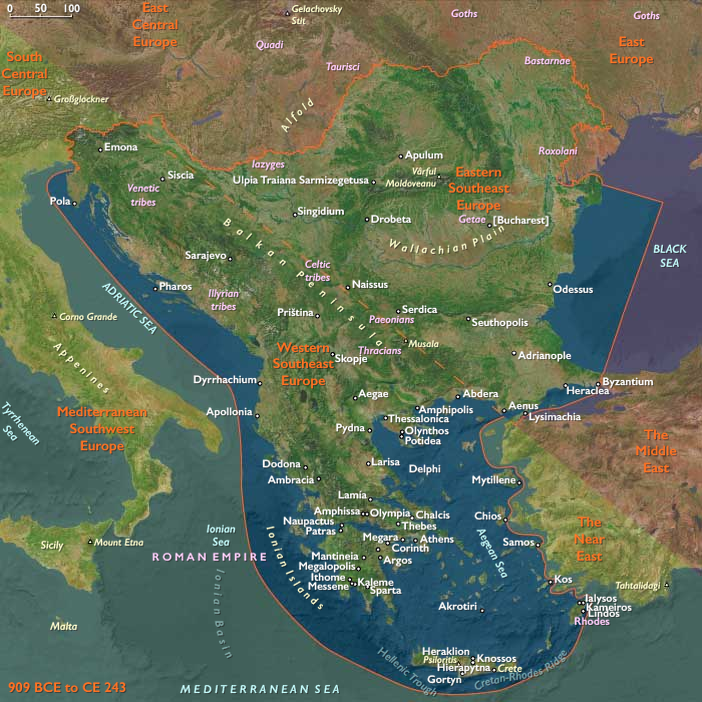
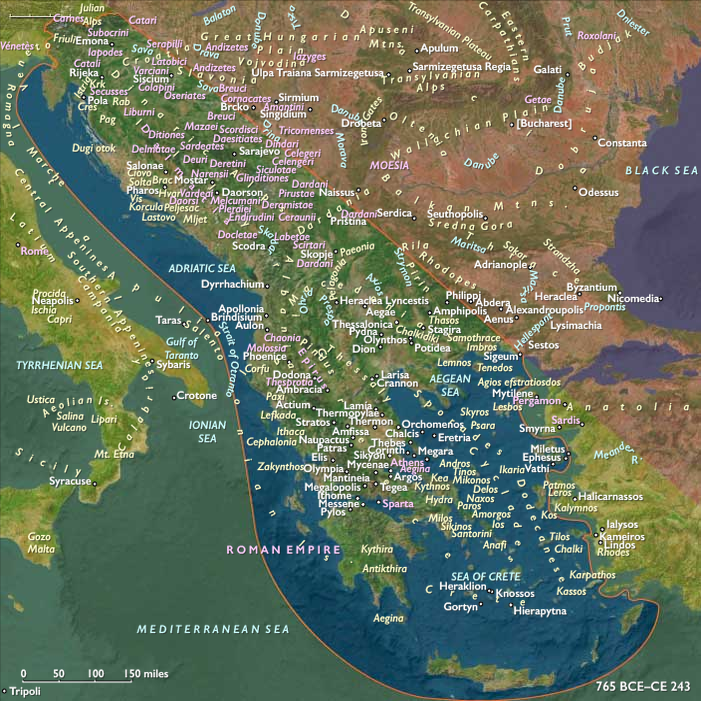
Rome conquers the Illyrians, capturing their King Gentius at Shkodër, which they call Scodra, and liquidate the kingdom.
(Gentius in the following yearwill be brought with his family to Rome).
Perseus has held off the Romans for three years, but the surrender of Gentius exposes Macedon's western flank.
Locations
People
Groups
- Molossians (Epirote tribe)
- Roman Republic
- Illyria, Kingdoms of
- Macedon, Antigonid Kingdom of
- Pergamon (Pergamum), Kingdom of
- Achaean League, Second
- Epirote League
Topics
Commodoties
Subjects
Regions
Subregions
Related Events
Filter results
Showing 10 events out of 63247 total
The ancient country of Lycia (Lycian chieftains Glaucus and Sarpedon figure in Homer's Iliad as allies of Troy in the Trojan War) occupies a mountainous promontory on the Mediterranean coast of southwestern Anatolia.
Having by 240 BCE become part of the Ptolemaic Kingdom, Lycia remained in their control through 200 BCE, and had apparently come under Seleucid control by 190 BCE, when the Seleucids' defeat in the Battle of Magnesia resulted in Lycia being awarded to Rhodes in the Peace of Apamea in 188 BCE.
The Lycian League (Lukiakou systema in Strabo's Greek, transliterated, a "standing together") is first known from two inscriptions of the early second century BCE in which it honors two citizens. T. Bryce ("Bryce, T.; Zahle, J. [1986]. The Lycians. 1. Copenhagen: Museum Tusculanum Press) hypothesizes that it was formed as an agent to persuade Rome to rescind the annexation of Lycia to Rhodes.
A fragment from Livy records a "pitiful embassy" in 178 BCE from Lycia to the Roman Senate complaining that the Lycians were being treated as slaves.
Whipping had been instituted as corporeal punishment and the women and children were being abused.
The Romans sent back a stern warning with the Lycians to Rhodes saying that they had not intended the Lycians or any other people born in freedom to be enslaved by Rhodes, and that the assignment was only a protectorate.
A fragment from Polybius tells a slightly different version of the story, which has the Romans sending legates to Rhodes to say that "the Lycians had not been handed over to Rhodes as a gift, but to be treated like friends and allies."
The Rhodians sent an embassy in return claiming that the Lycians had made the story up for reasons of their own and that in fact they were a financial burden on Rhodes.
The continuation of the story has not survived, but in 168 BCE, Rome takes Lycia away from Rhodes and turns over home rule to the League.
There is no question of independence.
Lycia is not to be sovereign, only self-governing under democratic principles.
It can neither negotiate with foreign powers nor disobey the Roman Senate.
It is not independent.
It can govern its own people and (for a time) mint its own coins as a right granted by Rome.
It does not determine its own borders.
Land and people can be assigned or taken away by the Senate.
This native government is an early federation with democratic principles; these will later came to the attention of the framers of the United States Constitution, influencing their thoughts.

Antiochus, angered at his loss of control over the Egyptian king, leads a second attack on Egypt in 168 BCE and sends a fleet to capture Cyprus, whose governor surrenders the island to Seleucid control.
Rumors have Eumenes of Pergamon negotiating secretly with the enemy as the Third Macedonian War drags on.
The mere suspicion of disloyalty, whatever the truth of the report, is enough to put Eumenes permanently in the shadow of Rome's displeasure.
Antiochus, demanding that Cyprus and Pelusium be ceded to him, occupies Lower Egypt and camps outside Alexandria.
Antiochus accepts coronation at Memphis, and installs a Seleucid governor.
The cause of the Ptolemaeans seems lost, but the Roman defeat of Perseus and his Macedonians at Pydna also deprives Antiochus of the benefits of his recent victories.
Ptolemy VI, making common cause with his brother and sister, had sent a renewed request to Rome for aid and the Senate had dispatched Gaius Popilius Laenas to Alexandria.
In Eleusis, a suburb of Alexandria, Popillius, with whom Antiochus had been friends during his stay in Rome, presents the king with the Senate's ultimatum that he evacuate Egypt and Cyprus immediately.
Taken by surprise, Antiochus requests time for consultation.
Popillius, however, draws a circle in the sand around the king with his walking stick and demands an unequivocal answer before Antiochus leaves the circle.
After a brief time, the astonished king, dismayed by this public humiliation, agrees to “do all the Romans demand,” and Popilius extends his hand to the king as to a friend and ally.
Roman intervention has thus reestablished the status quo.
By being allowed to retain southern Syria, to which Egypt has laid claim, Antiochus is able to preserve the territorial integrity of his realm.
The "Day of Eleusis" ends the Sixth Syrian War and Antiochus' hopes of conquering Egyptian territory.
The Romans in 168 BCE destroy Antissa, a city on the northwestern coast of Lesbos just north of the present Ándissa.
The political consequences of the lost battle are severe.
The Senate's settlement includes the deportation of all the royal officials and the permanent house arrest of Perseus.
There follows a ruthless purge, with allegedly anti-Roman citizens being denounced by their compatriots and deported in large numbers (three hundred thousand).
To set an example, Paullus orders the killing of five hundred Macedonians known for opposition against Rome.
He also exiles many more to Italy and confiscates their belongings in the name of Rome but according to Plutarch, keeping too much to himself.
The Romans depose Perseus—who, taken back to Rome in chains, will spend the rest of his life in captivity—dissolve the Macedonian monarchy, and divide Macedon into four formally autonomous republics, which are forbidden to have relations with one another; their annual tribute to Rome is set at half the rate they had previously paid to the king.
As in 194 and 189, the Romans withdraw without annexations.
Lucius Aemilius Paullus, an experienced soldier who is one of the consuls for 168 BCE, is appointed by the senate to deal with the Macedonian war and restore discipline in the Balkan peninsula.
By means of adroit tactical maneuvering, Paullus entices Perseus from his impregnable position on the Elpeus (Mavrólongos) River to occupy a weaker position in the plain south of Pydna (now Kítros, Greece; the actual site was probably near Kateríni).
Sixteen-year-old Publius Cornelius Aemilianus, a son of the younger Lucius Aemilius Paullus and a nephew of the wife of Scipio Africanus, first serves with his natural father at the Battle of Pydna on June 22, 168, in which the Roman legionaries, whose short swords are more effective in close combat than are the long Macedonian pikes, penetrate the Macedonian phalanx, which is in a state of disorder after crossing broken ground.
The Roman allies defeat Perseus' left wing of Thracians and light troops.
Macedonian losses are great, and Perseus flees.
This defeat is largely due to the inflexibility of Macedonian phalanx tactics compared to the maniple-based tactics of the Roman legions.
This is not the final conflict between the two rivals, but it breaks the back of Macedonian power.
Thus ends the Third Macedonian War.
The failure of Perseus reveals his inability to reconcile the needs of Macedonia with the reality of Roman predominance.
Eucratides, either a general of Demetrius or an ally of the Seleucids, manages to overthrow the Euthydemid dynasty and establish his own rule around 170 BCE, probably dethroning Antimachus I and Antimachus II.
The Indian branch of the Euthydemids try to strike back.
Demetrius (very likely Demetrius II), king of Bactria, the son and successor of Euthydemus, who ruled, according to some scholars, from about 190 to about 167 BCE, is said to have returned to Bactria with sixty thousand men to oust the usurper, but he apparently is defeated and killed in the encounter in 167.
Eucratides now rules Bactria as military governor, but resistance continues.
The slight historical evidence for the reign of Demetrius s open to varying interpretations.
Demetrius had earlier made such extensive conquests in northern India that for a brief time he virtually reestablished there the great Mauryan Empire that had collapsed about 184.
Other scholars, however, contend that it was a younger Demetrius (likewise a Bactrian king but not directly related to the son of Euthydemus) who made conquests in India, of a less extensive kind, and lost his kingdom to Eucratides after reigning from about 180 to 165.
The fact that one of these two men was the first to strike coins with a bilingual inscription in Greek and Prakrit suggests that he pursued a policy of treating the Indian peoples and the Bactrian Greeks as equals.
Mithridates, an Arsacid who had become ruler of Parthia in 171, first expands Parthia's control eastward by defeating King Eucratides of the Greco-Bactrian Kingdom.
This gives Parthia control over Bactria's territory west of the Arius river, the regions of Margiana and Aria (including the city of Herat in 167 BCE).
"The satrapy Turiva and that of Aspionus were taken away from Eucratides by the Parthians."
(Strabo XI.11.2) These victories give Parthia control of the overland trade routes between east and west (the Silk Road and the Persian Royal Road).
This control of trade will become the foundation of Parthia's wealth and power and be jealously guarded by the Arsacids, who will attempt to maintain direct control over the lands through which the major trade routes passed.
Antiochus had initially bestowed exemptions and privileges upon the Jews.
Enraged by his defeat and expulsion from Egypt by the Romans in 167 BCE, he sends a financial official to exact taxes from the cities of Judaea.
Upon the request of Menelaus' party, Antiochus' official attacks the city of Jerusalem by guile and largely destroys it, restoring Menelaus and executing many Jews.
Jason is forced to flee to Asia Minor.
He then builds a fortified position on the citadel, called by the Greeks the Akra.
This becomes the symbol of Judaea's enslavement, though in itself the presence of a royal garrison in a Hellenistic city is usual.
The city forfeits its privileges and is permanently garrisoned by Syrian soldiers.
The Greeks and those friendly toward them are united into the community of Antiochians; the worship of Yahweh and all of the Jewish rites, including circumcision and the observance of the Sabbath, are forbidden on pain of death.
Finally, in the holiest part of the Temple precincts, an altar to Zeus Olympios is erected on the twenty-fifth day of the Hebrew month Kislev (December) in 167, and sacrifices are to be made at the feet of an idol in the image of the King.
Years: 168BCE - 168BCE
Locations
People
Groups
- Molossians (Epirote tribe)
- Roman Republic
- Illyria, Kingdoms of
- Macedon, Antigonid Kingdom of
- Pergamon (Pergamum), Kingdom of
- Achaean League, Second
- Epirote League