
Rome and its new consul Gnaeus Mallius …
Years: 105BCE - 94BCE
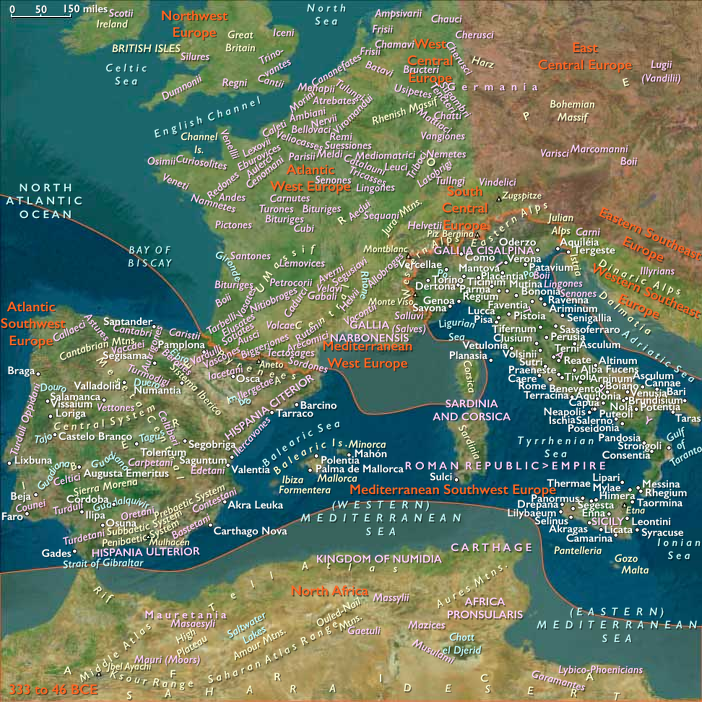
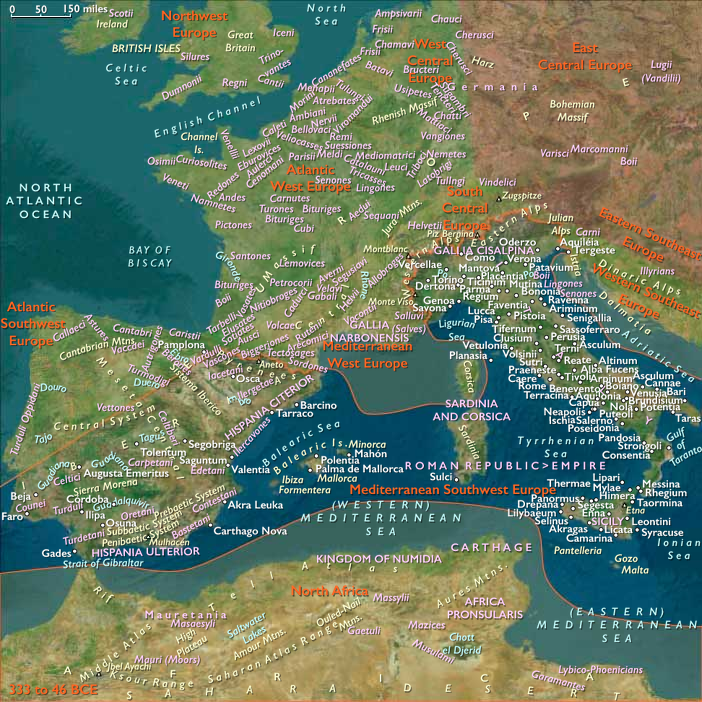
Rome and its new consul Gnaeus Mallius Maximus and the proconsul Quintus Servilius Caepio, in order to decisively settle the matter of the invading Cimbri and Teutones in 105 BCE, gather the largest force the Republic has fielded since the Second Punic War, and possibly the largest force it has ever sent to battle.
The force consists of over eighty thousand men, along with tens of thousands of support personnel and camp followers in two armies, one led by each consul.
The consuls lead their armies on their own armed migration to the Rhône River near Orange, Vaucluse, where, disliking and distrusting each other, they erect separate camps on opposite sides of the river; by so doing they leave their disunited force open to separate attack.
The overconfident Caepio foolishly attacks without support from Maximus; his legions are wiped out and his undefended camp overrun.
The now isolated and demoralized troops of Maximus are then easily defeated.
Thousands more are slain trying desperately to rally and defend his poorly positioned camp.
Only Caepio, Maximus, and a few hundred Romans escape with their lives across the carnage-choked river.
The Battle of Arausio is the costliest defeat Rome has suffered since Cannae: it’s losses and long-term consequences are far greater.
For the Cimbri and Teutones, it is a great triumph.
Instead of immediately gathering their allies and marching on Rome, the Cimbri proceed to Hispania, while the Teutones remain in Gaul.
Why they again fail to invade Italy remains a mystery.
Following the devastation of the Arausio, fear shakes the Roman Republic to its foundations.
The terror cimbricus becomes a watchword, as Rome expects the Cimbri at its gates at any time.
In this atmosphere of panic and desperation, an emergency is declared.
The constitution is ignored and Gaius Marius, the victor over Jugurtha of Numidia, is elected consul for an unprecedented, and arguably illegal, five years in a row, starting in 104 BCE.
Because of the destruction of the Roman force at Arausio and the pressure of the impending crisis, Marius is now given the latitude to construct a new army on his own terms.
Marius, ready to move against the Teutones by 102 BCE, chooses his ground carefully and builds a well-fortified camp on the top of a hill near Aquae Sextiae, where he lures the Teutones and their allies the Ambrones into attacking him.
During their attack, they are ambushed from the rear by a select force of five cohorts that Marius had hidden in a nearby wood.
The Teutones are routed and massacred and their king, Teutobod, is placed in Roman chains.
The Cimbri, who remain a formidable threat, return to Gaul in 101 BCE and prepare for the final stage of their struggle with Rome.
Marius's co-consul for this year, Quintus Lutatius Catulus, had failed to fortify the Alpine passes, through which the penetrate, for the first time, into northern Italy.
Catulus withdraws behind the Po River, leaving the countryside open to the invaders, but the Cimbri take their time ravishing the fertile region.
This gives Marius time to arrive with reinforcements—his same victorious legions from Aquae Sextiae.
The superiority of the new Roman legions and their cavalry are clearly demonstrated at Vercellae, near the confluence of the Sesia River with the Po on the Raudine Plain.
The Cimbri are virtually annihilated in the devastating defeat, and both their highest leaders, Boiorix and Lugius, fall.
The women kill both themselves and their children in order to avoid slavery.
Thus the war, which had begun with a mass migration, ends in defeat and mass suicide.
Meanwhile on the island of Sicily, another unsuccessful slave uprising against the Roman Republic, the Second Servile War had begun in 104 BCE and is finally suppressed in 100 BCE.
People
Groups
Topics
- Classical antiquity
- Pre-Roman Iron Age of Northern Europe
- Seleucid–Parthian wars
- Roman Age Optimum
- Roman Republic, Crisis of the
- Cimbrian War
- Jugurthine War (Numidian War)
- Servile War, Second (Slave War in Sicily, second)
Commodoties
Subjects
Regions
Subregions
Years: 105BCE - 94BCE
People
Groups
Topics
- Classical antiquity
- Pre-Roman Iron Age of Northern Europe
- Seleucid–Parthian wars
- Roman Age Optimum
- Roman Republic, Crisis of the
- Cimbrian War
- Jugurthine War (Numidian War)
- Servile War, Second (Slave War in Sicily, second)
Commodoties
Subjects
Regions
Subregions