
The Romano-British Migration to Armorica and the …
Years: 483 - 483
The Romano-British Migration to Armorica and the Birth of Brittany
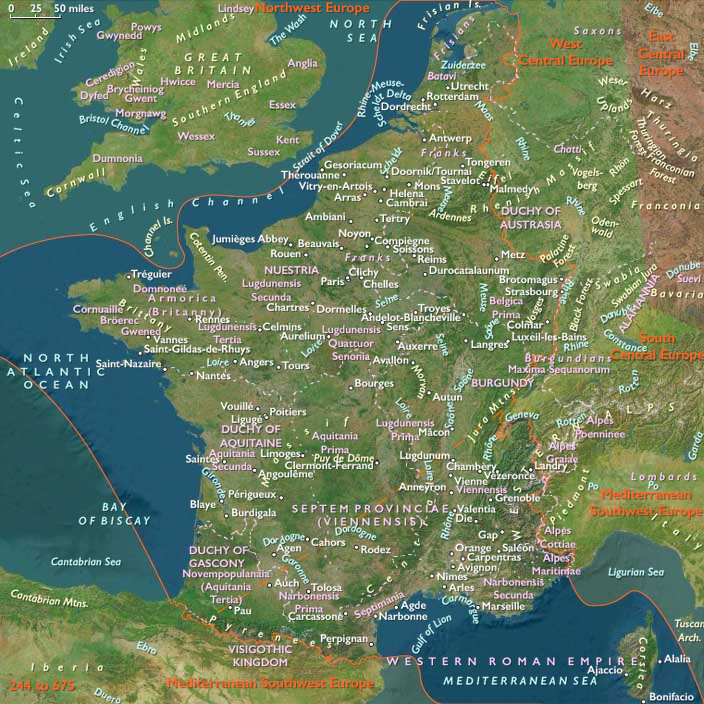
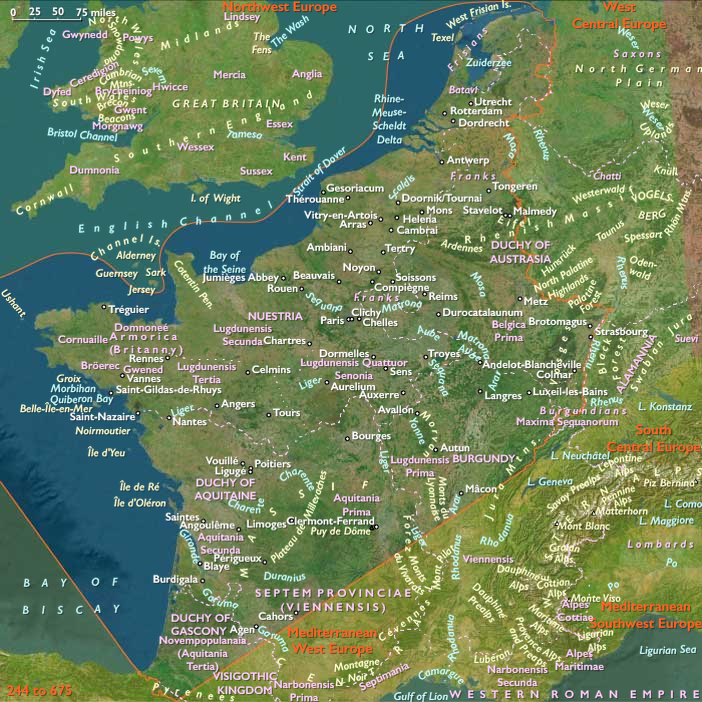
As the Western Roman Empire collapses, waves of Romano-British immigrants flee Britain, crossing the English Channel to settle in Armorica (modern-day Brittany). This migration, which had begun earlier in the fifth century, accelerates dramatically in response to the increasing pressure of:
- Anglo-Saxon raids and settlements in eastern and southern Britain, displacing native Britons.
- Scoti (Irish) incursions into western Britain, including Wales and Cornwall.
- The general breakdown of Roman authority in Britain following the withdrawal of Roman legions (c. 410 CE).
The Formation of a British Identity in Armorica
- The Romano-British immigrants, known as Britons or Bretons, settle primarily on the Armorican Peninsula, where they establish permanent communities.
- These migrants bring with them their language (a Brythonic Celtic dialect), Christianity, and Romano-British traditions, heavily influencing local culture.
- Over time, the Armorican Peninsula becomes known as "Brittany" (Bretagne in French), a reflection of its British origins.
Evidence of Cultural and Linguistic Ties
The connection between Britain and Brittany is evident in:
- Place names – Many regions in Brittany bear names linked to Cornwall and Devon, such as Domnonée (related to Dumnonia in Britain) and Cornouaille (Cornwall).
- Language – The Breton language, still spoken today, remains closely related to Cornish and Welsh.
- Religious and monastic ties – Many early Christian saints venerated in Brittany (e.g., Saint Samson, Saint Malo, and Saint Gildas) were originally from Britain, reinforcing the region’s shared heritage.
Armorica Transformed into Brittany
By the end of the fifth century, the influx of Britons has permanently reshaped Armorica, turning it into a distinct Celtic region within post-Roman Gaul. While surrounded by Frankish and Gallo-Roman territories, Brittany retains its cultural and political independence, developing alongside, but separate from, the Frankish Kingdom.
This migration is one of the most significant cultural shifts of the period, ensuring that Celtic Britain continues to influence the continent, even as much of Britain itself falls under Anglo-Saxon control.
Locations
Groups
- Britons (historical)
- Armorica
- Goths (East Germanic tribe)
- Scoti
- Breton people
- Anglo-Saxons
- Britain, Sub-Roman
- Visigothic Kingdom of Toulouse
- Burgundians, (second) Kingdom of the
- Roman Empire, Eastern: Leonid dynasty
- Francia (Merovingians)
Topics
Subjects
Regions
Subregions
Related Events
Showing 1 events out of 1 total
Years: 483 - 483
Locations
Groups
- Britons (historical)
- Armorica
- Goths (East Germanic tribe)
- Scoti
- Breton people
- Anglo-Saxons
- Britain, Sub-Roman
- Visigothic Kingdom of Toulouse
- Burgundians, (second) Kingdom of the
- Roman Empire, Eastern: Leonid dynasty
- Francia (Merovingians)
Topics
Subjects
Regions
Subregions