
…Roman refugees fleeing the Slav and Avar …
Years: 604 - 615
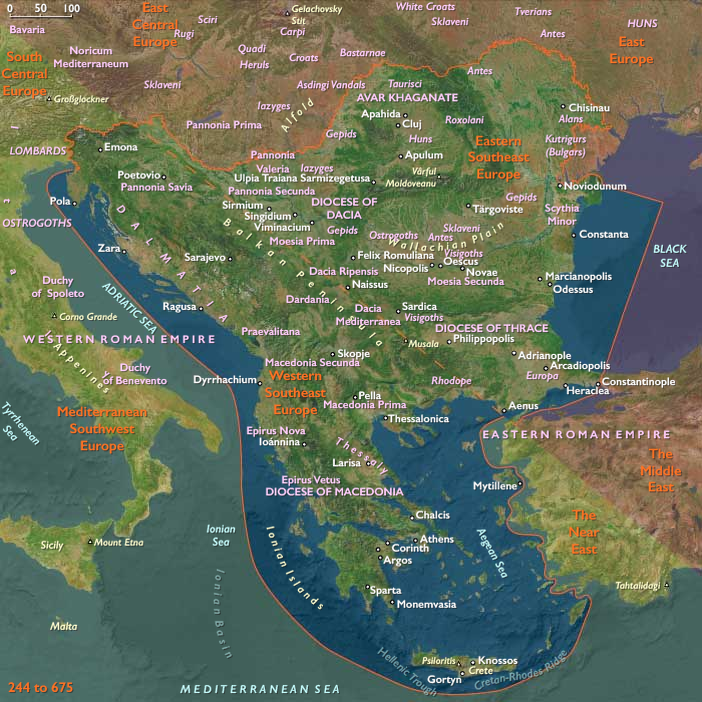
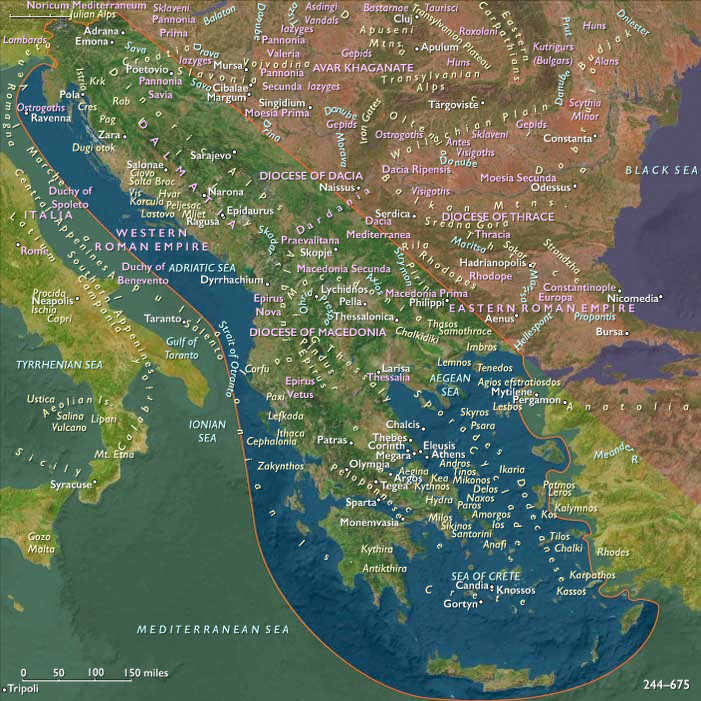
…Roman refugees fleeing the Slav and Avar sack of Epidaurus establish Rausa, or Ragusium (modern Dubrovnik, Italian Ragusa), just to the northwest.
A colony of Slavs soon joins the Romans there.
No contemporary written records about the migration of Croats have been preserved, especially not about the events as a whole and from the area itself.
Instead, historians rely on records written several centuries after the facts, and even those records may be based on oral tradition.
The Croats came as a Slavic tribe, coming into the Balkans from an area in and around today's Poland or western Ukraine.
Many modern scholars believe that the early Croat people were nomadic Iranian-speaking Alans who ruled over Slavic agricultural populations.
It is unclear whether the Alans contributed much more than a ruling caste or a class of warriors; the evidence on their contribution is mainly philological and etymological.
The book De Administrando Imperio, written in the tenth century, is the most referenced source on the migration of Slavic peoples into southeastern Europe.
It states three different variations of the events.
First, that Croats migrated around or before year 600 from White Croatia, the region that is now (roughly) Galicia, to the province of Dalmatia ruled by the Roman Empire, led by a group of five brothers, Kloukas, Lobelos, Kosentzis, Mouchlo and Chrobatos, and their two sisters, Touga and Bouga.
The second, possibly around year 620, when the Croats are invited by the Emperor Heraclius to counter the Avar threat on the Empire.
Third, where the Croats weren't actually invited by Heraclius, but instead defeat the Avars and settle on their own accord after migrating from an area near today's Silesia.
This record is supported by Historia Salonitana, the thirteenth-century writings of one Thomas the Archdeacon.
Archdeacon Thomas, as well as the twelfth-century Chronicle of the Priest of Duklja from the, state that the Croats remained after the Goths (under a leader referred to as "Totila") had occupied and pillaged the Roman province of Dalmatia.
The Chronicle speaks of a Gothic invasion (under a leader referred to as "Svevlad", followed by his descendants "Selimir" and "Ostroilo").
Locations
Groups
- Illyrians
- Alans (Sarmatian tribal grouping)
- Goths (East Germanic tribe)
- Macedonia, Diocese of
- Thrace, Diocese of
- Illyricum, Praetorian prefecture of
- Slavs, South
- Greeks, Medieval (Byzantines)
- Dalmatia (East Roman [Byzantine] province)
- Avar Khaganate (Eurasian Avars)
- Roman Empire, Eastern: Non-dynastic
- Roman Empire, Eastern: Heraclian dynasty
- Croats (South Slavs)
Topics
Commodoties
Subjects
Regions
Subregions
Related Events
Showing 2 events out of 2 total
Years: 604 - 615
Locations
Groups
- Illyrians
- Alans (Sarmatian tribal grouping)
- Goths (East Germanic tribe)
- Macedonia, Diocese of
- Thrace, Diocese of
- Illyricum, Praetorian prefecture of
- Slavs, South
- Greeks, Medieval (Byzantines)
- Dalmatia (East Roman [Byzantine] province)
- Avar Khaganate (Eurasian Avars)
- Roman Empire, Eastern: Non-dynastic
- Roman Empire, Eastern: Heraclian dynasty
- Croats (South Slavs)
Topics
Commodoties
Subjects
Regions
Subregions