
Roman control over Africa is not yet …
Years: 536 - 536
Roman control over Africa is not yet secure, despite Justinian's intentions and proclamations.
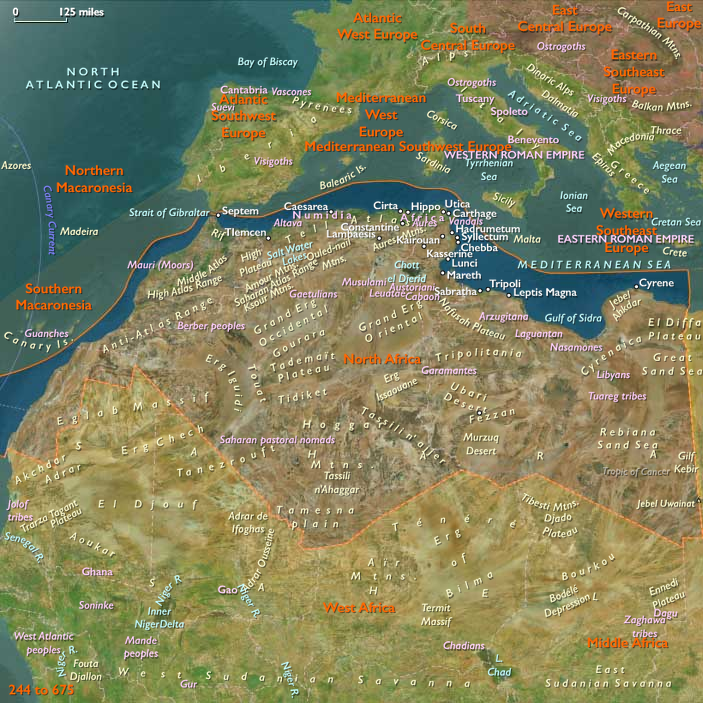
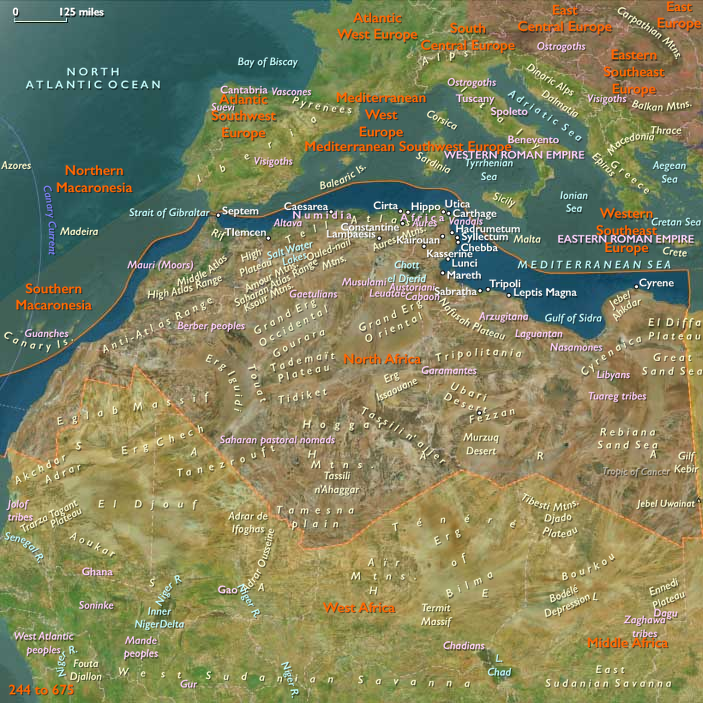
Belisarius had secured most of the provinces of Byzacena, Zeugitana and Tripolitania during his campaign, but further west, imperial control extends in a series of strongholds captured by the fleet along the coast as far as Constantine, while most of the inland areas of Numidia and Mauretania remain under the control of the local Moorish tribes, as indeed had been the case under the Vandal kings.
The Moors had initially acknowledged the Emperor's suzerainty and had given hostages to the imperial authorities, but they soon become restive and rise in revolt.
The first imperial governor, Belisarius' former domesticus Solomon, who, as exarch, combines the offices of both magister militum and praetorian prefect, is able to score successes against them and strengthen Roman rule in Africa, but his work is interrupted by a widespread military mutiny in Easter 536, caused by dissatisfaction of the soldiers with Solomon.
Solomon, together with Procopius, who works as his secretary, is able to escape to Sicily, which had just been conquered by Belisarius.
Solomon's lieutenants Martinus and Theodore are left behind, the first to try to reach the troops at Numidia, and the second to hold Carthage.
Upon hearing about the mutiny, Belisarius, with Solomon and one hundred picked men, sets sail for Africa.
Carthage is being besieged by nine thousand rebels, including many Vandals, under a certain Stotzas, who had served as a bodyguard of the general Martinus in the army under Belisarius.
The rebels aim to expel the imperial loyalists and establish Africa as a separate state, ruled by themselves.
Theodore is contemplating capitulation, when Belisarius appears.
The news of the famous general's arrival are sufficient for the rebels to abandon the siege and withdraw westwards.
Belisarius, although able to muster only two thousand men, immediately gives pursuit and catches up with and defeats the rebel forces at Membresa.
The bulk of the rebels, however, is able to flee, and continues to march towards Numidia, where Stotzas persuades most of the imperial garrison to join him, after murdering their officers; according to the historian Procopius, at this point two thirds of the Byzantine army in Africa had gone over to the rebel camp.
Belisarius himself is forced to return to Italy to prosecute the war against the Ostrogoths, and Justinian appoints his able cousin Germanus as magister militum to deal with the crisis.
He sends a mobile force of comitatenses, (mostly cavalry) and a elite guard.
Solomon returns to Constantinople.
Locations
People
Groups
- Africa proconsularis (Roman province)
- Mauretania Caesariensis (Roman province)
- Mauretania Tingitana (Roman province)
- Africa Byzacena (Roman province)
- Moors
- Roman Empire, Eastern: Justinian dynasty
- Africa, praetorian prefecture of
- Sicily, Roman (Byzantine)
Topics
- Migration Period
- Migration Period Pessimum
- Gothic (Italian) War
- Wars against the Moors
- Extreme weather events of 535-536
Commodoties
Subjects
- Commerce
- Symbols
- Watercraft
- Engineering
- Environment
- Labor and Service
- Conflict
- Faith
- Government
- Technology
- Movements
Regions
Subregions
Years: 536 - 536
Locations
People
Groups
- Africa proconsularis (Roman province)
- Mauretania Caesariensis (Roman province)
- Mauretania Tingitana (Roman province)
- Africa Byzacena (Roman province)
- Moors
- Roman Empire, Eastern: Justinian dynasty
- Africa, praetorian prefecture of
- Sicily, Roman (Byzantine)
Topics
- Migration Period
- Migration Period Pessimum
- Gothic (Italian) War
- Wars against the Moors
- Extreme weather events of 535-536
Commodoties
Subjects
- Commerce
- Symbols
- Watercraft
- Engineering
- Environment
- Labor and Service
- Conflict
- Faith
- Government
- Technology
- Movements
Regions
Subregions