The Fragile Restoration …
Years: 450 - 450
The Fragile Restoration of Roman Control in Gaul (c. 450 CE)
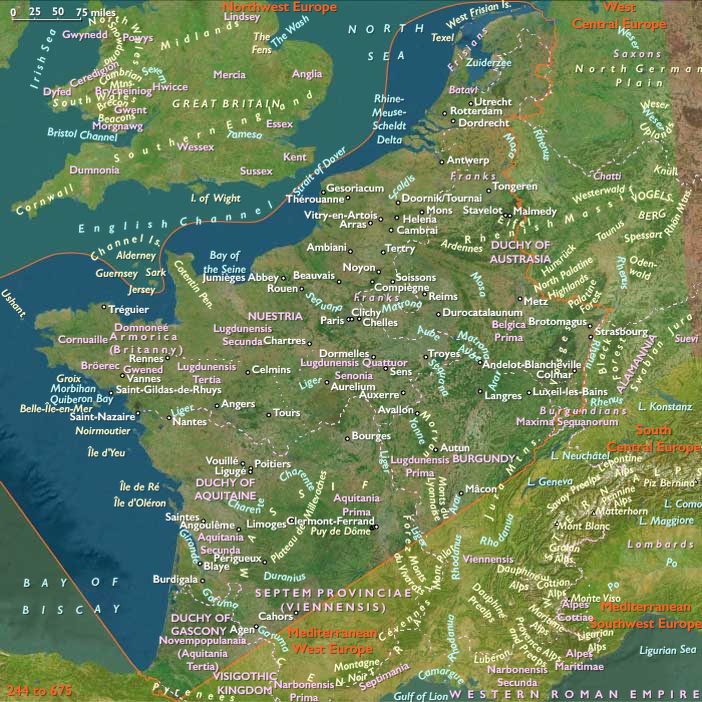
By 450 CE, Roman authority in Gaul has been partially restored, with much of the diocese nominally under imperial control. However, this recovery is tenuous at best, as the empire’s grip on its provinces beyond Italy continues to erode under the pressures of barbarian incursions and internal instability.
The Limits of Roman Control
- Armorica – Although technically part of the empire, Armorica (Brittany and western Gaul) is only nominally under Roman rule. Local populations and semi-independent military leaders operate with minimal oversight from Ravenna, maintaining a degree of autonomy.
- Foederati Settlements – Various Germanic tribes, having previously raided or fought against Rome, have been forcibly settled as foederati within imperial territory. They retain their own leaders and internal autonomy, but they are expected to defend their assigned regions in exchange for land and recognition.
- Gallia Belgica (Northern Gaul) – The territory between the Rhine (north of Xanten) and the Marne has been effectively abandoned to the Franks. Though there is no official Roman withdrawal, imperial forces no longer maintain direct control over the region.
The Line of Effective Roman Control
By 450, Rome’s effective authority in Gaul is limited to a southern and central core:
- A defensible line from Cologne to Amiens, extending to the coast at Boulogne.
- The Mediterranean coastline, which remains a vital lifeline for trade, supplies, and communication with Italy.
- A wide inland corridor, running upstream along the Loire, as far north as Amiens, and downstream along the Rhône, encompassing Aurelianum (Orléans), Auvergne, Provence, and Languedoc.
Growing Unrest Among Rome’s Foederati
Despite this partial restoration, Rome’s barbarian allies—who now hold significant portions of Gaul—are becoming increasingly restive:
- The Visigoths in Aquitania – Settled in Gallia Aquitania since 418 as foederati, the Visigoths under Theodoric I are growing increasingly defiant of Roman oversight. Their ambitions extend beyond their designated lands, and tensions with the empire are escalating toward open conflict.
- The Burgundians in Sapaudia – While less rebellious than the Visigoths, the Burgundians, settled in Sapaudia (modern Savoy) under Roman authority, are biding their time, waiting for the right opportunity to expand their power.
The Impending Collapse of Roman Gaul
Although Aetius’ military campaigns have briefly stabilized Gaul, the long-term outlook is grim. The empire’s reliance on foederati, coupled with its shrinking sphere of direct control, makes further territorial losses inevitable. Within a few decades, Gaul will slip beyond Rome’s grasp entirely, as barbarian kingdoms emerge from the remnants of imperial rule.
Locations
People
Groups
- Franks
- Armorica
- Gallia Aquitania (Roman province)
- Gallia Belgica (Roman province)
- Goths (East Germanic tribe)
- Septem Provinciae (Roman Diocese)
- Gaul, Diocese of
- Hunnic Empire
- Roman Empire: Theodosian dynasty (Constantinople)
- Gaul, Praetorian prefecture of
- Roman Empire, Western (Ravenna)
- Visigothic Kingdom of Toulouse
- Burgundians, (second) Kingdom of the
Topics
- Late Antiquity
- Migration Period
- Hun Raids on the Roman Empire
- Fall of the Western Roman Empire
- Migration Period Pessimum
Commodoties
Subjects
Regions
Subregions
Related Events
Filter results
Showing 10 events out of 58733 total
Yazdegerd II had gathered his forces in Nishapur in 443 and launched a prolonged campaign against the Kidarites, the last dynasty to regard themselves (on the legend of their coins) as the inheritors of the Kushan empire, which had disappeared as an independent entity two centuries earlier.
After numerous battles, he crushes them and drives them out beyond the Oxus river in 450.
The gentle and scholarly Theodosius, an easily dominated man who has allowed his government to be run by a succession of relatives and ministers, dies on July 28, 450, from injuries suffered during a hunting accident.
Aspar's influence has increased: on August 25, he and Theodosius' Christian sister, Pulcheria, appoint as emperor one Marcian, an Illyrian (or Thracian) officer and senator who had begun his career as a professional soldier and came to hold a high position in the service of Aspar.
As part of this arrangement, the fifty-eight year old Marcian is made the nominal husband of Pulcheria in order to formally perpetuate the Theodosian dynasty.
She gives the imperial diadem to the Marcian and is crowned as empress in the Hippodrome at Constantinople in a first religious coronation ceremony.
Aspar is made a patrician.
Marcian orders the execution (or assassination) of the unpopular court eunuch Chrysaphius, and discontinues the tribute payments to Attila.
Yazdegerd summons the leading Armenian nobles to the Persian capital Ctesiphon, pressuring them to cut their ties with the Western Church.
All the Temples of Aphrodisias (City of the Goddess Aphrodite) are demolished and its libraries burned down.
The city will later be renamed Stauroupolis (City of the Cross).
Corsica had remained under Roman rule until its conquest by the Vandals in 430.
Vandal invasions, beginning around 450, destroy the Roman agricultural colonies along the Corsican coasts.
Ravenna’s bishop, Peter Chrysologus (the surname means “golden-worded”; it will be added to his name at a later date, probably to create a Western counterpart to the Eastern patriarch St. John Chrysostom) writes a sympathetic letter to the Monophysite theologian Eutyches, advising obedience to Rome in matters of faith.
Dying in about 450, Chrysologus is remembered for his sermons, characterized by brevity and classical rhetoric.
The treaty ending the war between Constantinople and the Huns is harsher than that of 443; the Eastern Romans have to evacuate a wide belt of territory south of the Danube, and the tribute payable by them is continued, though the rate is not known.
When Marcian abruptly cancels the subsidies to the Huns, the prospect of conquests in the West divert Attila from revenge.
When in 449 a Frankish ruler (name and location unknown) died, Aetius, master of soldiers and the real ruler of the West, had adopted the younger son to secure the Rhine Frontier, and the elder son had fled to the court of Attila.
Attila appears to be on friendly terms with Aetius and his motives for marching into Gaul have not been recorded.
He announces that his objective in the West is the kingdom of the Visigoths, centered on Tolosa (Toulouse), and that he has no quarrel with the Western emperor, Valentinian III.
The historian Jordanes states that Attila was enticed by gifts from the Vandals' king Genseric to wage war on the Visigoths.
At the same time, Genseric would attempt to sow strife between the Visigoths and the Western Roman Empire (Getica 36.184–6).
Other contemporary writers offer different motivations: Honoria, the troublesome sister of the emperor Valentinian III, had been married off to the loyal senator Herculanus a few years before, keeping her in respectable confinement.
In the spring of 450, she had sent a message, together with her engagement ring, to the Hunnic king asking for Attila's help in escaping her confinement.
Though Honoria may not have intended a proposal of marriage, Attila chose to interpret her message as such.
He had accepted, asking for half of the western Empire as dowry.
When Valentinian discovered the plan, only the influence of his mother Galla Placidia had persuaded him to exile, rather than kill, Honoria.
He also wrote to Attila strenuously denying the legitimacy of the supposed marriage proposal.
Attila had sent an emissary to Ravenna to proclaim that Honoria is innocent, that the proposal had been legitimate, and that he will come to claim what is rightfully his.

Armenia, parts of which are now nominally subject to the Eastern Roman emperor, and others to the Sassanians of Persia, is actually controlled by native clan leaders known as “nakharars.
Although these nobles are mostly disunited and divided, they fight together to repel the Sassanians at Avarayr in 451.
Yazdegerd, advancing his pro-Zoroastrian policy, battles an uprising of sixty-six thousand Armenian Christians in the Battle of Avarayr in 451, on the Avarayr Plain.
Yazdegerd defeats the Armenian rebels led by Vartan Mamikonian.
Despite the battle death of Mamikonian, the Armenians consider this battle to have been a moral and religious victory, since Yazdegerd, out of respect for their efforts, allows them to remain Christian.
The anniversary will become a national and religious holiday.
Yazdegerd, having grown suspicious of Christians in the army and the nobility during his eastern campaign, had expelled many of them.
He had then persecuted the Assyrian Christians and, to a much lesser extent, Jews (he publishes a decree abolishing the Sabbath, and orders executions of Jewish leaders, including the Exilarch Mar Nuna).
Marcian, at the urging of Pope Leo, convokes the Christian church’s fourth ecumenical council, the Council of Chalcedon, in 451, primarily to resolve theological disputes about the person of Jesus Christ.
The council formally condemns the so-called Robber Synod and, once again, reaffirms the Nicene Creed.
Repudiating the Monophysite emphasis on the divinity of Christ over his humanity, the council promulgates a dogmatic statement called the "Faith of Chalcedon," which describes Christ as possessing two natures, divine and human, "without confusion, without change, without division," perfectly united in a single person.
The council, like its predecessor at Ephesus, upholds the title “theotokos” as descriptive of Mary.
The council also condemns the practice known as simony (after Simon Magus, who, according to “Acts of the Apostles,” attempted to buy the gifts of the Holy Spirit for Peter), in its most common form of buying church offices.
Leo steadfastly rejects the council’s bid to raise the status of the patriarch of Constantinople and make his see second only to Rome.
Theodoret, although identified with the Nestorian opposition, is persuaded to renounce Nestorius and is recognized as orthodox.
Eutyches is condemned, deposed, and exiled.
The council’s condemnation of Eutyches’ doctrine of Monophysitism alienates the churches of Egypt, Ethiopia, Syria, Mesopotamia, and Armenia, creating dissension in the Eastern Roman Empire.
Years: 450 - 450
Locations
People
Groups
- Franks
- Armorica
- Gallia Aquitania (Roman province)
- Gallia Belgica (Roman province)
- Goths (East Germanic tribe)
- Septem Provinciae (Roman Diocese)
- Gaul, Diocese of
- Hunnic Empire
- Roman Empire: Theodosian dynasty (Constantinople)
- Gaul, Praetorian prefecture of
- Roman Empire, Western (Ravenna)
- Visigothic Kingdom of Toulouse
- Burgundians, (second) Kingdom of the
Topics
- Late Antiquity
- Migration Period
- Hun Raids on the Roman Empire
- Fall of the Western Roman Empire
- Migration Period Pessimum