Robert of Neustria …
Years: 922 - 922
Robert of Neustria Becomes King of the Franks (922) and the Rise of Herbert II of Vermandois
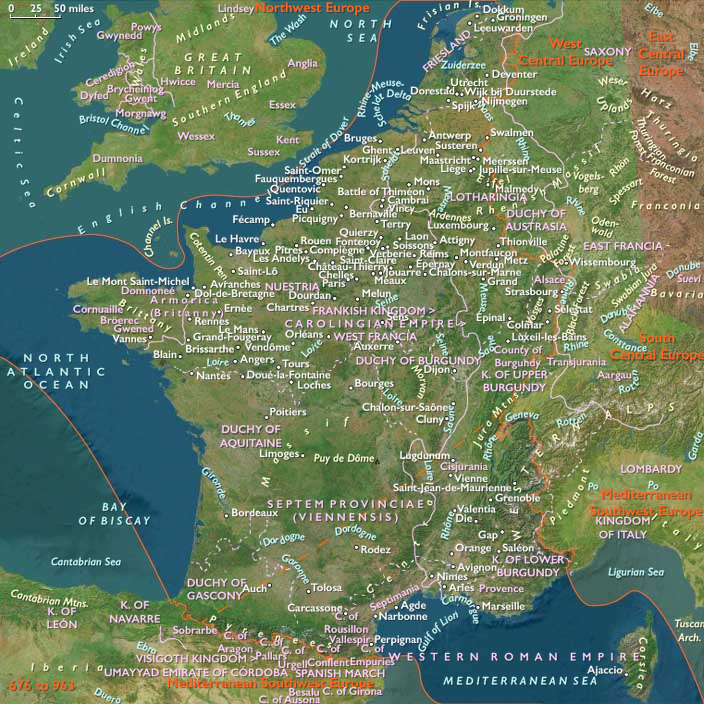
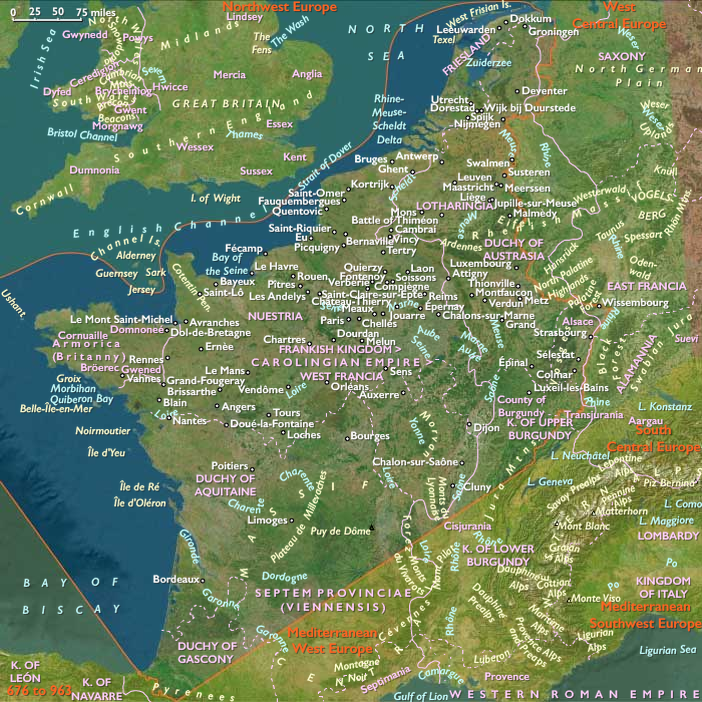
Following the rebellion against Charles the Simple, Robert of Neustria, backed by the Frankish nobility and clergy, successfully forces Charles into exile in Lorraine and is crowned King of the Franks (Rex Francorum) at Reims on June 29, 922. This marks the first successful deposition of a Carolingian ruler in West Francia, further shifting power from the Carolingians to the Robertians.
Herbert II of Vermandois: Expanding Power and Influence
- Herbert II, son of Herbert I of Vermandois and Bertha de Morvois, is deeply aware of his descent from Charlemagne and seeks to expand his territorial and political power.
- Having inherited his father’s domains, Herbert steadily strengthens his position:
- In 907, he acquires the Abbey of St. Medard, Soissons, taking the role of lay abbot, which grants him control over the abbey’s vast income and landholdings.
- His marriage to a daughter of King Robert I secures for him the County of Meaux, further expanding his influence in northern France.
Herbert’s Control Over the Archbishopric of Reims
- In 922, when Seulf is appointed Archbishop of Reims, Herbert II ensures his dominance over the Church by extracting a solemn promise from Seulf that he can nominate his successor.
- This political maneuver effectively places Herbert in control of the most important ecclesiastical office in West Francia, giving him significant influence over royal legitimacy and noble alliances.
The Political Landscape After Robert’s Coronation
- Robert I’s rule is immediately contested by Charles the Simple, who still claims Lotharingia and retains some support.
- Herbert II of Vermandois emerges as one of the most powerful nobles in West Francia, consolidating his holdings and shaping the political future of the kingdom.
Conclusion: The Decline of Carolingian Rule and the Rise of the Robertians
The coronation of Robert I in 922 represents a major shift in West Francia, as Carolingian legitimacy is openly challenged by the rising power of the Robertians and other great magnates. Meanwhile, Herbert II of Vermandois positions himself as a kingmaker, leveraging his Carolingian ancestry, vast territories, and control over the Archbishopric of Reims to secure his dynasty’s future influence.
Locations
People
Groups
- Franks
- Christianity, Chalcedonian
- Vikings
- Francia Occidentalis (West Francia, or France), Kingdom of
- Francia Orientalis (East Francia), Kingdom of
- Hungary, Principality of
- Lotharingia, Duchy of
Topics
Commodoties
Subjects
Regions
Subregions
Related Events
Filter results
Showing 10 events out of 53278 total
Ibn Fadlan also records his encounters with the Oghuz on the east coast of the Caspian, the Pechenegs on the Ural River, and the Bashkirs in what is now central Russia.
All told, the delegation covers some four thousand kilometers kilometers (twenty-five hundred miles).
When the embassy arrives to the Volga Bulgars’ capital on May 12, 922 ,Ibn Fadlan reads aloud a letter from the Caliph to the Bulgar Khan, and presents him with gifts from the caliphate.
The meeting with the Bulgar ruler, “a man of striking appearance and dignity, stout and broad, who sounded as though he were speaking from inside a large barrel,” left Ibn Fadlan “frightened and distressed,” since he was blamed for not bringing with him the promised money from the caliph to build a fortress as defense against enemies of the Bulgars.
A substantial portion of Ibn Fadlan's account is dedicated to the description of a people he calls the Rūs or Rūsiyyah.
Most scholars identify them with the Rus' or Varangians, which would make Ibn Fadlan's account one of the earliest portrayals of Vikings.
The Rūs appear as traders who set up shop on the river banks nearby the Bolğar camp.
They are described as having bodies tall as (date) palm-trees, with blond hair and ruddy skin.
They are tattooed from "fingernails to neck" with dark blue or dark green "tree patterns" and other "figures" and that all men are armed with an ax, sword and long knife.
Ibn Fadlan describes the Rus as "perfect physical specimens" and the hygiene of the Rūsiyyah as disgusting (while also noting with some astonishment that they comb their hair every day) and considers them vulgar and unsophisticated.
In that, his account contrasts with that of the Persian traveler Ibn Rustah, whose impressions of the Rus were more favorable.
He also describes in great detail the funeral of one of their chieftains (a ship burial involving human sacrifice).
Some scholars believe that it took place in the modern Balymer complex.
The wars of reconquest on the eastern frontier in this period and the general military orientation of imperial policy have brought to the fore a new class of aristocracy, whose wealth and power are based on land ownership and who hold most of the higher military posts.
Trade and industry in the cities are so rigidly controlled by the government that almost the only profitable form of investment for private enterprise is the acquisition of landed property.
The military aristocracy, therefore, has taken to buying up the farms of free peasants and soldiers and reducing their owners to varying forms of dependence.
As the empire grows stronger, the rich become richer.
Given the system of agriculture prevailing in Anatolia and the Balkans, every failure of crops, every famine, drought, or plague produces a quota of destitute peasant-soldiers willing to turn themselves and their land over to the protection of a prosperous and ambitious landlord.
The first emperor to see the danger in this development is Romanus I Lekapenos, who, in 922, passes laws to defend the small landowners against the acquisitive instincts of the “powerful”; for he realizes that the economic as well as the military strength of the empire depends on the maintenance within the theme system of the institution of free, yet taxpaying, soldier-farmers and peasants in village communities.
(Only freemen owe military service.)
A large Bulgarian army under the Kavhan Theodore Sigritsa marches swiftly through the Strandzha Mountains in 922 to reach the outskirts of Constantinople.
Romanos sends troops under the Domestic of the Schools Pothos Argyros and the admiral Alexios Mosele to face the Bulgarians.
The battle takes place at Pegae.
The initial Bulgarian blow is irresistible, and the imperial commanders are the first to flee, with Mosele drowning in a desperate attempt to reach a ship.
Most of the defending soldiers and sailors are killed, drowned, or captured.
After the battle, the Bulgarians burn the palaces in Pegae, loot the Golden Horn, and triumphantly return to Preslav.
Constantinople has meanwhile attempted to ignite Serbia against Simeon, but he has substituted Pavle with Zaharije Pribisavljević, a former refugee at Constantinople that he had captured.
Islamic mystic Al-Hallaj was born around 858 in Fars province of Persia to a cotton-carder (Hallaj means "cotton-carder" in Arabic).
His grandfather was a Zoroastrian.
His father lived a simple life, and this form of lifestyle had greatly interested the young Al-Hallaj.
As a youngster he memorized the Qur'an and would often retreat from worldly pursuits to join other mystics in study.
Al-Hallaj was originally a Hanbali Sufi Muslim and later turned to be a Qarmatian Batiniyya.
Al-Hallaj had eventually married and made a pilgrimage to Mecca, where he stayed for one year, facing the mosque, in fasting and total silence.
After his stay at the city, he had traveled extensively, writing and teaching along the way.
He had traveled as far as India and Central Asia, gaining many followers, many of whom had accompanied him on his second and third trips to Mecca.
After this period of travel, he had settled down in the Abbasid capital of Baghdad.
Among other Sufis, Al-Hallaj is an anomaly.
Many Sufi masters feel that it is inappropriate to share mysticism with the masses, yet Al-Hallaj openly does so in his writings and through his teachings.
He had thus began to make enemies.
This had been exacerbated by occasions when he would fall into trances which he attributed to being in the presence of God.
During one of these trances, he would utter "I am The Truth, " which is taken to mean that he was claiming to be God, since al-Ḥaqq "the Truth" is one of the Ninety Nine Names of Allah.
In another controversial statement, al-Hallaj had claimed "There is nothing wrapped in my turban but God, " and similarly he would point to his cloak and say, "There is nothing in my cloak but God."
This type of mystical utterance is known as shath.
Statements like these had led to a long trial, and his subsequent imprisonment for eleven years in a Baghdad prison.
Accused of heterodoxy and charlatanism, he is publicly dismembered and burned to death on March 26, 922.
Legends will soon develop around al-Hallaj’s supposed Christlike resurrection.

An infuriated Simeon, no longer able to climb to the throne in Constantinople by diplomatic means, once again has to wage war to impose his will.
Bulgaria increases its pressure on the Empire between 920 and 922, campaigning in the west through Thessaly and reaching the Isthmus of Corinth.
John, Bishop of Pavia, surrenders his city to Rudolph in 922; it will be sacked by the Magyars in 924.
Rudolph is here crowned King of the Lombards.
Abd ar-Rahman III, the Umayyad emir of al-Andalus, has failed to restore calm by his grant of amnesty to rebel Muslim Arabs, Berbers, and Muladi (Spanish converts to Islam).
The emir has launched three different campaigns against Ibn Hafsun (who died in 917) and his sons, who command an army of dissenters and tribesman.
Among the rebel leader’s sons, Jafar ibn Hafsun holds the stronghold of Toledo.
Abd ar-Rahman orders the ravaging of the city's countryside.
Jafar, after two years of siege, escapes the city to ask for help in the northern Christian kingdoms.
In the meantime, Abd ar-Rahman obtains the surrender of the city from its population, after promising them immunity, although four thousand rebels escape in a night sally.
The city surrenders on August 2, 922.
The Banu Muhallab of Guadix submit to Abd ar-Rahman in 921.
The rebel leaders of Jerez and …
Years: 922 - 922
Locations
People
Groups
- Franks
- Christianity, Chalcedonian
- Vikings
- Francia Occidentalis (West Francia, or France), Kingdom of
- Francia Orientalis (East Francia), Kingdom of
- Hungary, Principality of
- Lotharingia, Duchy of