
Robert Livingston secures a patent in 1686 …
Years: 1686 - 1686
Robert Livingston secures a patent in 1686 raising his landholdings to the status of a manor.
The manor and lordship of Livingston, which will be confirmed by royal charter of King George I in 1715, is to last for a century. (The family will continue a portion of the estate into the twenty-first century).
Livingston is the son of a minister of the Church of Scotland, a lineal descendant of the fourth Lord Livingston, ancestor of the earls of Linlithgow and Callendar, who had been sent into exile in 1663 due to his resistance to attempts to turn the Presbyterian national church into an Episcopalian institution.
Raised with his exiled family in Rotterdam, in the Dutch Republic, Robert Livingston had thus become fluent in the Dutch language, which is to help him greatly in his later career in the former Dutch colony of New Netherland, whither Robert had emigrated in 1673, settling in the frontier village of Albany, New York, in 1674.
Serving as an intermediary between speakers of the English and Dutch languages, he had soon been appointed the town clerk and secretary of New York's board of commissioners for Indian affairs.
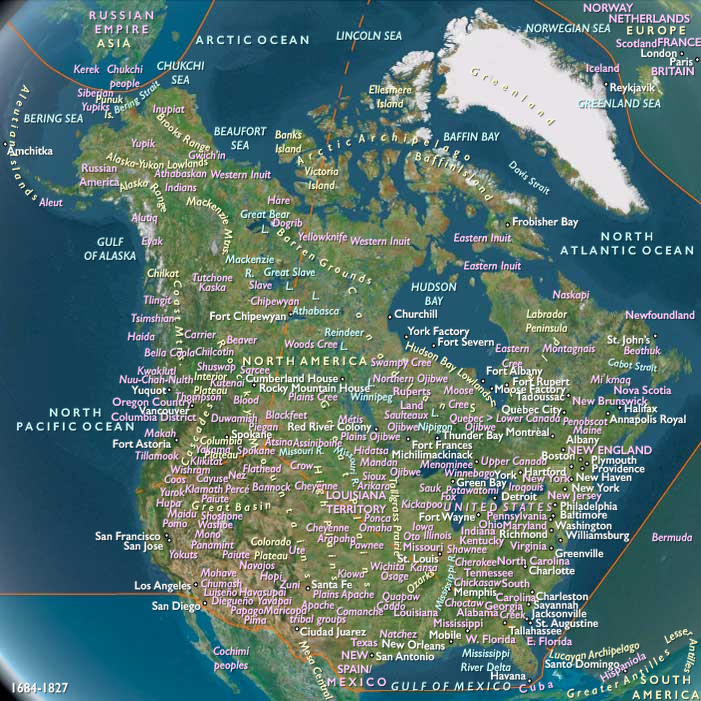
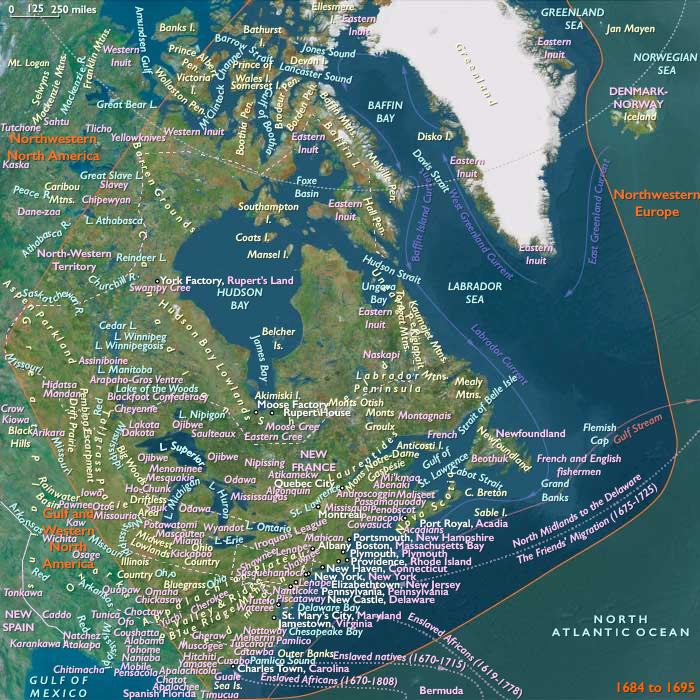
Marrying advantageously, growing wealthy in the fur trade, and building up influence with successive governors of New York, he has also been able to purchase native claims to large tracts of land along the Hudson River, thereby eventually acquiring an estate of one hundred and sixty thousand acres (sixty-five thousand hectares) in New York, embracing large portions of modern Dutchess and Columbia counties.
Locations
People
Groups
Topics
Commodoties
Subjects
Regions
Subregions
Related Events
Showing 10 events out of 29448 total
Years: 1686 - 1686
Locations
People
Groups
Topics
Commodoties
Subjects
Regions
Subregions