
The Schola Medica Salernitana, the world's …
Years: 1077 - 1077
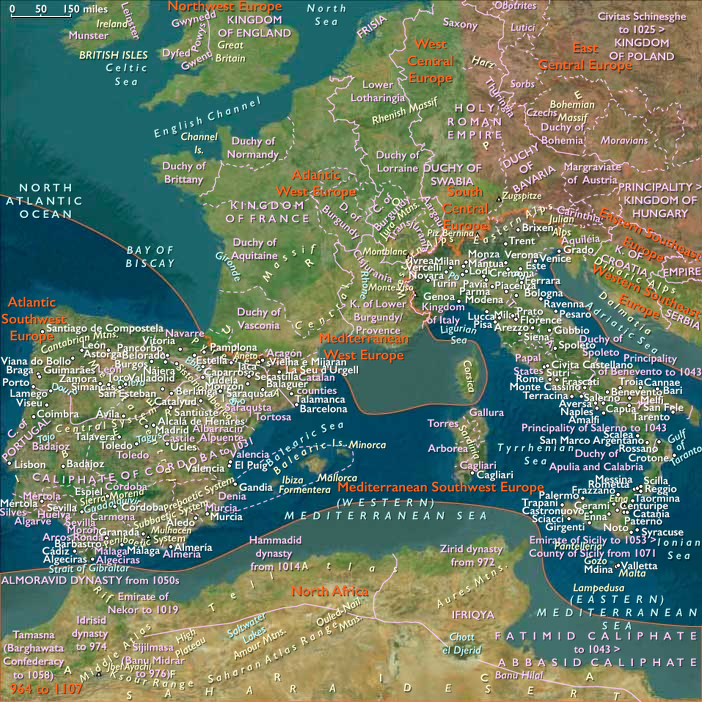
The Schola Medica Salernitana, the world's first medical school, is the most important source of medical knowledge in Western Europe at this time.
Arabic medical treatises, both those that are translations of Greek texts and those that are originally written in Arabic, had accumulated in the library of Montecassino, where they have been translated into Latin; thus the received lore of Hippocrates, Galen and Dioscorides is supplemented and invigorated by Arabic medical practice, known from contacts with Sicily and North Africa.
As a result, the medical practitioners of Salerno, both men and women, are unrivaled in the medieval Western Mediterranean for practical concerns.
The school, which finds its original base in the dispensary of a monastery founded in the ninth century, achieves its utmost splendor between the tenth and thirteenth centuries, from the last decades of Lombard power, during which its fame begins to spread more than locally, to the fall of the Hohenstaufen.
The arrival in Salerno of Constantine Africanus in 1077 marks the beginning of Salerno's classic period.
As a translator, Alfanu is well-versed in both Latin and Arabic and he has translated many manuscripts from the latter into the former.
His interest in medicine and the translation of Arabic treatises on the subject leads him to invite Constantine the African from Carthage (in what is now Tunisia) to Salerno to assist in the translation of Arabic medical texts.
Constantine brings with him to Salerno a library of Arabic medical texts which he commences to translate into Latin.
Through the encouragement of Alfano I, Archbishop of Salerno and translations of Constantine Africanus, Salerno gains the title of "Town of Hippocrates" (Hippocratica Civitas or Hippocratica Urbs).
People from all over the world flock to the "Schola Salerni", both the sick, in the hope of recovering, and students, to learn the art of medicine.
Locations
People
Groups
Topics
Subjects
Regions
Subregions
Related Events
Showing 10 events out of 50628 total
Years: 1077 - 1077
Locations
People
Groups
Topics
Subjects
Regions
Subregions