
Agriculture begins to be practiced along a …
Years: 7821BCE - 7678BCE
Comprising the lower Tigris and Euphrates valleys, Syria, Palestine, and the Nile Valley of Egypt, the Fertile Crescent is very fertile indeed, much more so than today.
To the west, much of northern Africa's vast Sahara Desert, bone-dry in historic times, is semi-arid, even wet.
Rivers flow in Arabia, forests carpet the Levant, and lakes, swamps, and marshes dot the Southwest Asian plains.
Fish, fowl, and game are abundant; the virgin soils rich and deep.
Population densities are lower in the Sahara than along the Nile, where some sedentary communities exploited fish and wild plant foods intensively after 8000, coincident with the beginning of agriculture and animal domestication in the Near East. (Anthropologists continue to debate whether food production was introduced into the Nile Valley, or resulted from indigenous developments.)
Wild barley and emmer, a forerunner of wheat, are the bases from which cereal crops began to be domesticated.
Goats and pigs were domesticated in about 8000, and the domestic cat may have originated around the same time, when nomadic humans settle into village life.
The cat (Felis catus), also known as the domestic cat or house cat to distinguish it from other felines and felids, may have originated about 8000 BCE, when nomadic humans settle into village life.
A 2007 study published in the journal Science asserts that all house cats are descended from a group of self-domesticating desert wildcats, Felis silvestris lybica, circa ten thousand years ago, in the Near East.
Groups
Topics
Commodoties
Subjects
- Commerce
- Environment
- Labor and Service
- Conflict
- Faith
- Government
- Technology
- Anthropology
- Archaeology
- Zoology
Regions
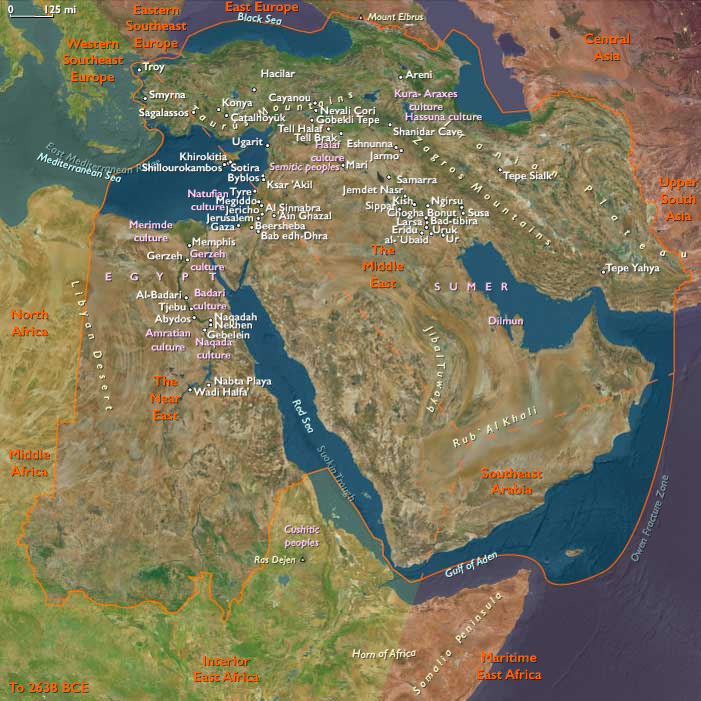
Subregions
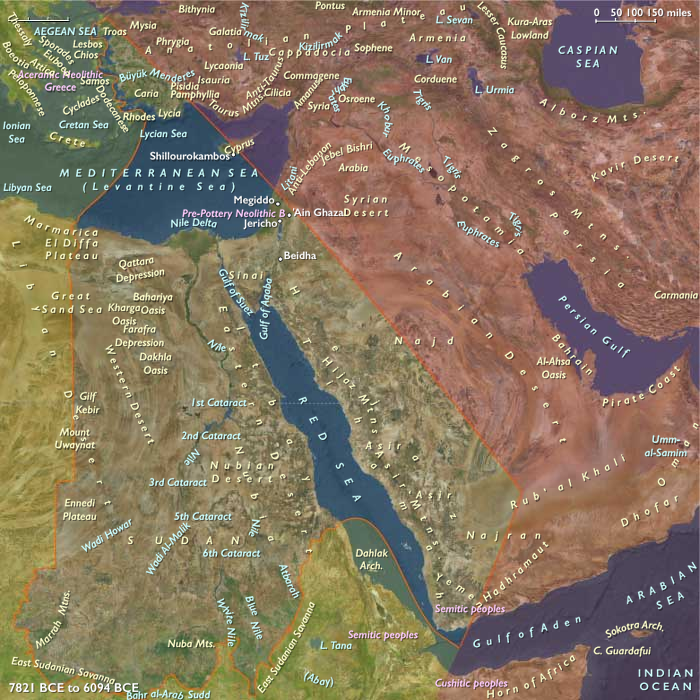
Years: 7821BCE - 7678BCE
Groups
Topics
Commodoties
Subjects
- Commerce
- Environment
- Labor and Service
- Conflict
- Faith
- Government
- Technology
- Anthropology
- Archaeology
- Zoology
Regions
Subregions