…Rimini, still in use and one of …
Years: 187BCE - 187BCE
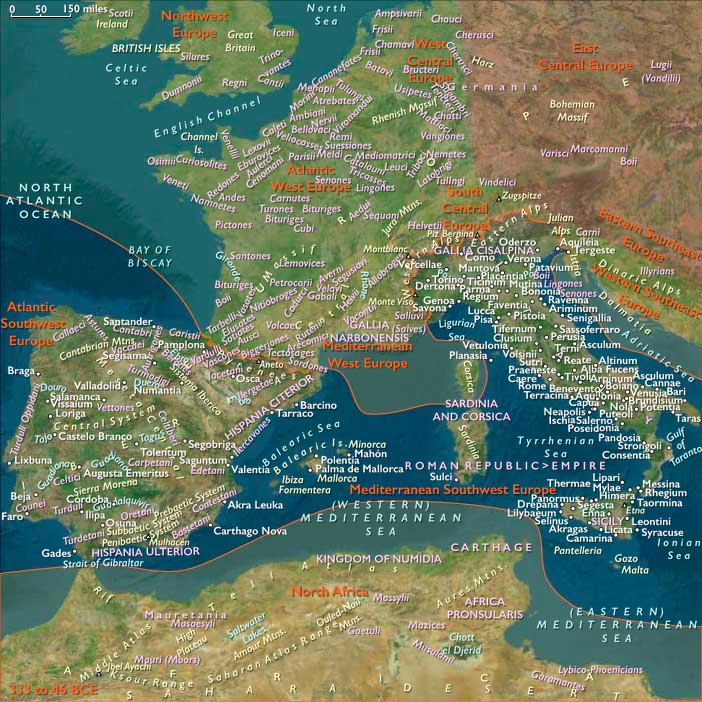
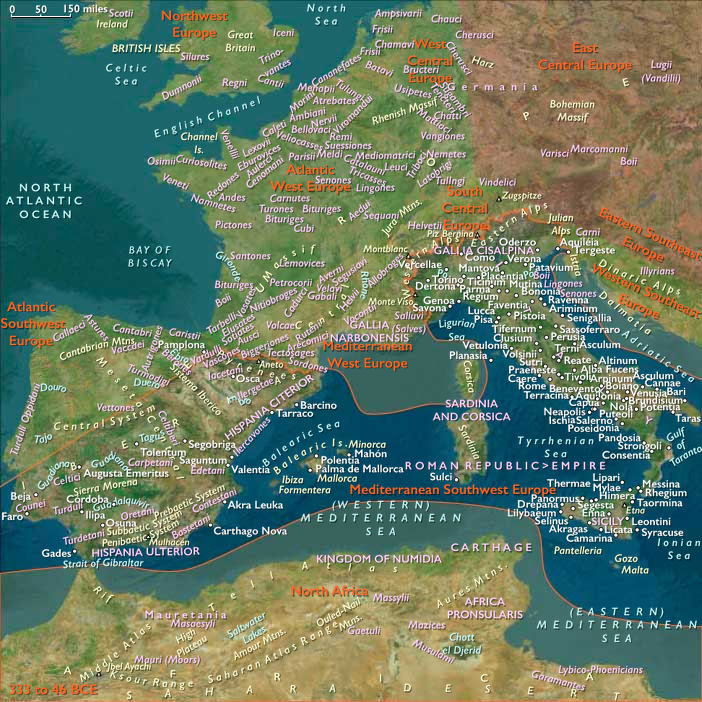
…Rimini, still in use and one of the most important roads in Northern Italy.
Locations
People
Groups
Topics
Commodoties
Subjects
Regions
Subregions
Related Events
Filter results
Showing 10 events out of 63350 total
Antiochus, faced with rebellion in the east, is without resources to suppress them.
Mounting a fresh expedition in 187 to the east of his kingdom in Luristan, in the upstart kingdom of Elymais, the king, now fifty-four, is murdered in a Baal temple near Susa, where he is exacting tribute in order to obtain much-needed revenue.
The empire inherited in 187 BCE by Antiochus' thirty-year-old son, Seleucus IV Philopater (“Father-loving”), though much reduced after the war with Rome (190-189), is still large, consisting of Syria (including Cilicia and Palestine), Mesopotamia, Babylonia, and nearer Iran (Media and Persia).
Roman praetor Marcus Aemilius Lepidus, governor of Sicily in 191 BCE, gains the office of consul in 187.
He and his colleague, Gaius Flaminius, subdue the Ligurians.
Ancient Ligures had settled the Mediterranean coast from Rhône to Arno, but later Gallic migration has mixed and produced the Gallo-Ligurian culture.
He oversees construction of the Via Aemilia, a Roman Road from the town of Piacenza to …
Reggio nell’Emilia, though not Roman in origin, begins as an historical site with the construction by Lepidus of the Via Aemilia, a trunk road in the north Italian plains leading from Piacenza to Rimini.
Reggio would become a justice's administration center, with a forum called at first Lepidi, then Lepidum Regium, and in the end simply Regium, whence the city's current name.
During the Roman age, Regium is cited only by Festus and Cicero, as one of the military stations on the Via Aemilia.
However, it will flourish as a city, a municipium with its own statutes, magistrates and art collegia.
The building of the Via Aemilia in 187 BCE makes Bologna an important center, connected to Arezzo by way of the Via Flaminia minor and to Aquileia through the Via Aemilia Altinate.
Hannibal's most famous achievement had been at the outbreak of the Second Punic War, when the Carthaginian military commander and tactician marched an army, which included war elephants, from Iberia over the Pyrenees and the Alps into northern Italy.
He eventually takes refuge with Prusias of Bithynia, who at this time is engaged in warfare with Rome's ally, King Eumenes II of Pergamon.
He serves Prusias in this war, and, in one of the victories he gains over Eumenes at sea, it is said that he had had cauldrons of snakes thrown into the enemy vessels.
The Carni are usually considered a Gaulish tribe, although some associate them with the Venetic peoples, a group closely related to but probably distinct from the Celts.
Their area of settlement isn't known with precision.
Strabo confines them to the mountains, while Ptolemy assigns them two cities near the Adriatic coast.
They are likely eponymous of the regions of Carnia, Carniola and Carinthia.
The first historical date related to the arrival of the Carni is 186 BCE, when some fifty thousand Carni, composed of armed men, women and children, descend from the northeast corner of transpadane Italy towards the plains (in which they previously used to winter) and on a hill they establish a stable defensive settlement, Akileja, situated at the head of the Adriatic at the edge of the lagoons, about ten kilometers from the sea, on the river Natiso (modern Natissa).
The bacchanalia, the wild and mystic festivals of the Roman and Greek god Bacchus introduced into Rome from lower Italy by way of Etruria around 200 BCE, were originally held in secret and only attended by women.
The festivals occurred on three days of the year in the grove of Simila near the Aventine Hill, on March 16 and March 17.
Later, admission to the rites was extended to men and celebrations took place five times a month.
According to Livy, the extension happened in an era when the leader of the Bacchus cult was Paculla Annia—though it is now believed that some men had participated before that.
Livy informs us that the rapid spread of the cult, which he claims indulged in all kinds of crimes and political conspiracies at its nocturnal meetings, led in 186 BCE to a decree of the Senate—the so-called Senatus consultum de Bacchanalibus, inscribed on a bronze tablet discovered in 1640 in Apulia in Southern Italy, now at the Kunsthistorisches Museum in Vienna—by which the Bacchanalia were prohibited throughout all Italy except in certain special cases which must be approved specifically by the Senate.
In spite of the severe punishment inflicted on those found in violation of this decree (Livy claims there were more executions than imprisonment), the Bacchanalia would survive in southern Italy long past the repression.
Modern scholars hold Livy's account in doubt and believe that the Senate acted against the Bacchants for one or more of three reasons.
First, because women occupied leadership positions in the cult (contrary to traditional Roman family values).
Second, because slaves and the poor were the cult's members and were planning to overthrow the Roman government.
Or third, according to a theory proposed by Erich Gruen, as a display of the Senate's supreme power to the Italian allies as well as competitors within the Roman political system, such as individual victorious generals whose popularity made them a threat to the senate's collective authority.

Bathhouses in India now exist in palaces, monasteries, and the houses of the wealthy.
Each bathhouse features a dressing room, a steam room with stone benches arranged around a fireplace, a cool basement room for relaxing, and a swimming pool for finishing the bath.
Mauryan territories, centered around the capital of Pataliputra, had shrunk considerably from the time of the great Emperor Ashoka when Brihadratha came to the throne in 192 BCE.
The Yuga Purana section of the Gargi Samhita says that the Yavana (Greco-Bactrian) army led by King Dhamamita (Demetrius) invaded the Mauryan territories during Brihadratha's reign and after occupying Panchala region and the cities of Saketa and Mathura, they finally captured Pataliputra.
But soon they had to leave to Bactria to fight a fierce battle (probably between Eucratides and Demetrius).
The seventh century CE historian Banabhatta relates in his Harshacharita that the king’s principlal senapati (general), Pusyamitra Sunga, while parading the entire Mauryan army before Brihadratha on the pretext of showing him the strength of the army, crushed his master because he was too weak to keep his promise (probably to repulse the Yavanas).
Pusyamitra now ascends the throne, becoming the ruler of Magadha and neighboring territories.
The kingdom of Pushyamitra is extended up to Narmada in the south, and controls Jalandhar and Sialkot in the Punjab in the northwestern regions, and the city of Ujjain in central India.
With the demise of the Mauryas, the Kabul Valley and much of the Punjab soon passes into the hands of the Indo-Greeks and the Deccan to the Satavahanas.
Ankmachis is the second Pharaoh of the rebel Thirty-fifth dynasty, which controls much of Lower Egypt during the reigns of Ptolemies IV and V. Believed to be the son of Harmachis, who had declared independence around 205 BCE, his rule had begun in approximately 199.
He had held Lykopolis in 197 but was later forced to withdraw to Thebes.
The civil war between the northern and southern areas of Egypt ends with the arrest of Ankmachis by the Ptolemaic general Conanus, but the underlying grievances continue and there will be riots again later in the dynasty.