Ricimer is made consul in 459, but …
Years: 459 - 459
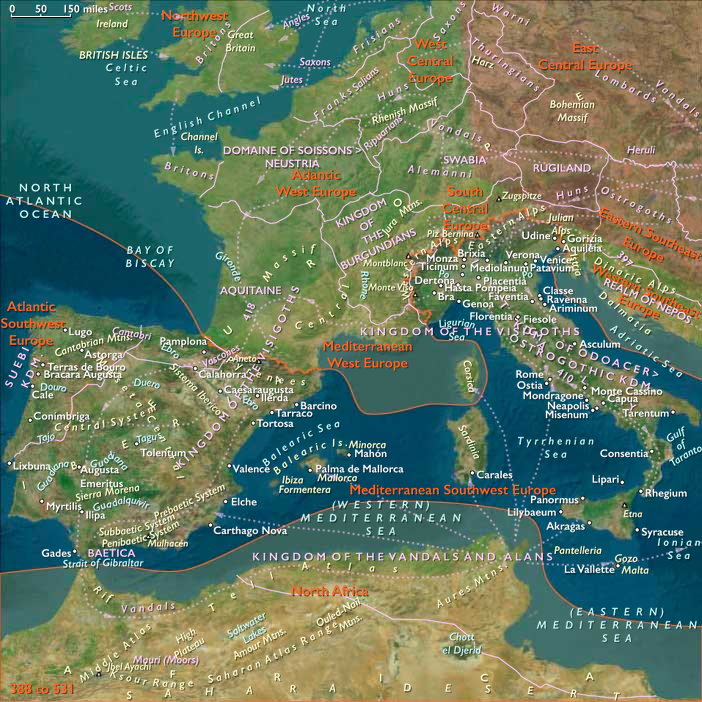
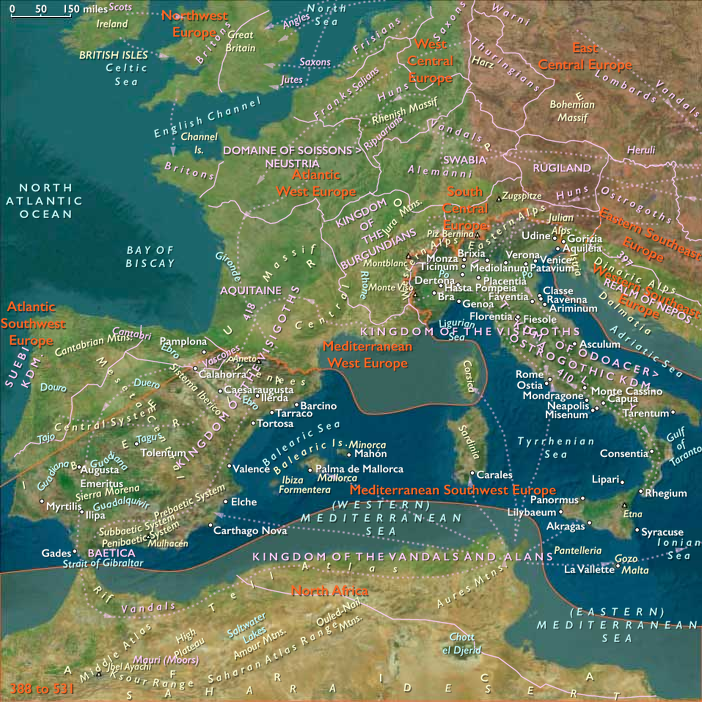
Ricimer is made consul in 459, but the emperor will not allow himself to be dominated.
Locations
People
Groups
Topics
Subjects
Regions
Subregions
Related Events
Filter results
Showing 10 events out of 58649 total
Emperor Xiaowu proves to be licentious and cruel, supposedly committing incest with the daughters of an uncle who had helped him gain the throne; his rivals also claim he had incest with his mother.
This leads to two rebellions by the imperial clan, one of which sees him slaughter the inhabitants of Guangling.
Emperor Leo signs a peace treaty with the Ostrogoths; King Theodemir, in compliance with the terms, sends his five-year-old son Theodoric as a child hostage to Constantinople.
Simeon, a Syrian Christian ascetic dismissed from a Syrian monastery for excessive austerity, became a hermit on Mount Telanissae.
He eventually moves to a platform at the top of a pillar, or stylos.
His advice sought by thousands of pilgrims, he remains at the top of the pillar until his death in about 459.
Simeon, who will be widely imitated, is the first of early Christianity’s so-called pillar ascetics.
The civil war in Persia had affected the nation so much as to have cost a province: Vatche, the king of Aghouank (Albania), a territory of Armenia, had rebelled against Persian rule and declared himself independent while the brothers were busy fighting among each other.
After Peroz I secures the throne in the year 457, he leads an army into Albania and completely subjugates the nation.
He then dismisses his Hephthalite allies with costly presents and proceeds to rule the empire in moderation and justice.
Dhatusena is the son of Sangha, the daughter of King Mahanama who ruled Anuradhapura from 410 to 432.
The country had been invaded in 433 by six Tamil leaders from South India, known as the six Dravidians.
They overthrew the Sri Lankan monarch and have ruled the country for the past twenty six years, during which time, Sinhalese leaders had abandoned Rajarata and fled to the Ruhuna principality in the south of the country.
Ruhuna is the base for resistance against the invading rulers.
Dhatusena had been raised by his uncle, a Buddhist monk named Mahanama.
The Pandyan invaders were searching for Dhatusena, and his uncle had ordained him as a Buddhist monk to disguise him.
Dhatusena later organizes a resistance movement against the Tamil invaders and leads a rebellion against them.
Dhatusena claimed the kingship of the country in 455.
By the time Dhatusena starts the rebellion, three of the six Pandayn invaders are already dead, and in the battles that occur during the rebellion, two more are killed.
The final battle takes place in 459, where the last king, Pithiya, is killed.
Having successfully defeated the Pandyan invaders, Dhatusena is crowned as the king of Sri Lanka in 459, taking Anuradhapura as his capital.
The invasions of the Imperial province of Hispania Tarraconensis, beginning in 409, had encouraged the Basques and Cantabri to revolt.
This ends in 475, when the Visigoths who now control the province force the Roman government in Tarraco to grant their kingdom full independence.
There is no evidence of destruction and apparently the capture of the city is relatively quiet.
The Transformation of Francia Under Chlodio
Under Chlodio, the concept of Francia undergoes a fundamental shift, both in geography and in political meaning. No longer merely barbaricum trans Rhenum—a term used by the Romans to describe barbarian lands beyond the Rhine—Francia emerges as a landed political entity on both sides of the river, firmly embedded in the power struggles of the Western Roman Empire.
From a Tribal Federation to a Territorial Kingdom
- Chlodio’s expansion into northern Gaul, including the conquest of Cambrai and Tournai, permanently alters the borders of Francia.
- The Franks, once considered external raiders, now rule over former Roman territories, integrating themselves into the imperial system as foederati.
- This transformation means that Francia is no longer just a tribal collective, but a recognized political force within the collapsing Roman world.
The Merovingian Expansion
Chlodio’s family, the Merovingians, will continue this territorial consolidation:
- Childeric I will strengthen Frankish control over Belgica Secunda, aligning with the Romans.
- Clovis I will extend Francia even further south, ultimately defeating the last remnants of Roman authority in Gaul and establishing the Frankish Kingdom as the dominant successor state to the Western Roman Empire.
Saxon Pressure and the Southward Shift of the Franks
As the Saxons expand from the northeast, they press the Frankish borders southwestward. This results in a gradual migration of most of the original Frankish people toward a new core region, roughly between:
- The Somme River (to the west).
- Münster (to the east, in modern Germany).
This shift solidifies the Frankish heartland in what is now northern France and western Germany, creating the geographic foundation of what will eventually evolve into the Carolingian Empire and medieval France.
The Romans had been able to reestablish the Rhine frontier after the invasions of 407 and hold northern Gaul tenuously until the end of the 450s, when control is finally lost to the Franks and local military commanders who claim to represent central Roman authority.
Trier during this period,had been captured by the Franks (possibly in 413 and 421), as well as in 451 by the Huns under Attila.
Xie He writes his Six Canons of Painting, the earliest work on the theory of art, taken from the preface to his book The Record of the Classification of Old Painters.
The Six Principles are:
• Spirit Resonance, or vitality, and which translates to the nervous energy transmitted from the artist into the work.
Xie He says that without Spirit Resonance, the overall energy of a work of art, there is no need to look further.
• Bone Method, or the way of using the brush.
This refers not only to texture and brush stroke, but to the close link between handwriting and personality.
In Xie’s time, the art of calligraphy is inseparable from painting.
• Correspondence to the Object, or the depicting of form, which includes shape and line.
• Suitability to Type, or the application of color, including layers, value and tone.
• Division and Planning, or placing and arrangement, corresponding to framing, composition, space and depth.
• Transmission by Copying, or the copying of models, not only from life but also the works of antiquity.
The skillfully rendered landscapes and genre paintings of Taoist Gu Kaizhi conform to the artistic precepts set forth by Xie He.

Attila’s Hunnish horde had disintegrated shortly after his death, its members disappearing, probably through cultural assimilation.
The dissolution of the Hunnish empire sparks a great migration among the Slavic tribes, who move northward into the upper Dnepr region, westward as far as the Elbe, and southward and eastward around and through the Carpathians.
Some groups eventually settle in Bohemia, Bulgaria, and Macedonia; others enter present Romania and the Plain of Hungary.
They will eventually form three main groups, which will become, respectively, East Slavs, or Antae (the future Great Russians, White Russians, and Ukrainians); West Slavs, or Venedi (the future Poles, Czechs, Slovaks and Wends); and South Slavs, or Sklaveni (the future Bosnians, Bulgarians, Croats, Dalmatians, Macedonians, Montenegrins, Serbs, and Slovenes, as well as, arguably, most speakers of modern Greek).