
Abraham Pineo Gesner develops a process to …
Years: 1846 - 1846
Abraham Pineo Gesner develops a process to refine a liquid fuel, which he calls kerosene, from coal, bitumen or oil shale.
The process of distilling crude oil/petroleum into kerosene, as well as other hydrocarbon compounds, was first written about in the ninth century by the Persian scholar Rāzi (or Rhazes).
In his Kitab al-Asrar (Book of Secrets), the physician and chemist Razi described two methods for the production of kerosene, termed naft abyad ("white naphtha"), using an apparatus called an alembic.
One method used clay as an absorbent, whereas the other method used ammonium chloride (sal ammoniac).
The distillation process was repeated until most of the volatile hydrocarbon fractions had been removed and the final product was perfectly clear and safe to burn.
Kerosene was also produced during the same period from oil shale and bitumen by heating the rock to extract the oil, which was then distilled.
During the medieval Chinese Ming Dynasty, the Chinese made use of kerosene through extracting and purifying petroleum and then converted it into lamp fuel.
The Chinese made use of petroleum for lighting lamps and heating homes as early as 1500 BCE.
Although "coal oil" was well known by industrial chemists at least as early as the 1700s as a byproduct of making coal gas and coal tar, it burned with a smoky flame that prevented its use for indoor illumination.
In cities, much indoor illumination is provided by piped-in coal gas, but outside the cities, and for spot lighting within the cities, the lucrative market for fueling indoor lamps is supplied by whale oil, specifically that from sperm whales, which burns brighter and cleaner.
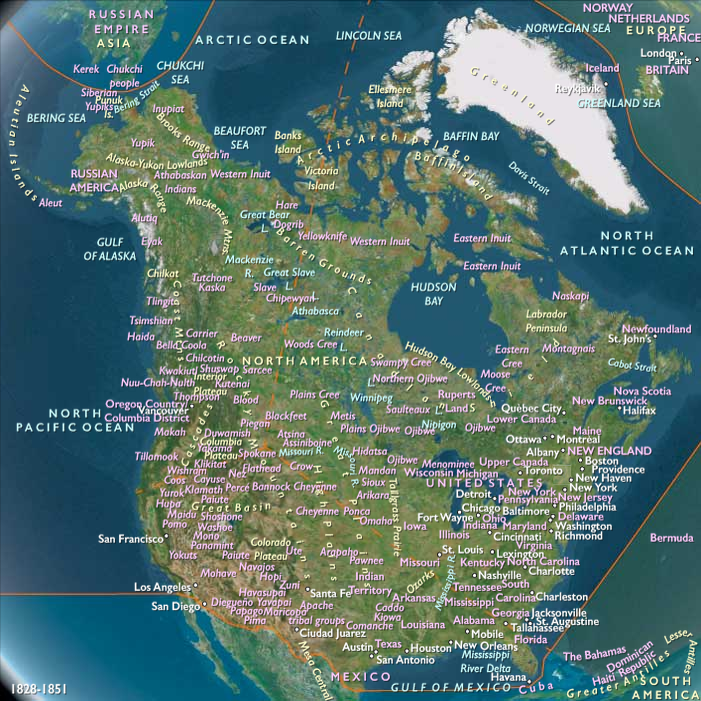
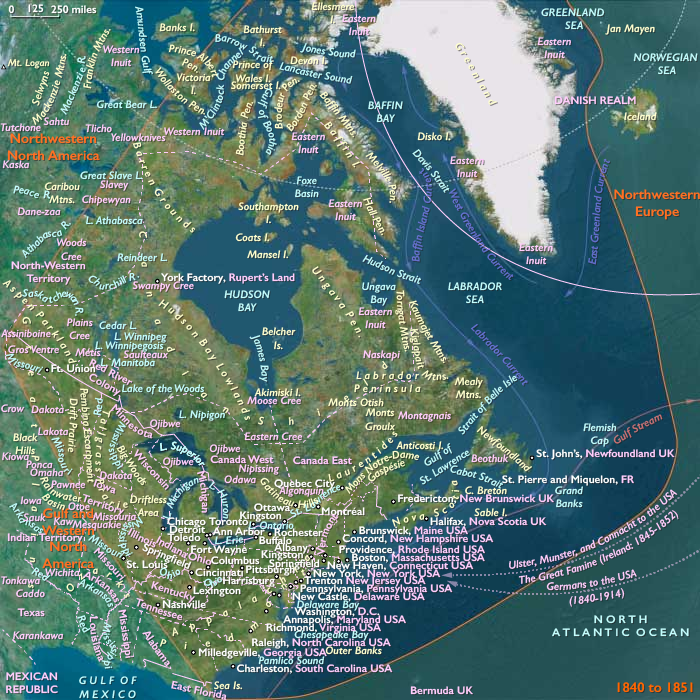
Canadian geologist Abraham Gesner will claim that in 1846, he had given a public demonstration in Charlottetown, Prince Edward Island of a new process he had discovered.
He heats coal in a retort, and distills from it a clear, thin fluid that he shows makes an excellent lamp fuel.
He coins the name "kerosene" for his fuel, a contraction of keroselaion, meaning wax-oil.
The cost of extracting kerosene from coal is high.
Locations
Groups
- Prince Edward Island (British colony)
- Britain (United Kingdom of Great Britain and Ireland)
- Canada, Province of
Topics
Commodoties
Subjects
Regions
Subregions
Years: 1846 - 1846
Locations
Groups
- Prince Edward Island (British colony)
- Britain (United Kingdom of Great Britain and Ireland)
- Canada, Province of
Topics
Commodoties
Subjects
Regions
Subregions