
Richard had sent his nephew Henry II …
Years: 1192 - 1192
April
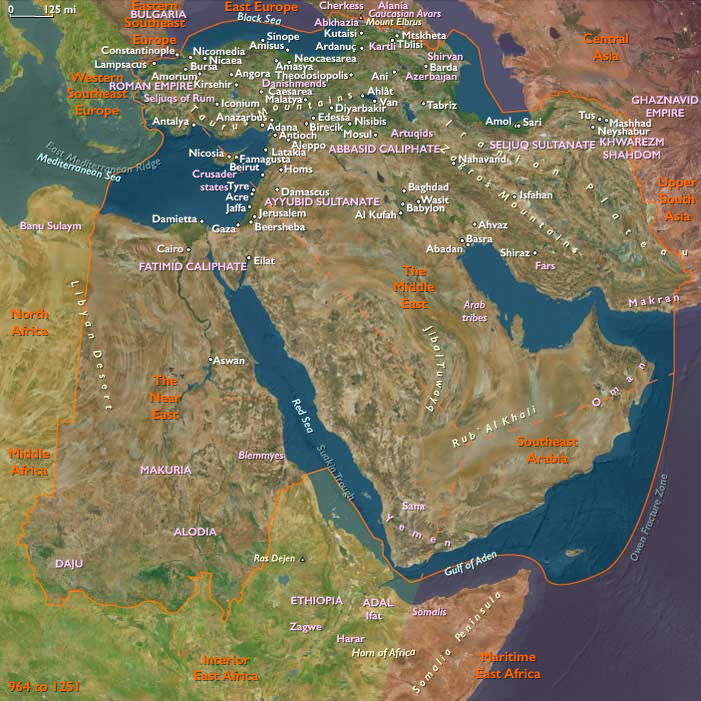
Richard had sent his nephew Henry II of Champagne as his representative from Acre to Tyre, to inform Conrad, now in his mid to late forties, of his election as King of Jerusalem.
Conrad’s wife, Queen Isabella, who is pregnant, is late in returning from the baths to dine with him, so on April 28, he goes to eat at the house of his kinsman and friend, Philip, Bishop of Beauvais.
The bishop had already eaten, so Conrad returns home; on his way, he is stabbed at least twice in the side and back by two Hashshashin.
His attendants, who kill one of his attackers and capture the other, carry him home to receive the last rites before dying of his wounds.
Henry returns to Tyre two days later, ostensibly to help organize Conrad's coronation, but finds that a funeral is being prepared instead.
Immediately betrothed to the newly widowed Isabella, he will wed her just a week after Conrad's death.
The murder remains unsolved.
The surviving Hashshashin claims under torture that Richard is behind the killing, although this is impossible to prove.
Another suspect is Humphrey IV of Toron, Isabella's first husband.
Saladin's involvement has also been alleged, but as Conrad seems to have been undertaking negotiations with him to secure the kingdom, this seems less likely; also, Saladin himself has no love for the Hashshashin.
Locations
People
- Al-Adil I
- Conrad of Montferrat
- Guy of Lusignan
- Henry II, Count of Champagne
- Henry VI, Holy Roman Emperor
- Humphrey IV of Toron
- Isabella I of Jerusalem
- Pope Celestine III
- Pope Innocent III
- Richard I of England
- Saladin
Groups
- Arab people
- Persian people
- Kurdish people
- Muslims, Sunni
- Muslims, Shi'a
- Syrian people
- Flemish people
- Turkmen people
- Cyprus, East Roman (Byzantine)
- French people (Latins)
- Christians, Roman Catholic
- Assassins
- Nizari
- Jerusalem, Latin Kingdom of
- Italians (Latins)
- Anglo-Normans
- Hospitallers of St. John of Jerusalem
- Templar, Knights (Poor Knights of Christ and of the Temple of Solomon)
- England, (Plantagenet, Angevin) Kingdom of
- Damascus, Ayyubid Dynasty of
- Egypt, Ayyubid Sultanate of
- Teutonic Knights of Acre (House of the Hospitalers of Saint Mary of the Teutons in Jerusalem)
- Cyprus, Kingdom of
Topics
Commodoties
Subjects
Regions
Subregions
Related Events
Filter results
Showing 10 events out of 47857 total
The Chinese introduce the seven-day week into their calendar around 1200.
European Fashion Trends in the Late 12th Century
Throughout 12th-century Europe, the fitted tunic remained the fundamental garment for both men and women. Typically, an over-tunic, known as a bliaut, was worn over an under-tunic, providing layers for warmth, modesty, and social distinction.
The Evolution of Women's Fashion: The Form-Fitting Bliaut
By 1200, women’s bliauts became increasingly form-fitting due to tight lacing, particularly along the sides. This innovation created a curved silhouette, which, when belted at the hips, gave the illusion of a long-waisted figure—an aesthetic preference of the time. The bliaut often featured wide, trailing sleeves, elaborate embroidery, and luxurious fabrics, particularly among the nobility.
The Mantle: A Standard Outdoor Garment
For outdoor wear, both men and women donned a mantle, a long, draped cloak that hung from the back of the shoulders and extended to the ground. These mantles, often clasped at the neck with a brooch, served as protective outerwear while also displaying wealth and status through their materials and embellishments.
This period saw increasing refinement in European dress, influenced by courtly culture, the Crusades, and growing trade networks, which introduced richer textiles and new tailoring techniques.
Fibonacci’s Liber Abaci and the Introduction of Hindu-Arabic Numerals to the Latin West (1202 CE)
The cumbersome mathematics of the Latin West, which relied on Roman numerals and inefficient counting methods, underwent a revolutionary transformation with the introduction of the Hindu-Arabic numeral system and the place-value decimal system. This transformation was formalized in 1202 by the Italian mathematician Leonardo of Pisa, better known as Fibonacci, in his groundbreaking mathematical treatise, Liber Abaci (Book of the Abacus).
The Significance of Liber Abaci
- Fibonacci’s Liber Abaci introduced the modern Hindu-Arabic numeral system, which uses ten symbols (0–9) and a place-value system to perform arithmetic operations more efficiently.
- The Arabic decimal system, which had been transmitted through Islamic scholars, replaced the Roman numeral system, which lacked a positional structure and was difficult for performing calculations.
- Fibonacci demonstrated how merchants and scholars could use the new numerals for commercial arithmetic, weights and measures, interest calculations, and algebraic equations.
Impact on European Mathematics
-
Simplified Arithmetic
- The introduction of zero (0) and positional notation allowed for more efficient calculations.
- Addition, subtraction, multiplication, and division became far easier than with Roman numerals, which required cumbersome abacus-based calculations.
-
Commercial Applications
- Fibonacci emphasized the benefits of the new system for trade, accounting, and finance.
- The new numerals facilitated bookkeeping, helping merchants across Italy and beyond.
-
Foundation for Algebraic Development
- Liber Abaci also introduced basic algebraic techniques, building on Arabic and Indian mathematical traditions.
- It laid the groundwork for later advancements in algebra and number theory in Renaissance Europe.
The Slow but Lasting Adoption of Hindu-Arabic Numerals
- Initially, medieval scholars and officials resisted adopting the new system, as Roman numerals were deeply ingrained in Western tradition.
- However, over time, Italian merchants and bankers recognized its practical superiority.
- By the 15th century, Hindu-Arabic numerals had become standard across Europe, replacing the older Roman system in scholarly, commercial, and financial contexts.
Fibonacci’s Liber Abaci was a turning point in Western mathematics, ushering in a new era of numerical efficiencythat would eventually pave the way for modern arithmetic and algebra.
The Great Famine in Western Europe (Late 12th Century)
During the late 12th century, unrelenting rainfall and severe weather patterns led to catastrophic harvest failuresacross Western Europe, triggering one of the worst famines of the century. With grain stores depleted and food production in crisis, widespread hunger, malnutrition, and social unrest followed, exacerbating existing economic and political pressures.
Causes of the Famine
-
Excessive Rainfall and Crop Failures
- Prolonged heavy rains ruined grain crops, delayed planting seasons, and waterlogged fields led to widespread rot and fungal infections.
- The shortage of wheat, barley, and rye—the staple grains of medieval Europe—crippled food supplies.
-
Lack of Agricultural Surplus
- Medieval agrarian economies operated on a subsistence model, leaving little to no surplus grain for emergencies.
- A single year of poor harvests could devastate entire communities, and successive bad years led to full-blown famine.
-
Population Growth Straining Resources
- By the late 12th century, population growth had put increasing pressure on available farmland.
- When food shortages struck, even minor disruptions had catastrophic consequences.
Consequences of the Famine
-
Mass Starvation and Desperation
- Rural communities were hardest hit, forcing peasants to forage for wild foods, eat roots and bark, or rely on charity.
- Urban grain shortages led to soaring food prices, making bread—the staple food of most medieval diets—too expensive for many to afford.
-
Migration and Social Displacement
- Large numbers of desperate peasants abandoned their villages, migrating in search of food and alms.
- Some flocked to cities, further straining already struggling urban economies.
-
Political and Economic Instability
- Kings and lords struggled to maintain order as starving populations rioted or resorted to theft.
- Landowners and rulers faced declining revenues, as peasant laborers died or fled their fields.
- In some regions, weakened governance led to increased lawlessness, with bands of robbers and mercenaries exploiting the crisis.
Long-Term Impact
- The famine highlighted the fragility of medieval agrarian economies, where societies were highly vulnerable to climatic fluctuations.
- It exposed the limitations of feudal rulers in responding to widespread food crises, leading to increased distrust in local lords.
- The famine reinforced the need for better grain storage, improved agricultural techniques, and more stable economic policies, lessons that would be tested in later medieval crises.
The Great Famine of the late 12th century was a harsh reminder of the precarious nature of medieval life, where climatic shifts could rapidly plunge entire populations into suffering, starvation, and political unrest.
Northeast Europe (1192–1203 CE): Northern Crusades, Military Conquest, and Baltic Transformation
Introduction
Between 1192 and 1203 CE, Northeast Europe entered a decisive phase marked by the formal initiation and escalation of the Northern Crusades, territorial expansion by Scandinavian kingdoms, and sustained resistance by the pagan Baltic tribes. This era profoundly transformed the region through military conquest, forced conversions, and the establishment of enduring Christian domains.
Formalization of the Northern Crusades
The official commencement of the Northern Crusades was marked by Pope Celestine III's call in 1193, which aimed explicitly at forcibly converting pagan peoples along the southern and eastern shores of the Baltic Sea. Although Scandinavian kingdoms and the Holy Roman Empire had begun subjugating neighboring pagan populations, such as the Polabian Wends, Sorbs, and Obotrites, notably beginning with the Wendish Crusade in 1147, this papal endorsement intensified and legitimated further military campaigns.
The Catholic kings of Denmark and Sweden, the German Livonian and Teutonic military orders, and their allies increasingly coordinated their efforts, aggressively extending Christian rule through conquest, conversion, and military occupation of Baltic territories.
Danish and German Military Advances
Denmark under King Canute VI (r. 1182–1202) significantly expanded its territorial ambitions, consolidating control along the southern Baltic coast, including strategic points in modern-day Pomerania and the island of Rügen. Danish and German forces systematically targeted pagan tribes, including the Livs, Latgallians, and Estonians, initiating a long period of forced conversion, occupation, and cultural transformation.
The German crusading orders, notably the Livonian Brothers of the Sword, established strong fortifications and military outposts, greatly enhancing their capability to subjugate local populations and sustain military dominance.
Swedish Crusading and Expansion
Swedish campaigns continued vigorously, focusing notably on southern Finland and intermittently against neighboring Russian territories. Although many of these military campaigns would later be characterized as crusades by romantic nationalist historians in the nineteenth century, contemporary motivations included territorial expansion, control over trade routes, and the propagation of Christianity. These efforts significantly accelerated Swedish colonization in southern Finland and deepened cultural separation between Finnish populations and their southern Baltic kin, particularly the Estonians.
Baltic Resistance and Military Occupation
Pagan tribes such as the Semigallians, Curonians, Prussians, and the Finns faced relentless military campaigns. Defeat often led to forced baptism, military occupation, or in severe cases, extermination. However, Baltic populations remained defiant, fiercely defending their territories through organized alliances, guerilla tactics, and sustained fortifications, despite significant territorial losses.
Economic Growth and Urban Expansion
Economic vitality continued to rise, with trading hubs like Visby on Gotland strengthening their roles as centers of commerce between Scandinavia, German territories, and Baltic lands. Danish cities such as Roskilde and Lund flourished due to increased royal investment, thriving merchant guilds, and expanding urban infrastructure that supported growing trade networks.
Ecclesiastical Influence and Cultural Consolidation
The influence of the Catholic Church significantly increased with expanding crusader-controlled territories. Monastic communities, particularly Cistercian establishments, grew extensively, providing education, legal structures, and cultural institutions. Clerical authorities became pivotal figures in newly conquered regions, advancing Christianization and integrating Baltic territories more deeply into the broader Latin Christian cultural sphere.
Legacy of the Era
The era from 1192 to 1203 CE was transformative, permanently reshaping Northeast Europe's cultural, political, and religious landscapes. The initiation and escalation of the Northern Crusades dramatically altered the region through military conquest and forced religious conversion, setting patterns of interaction and conflict that would persist for centuries. Baltic resistance persisted, even as the foundations for enduring Christian political and cultural dominance were established.
The Catholic kings of Denmark and Sweden, the German Livonian and Teutonic military orders, and their allies launch the Northern Crusades, or Baltic Crusades, against the pagan peoples of Northern Europe around the southern and eastern shores of the Baltic Sea.
Swedish and German campaigns against Russian Eastern Orthodox Christians are also sometimes considered part of the Northern Crusades.
(Some of these wars are called crusades during the Middle Ages, but others, including most of the Swedish ones, will first be dubbed crusades by nineteenth century romantic nationalist historians.)
The official starting point for the Northern Crusades is Pope Celestine III's call in 1193; but the already Christian kingdoms of Scandinavia and the Holy Roman Empire had started to move to subjugate their pagan neighbors even earlier, notably the Polabian Wends, Sorbs, and Obotrites between the Elbe and Oder rivers (by the Saxons, Danes, and Poles, beginning with the Wendish Crusade in 1147).
The eastern Baltic world is transformed by military conquest: first the Livs, Latgallians and Estonians, then the Semigallians, Curonians, Prussians and the Finns undergo defeat, baptism, military occupation and sometimes extermination by groups of Germans, Danes and Swedes.
East Central Europe (1192–1203 CE): Přemyslid Restoration under Ottokar I, Emergence of Andrew II in Hungary, Continued Polish Decentralization, and Austria’s Ascendant Babenberg Dynasty
Between 1192 and 1203 CE, East Central Europe—including modern-day Poland, Czechia, Slovakia, Hungary, and eastern regions of Germany and Austria east of 10°E and north of the defined southeastern boundary—experienced critical political transitions, dynastic realignments, and continued territorial consolidation. Bohemia saw renewed Přemyslid strength under Ottokar I, Hungary navigated succession struggles leading toward the ascendancy of Andrew II, Poland remained politically fragmented with strong regional principalities, and Austria continued its growth and stabilization under the prominent Babenberg dynasty. This era was pivotal in establishing lasting political frameworks, economic prosperity, and enduring cultural traditions across the region.
Political and Military Developments
Přemyslid Restoration under Ottokar I in Bohemia
-
In 1197, Ottokar I Přemysl (r. 1197–1230) secured power, bringing renewed stability and reinvigorating Přemyslid authority after prolonged dynastic strife. His effective governance restored Bohemia’s regional influence and solidified its alliance with the Holy Roman Empire.
-
Ottokar’s political acumen laid foundations for future Bohemian royal autonomy, leading eventually to his hereditary royal title recognition in 1198 by Philip of Swabia, bolstering the Přemyslid dynasty’s long-term prominence.
Hungarian Succession Struggles and Rise of Andrew II
-
Hungary entered a period of complex succession disputes after Béla III’s death (1196). His sons, Emeric (1196–1204) and Andrew II (1205–1235), contended for power, causing brief internal instability.
-
Emeric, ruling from 1196, attempted to stabilize royal power but faced challenges from his ambitious younger brother Andrew, whose eventual ascendancy in the following era (1205) would profoundly impact Hungarian politics.
Persistent Polish Decentralization and Regional Autonomy
-
Poland continued its fragmented political landscape, divided among powerful Piast principalities such as Silesia under Duke Henry I the Bearded, Greater Poland, Masovia, and Lesser Poland. Rivalry among these territories persisted, further decentralizing political authority and strengthening local aristocratic rule.
Austria’s Stability and Expansion under Leopold V and Frederick I
-
Under Duke Leopold V (r. 1177–1194) and his successor, Frederick I (r. 1195–1198), the Austrian Babenberg dynasty further solidified territorial cohesion, political stability, and regional influence within the Holy Roman Empire.
-
Austria’s expansion and strengthening of ducal authority prepared the foundation for greater autonomy and influence throughout the medieval period.
Imperial Transition after Frederick Barbarossa’s Death
-
The death of Emperor Frederick Barbarossa (1190) during the Third Crusade shifted imperial dynamics, temporarily affecting the political balance in East Central Europe. His successor, Henry VI (r. 1190–1197), and the subsequent imperial interregnum significantly influenced regional politics, alliances, and dynastic stability.
Economic and Technological Developments
Continued Economic Expansion and Urban Prosperity
-
Economic growth remained robust, supported by vibrant trade networks connecting regional economies with Baltic, Byzantine, Western European, and Mediterranean markets. Major urban centers like Prague, Vienna, Esztergom, Kraków, and Wrocław expanded as prosperous commercial hubs.
Agricultural Productivity and Technological Advancements
-
Continued adoption of advanced agricultural practices, including improved plowing techniques and systematic crop rotation, increased agricultural productivity. These innovations supported urban growth, population expansion, and regional prosperity.
Cultural and Artistic Developments
Bohemian Cultural Revival under Ottokar I
-
Ottokar I strongly supported ecclesiastical institutions, architectural projects, and manuscript production, significantly contributing to Bohemia’s cultural flourishing and reestablishing Prague as an influential intellectual and artistic center.
Hungarian Ecclesiastical and Cultural Continuity
-
Despite internal succession disputes, Hungary maintained robust cultural and religious activities. Ecclesiastical institutions, monasteries, and scholarly communities flourished, ensuring continuity and resilience in Hungarian cultural life.
Cultural Stability in Fragmented Poland
-
Polish cultural continuity remained resilient amid political fragmentation. Monasteries and ecclesiastical institutions continued scholarly and artistic traditions, preserving regional cultural and religious identities.
Settlement and Urban Development
Urban Consolidation and Expansion in Bohemia
-
Under Ottokar I, Bohemian towns such as Prague significantly expanded, enhancing fortifications, administrative structures, and economic infrastructure. This urban growth supported Přemyslid centralization and regional prominence.
Hungarian Urban Development Despite Instability
-
Hungarian urban centers, notably Esztergom and Székesfehérvár, maintained growth and infrastructure development, despite succession disputes, reflecting continued economic prosperity and strong local governance structures.
Austrian Territorial Cohesion and Urban Growth
-
Austria’s urban centers, especially Vienna, flourished under Babenberg rule, consolidating territorial cohesion, economic vitality, and regional administrative authority, reinforcing Austria’s long-term significance within East Central Europe.
Social and Religious Developments
Strengthened Ecclesiastical Structures and Religious Identity
-
Ecclesiastical institutions expanded and strengthened throughout the region, shaping governance, education, and cultural identities. Monasteries, bishoprics, and religious orders played vital roles in societal cohesion, education, and cultural preservation.
Aristocratic Dominance and Dynastic Stability
-
Aristocratic governance and dynastic authority continued to shape regional politics significantly. Bohemia’s Přemyslid restoration under Ottokar I, Austria’s Babenberg stability, and Hungary’s aristocratic power structures highlighted the pivotal role of nobility. Poland’s regional aristocratic autonomy deepened amid persistent fragmentation.
Long-Term Consequences and Historical Significance
The era 1192–1203 CE critically shaped East Central Europe’s political landscape, economic vitality, and cultural identity. The restoration of Přemyslid authority in Bohemia under Ottokar I, Hungary’s succession struggles leading toward Andrew II’s significant future rule, Austria’s territorial and political strengthening, and Poland’s persistent decentralization deeply influenced regional trajectories. These developments laid enduring foundations for the distinct political structures, economic patterns, and cultural identities characterizing East Central Europe throughout the medieval period and beyond.
Constantinople’s Empire is reduced, around the turn of the twelfth century, by the conquests of Serbian leader Stefan Nemaja; by the formation of the Second Bulgarian Empire; and finally by the knights of the misdirected Fourth Crusade, who enter the capital city itself and depose the reigning emperor, restoring to the throne their client and his aged, blinded father.
Eastern Southeast Europe (1192–1203 CE): Political Turmoil, Fragmentation, and External Incursions
Settlement and Migration Patterns
Frontier Security and Szekler Communities
The Szeklers continued playing a pivotal role in frontier security within Transylvania, defending against incursions and maintaining the Hungarian Kingdom’s eastern borders amidst increasing regional instability. Their role became increasingly vital as the power vacuum left by Byzantine decline intensified frontier conflicts.
Expansion of Transylvanian Saxon Settlements
The Transylvanian Saxons, predominantly settlers from the Low Countries and German-speaking regions, further consolidated their presence. Originally invited by Hungarian rulers in previous decades to strengthen frontier defenses, they continued developing fortified towns, which significantly enhanced regional agricultural productivity, trade, and security.
Arrival and Integration of Roma Populations
Ancestral populations of modern European Roma, known historically as the Doma, entered the Balkans around the beginning of the twelfth century. Having originated from northwestern India and migrated westward around CE 500, these groups gradually spread throughout Europe, beginning their integration into local societies while preserving their distinct cultural identities.
Economic and Technological Developments
Continued Venetian Trade Dominance
Economic conditions remained heavily influenced by Venetian commercial interests, whose dominance over key trade routes and markets persisted despite Byzantine attempts to challenge their control. This ongoing economic rivalry underscored the difficulty Constantinople faced in asserting regional trade autonomy during a period of increasing fragmentation.
Military and Defensive Enhancements
Technological advancements continued to prioritize military defense, particularly through fortifications in strategic urban centers, notably Constantinople. Enhanced defensive systems and improved logistical capabilities remained crucial amidst mounting internal and external pressures.
Cultural and Artistic Developments
Byzantine Cultural Continuity Amid Transition
Despite political upheaval, Byzantine culture continued to flourish, integrating Western artistic elements that had become more prominent during the reign of Manuel I Komnenos. The court in Constantinople maintained significant cultural exchanges, reflecting a complex blend of Eastern and Western influences.
Scholarly and Educational Stability
Institutions of learning preserved classical and theological traditions, adapting to the turbulent political environment. The continuity of intellectual pursuits provided resilience amidst shifting political and military conditions.
Social and Religious Developments
Succession Crisis and Diplomatic Complexity
The death of Emperor Manuel I Komnenos in 1180 resulted in a prolonged succession crisis that exacerbated internal factionalism and weakened Byzantine political coherence. The resulting instability deeply impacted diplomatic relations with neighboring states, particularly Hungary, Serbia, and the increasingly assertive Latin powers.
Increasing Latin Influence and Internal Tensions
Latin (Western European) influences, extensively promoted during Manuel’s reign, increasingly became sources of internal friction. Policies intended to bridge Eastern and Western divides instead intensified tensions between Greek and Latin communities, significantly affecting social stability and political unity.
Expansion of Christian Institutional Influence
Christian institutions continued to expand their presence and influence amidst internal turmoil, providing crucial social cohesion and spiritual guidance. Ecclesiastical structures remained central to regional stability, even as secular authorities weakened.
Byzantine Fragmentation and External Pressures
Serbian and Bulgarian Expansion
Around the turn of the twelfth century, Byzantine authority in the Balkans was severely diminished by the military successes of Serbian leader Stefan Nemanja, whose conquests substantially reduced imperial influence in the western Balkans. Concurrently, the rise of the Second Bulgarian Empire under the leadership of Tsar Kaloyan further curtailed Byzantine territorial control.
Fourth Crusade and the Fall of Constantinople
The devastating events of the Fourth Crusade culminated in the crusaders’ diversion toward Constantinople in 1203. Originally aimed at retaking Jerusalem, the crusaders instead captured Constantinople, deposed the reigning emperor, and installed their own puppet ruler alongside his elderly, blinded father. This event was catastrophic for Byzantine authority, significantly altering regional power dynamics and precipitating further political fragmentation.
Long-Term Consequences and Historical Significance
The era from 1192 to 1203 CE was marked by profound political upheaval, demographic shifts, economic rivalry, and the onset of severe territorial fragmentation. The arrival and integration of Roma populations, the rise of Serbian and Bulgarian powers, and the catastrophic impact of the Fourth Crusade significantly reshaped Eastern Southeast Europe's historical trajectory, laying critical foundations for the profound transformations of the following centuries
Henry VI of the Holy Roman Emperor launches the Crusade of 1197 in response to the partial victory of Frederick I Barbarossa's crusade in 1190.
The Crusade, also known as the "Emperor's Crusade”, ends abruptly, after the fall of Sidon and Beirut.
Henry VI dies of a fever in Messina in October 1197, and many higher-ranking nobles return to Germany to protect their interests in the next imperial election.
The remaining nobles in the Crusade capture Sidon and Beirut before returning to Germany.
Years: 1192 - 1192
April
Locations
People
- Al-Adil I
- Conrad of Montferrat
- Guy of Lusignan
- Henry II, Count of Champagne
- Henry VI, Holy Roman Emperor
- Humphrey IV of Toron
- Isabella I of Jerusalem
- Pope Celestine III
- Pope Innocent III
- Richard I of England
- Saladin
Groups
- Arab people
- Persian people
- Kurdish people
- Muslims, Sunni
- Muslims, Shi'a
- Syrian people
- Flemish people
- Turkmen people
- Cyprus, East Roman (Byzantine)
- French people (Latins)
- Christians, Roman Catholic
- Assassins
- Nizari
- Jerusalem, Latin Kingdom of
- Italians (Latins)
- Anglo-Normans
- Hospitallers of St. John of Jerusalem
- Templar, Knights (Poor Knights of Christ and of the Temple of Solomon)
- England, (Plantagenet, Angevin) Kingdom of
- Damascus, Ayyubid Dynasty of
- Egypt, Ayyubid Sultanate of
- Teutonic Knights of Acre (House of the Hospitalers of Saint Mary of the Teutons in Jerusalem)
- Cyprus, Kingdom of
