
Rhadamistus, son of King Parsman I of …
Years: 51 - 51
Rhadamistus, son of King Parsman I of Iberia (Pharasmanes), is known for his ambition, good looks, and valor.
Parsman, fearing usurpation by his son, has persuaded Rhadamistus to make war upon his uncle, King Mithridates of Armenia, Parsman’s brother, and father of Rhadamistus' wife, Zenobia.
The Iberians invade with a large army and force Mithridates into the fortress of Gorneas (Garni), which is garrisoned by the Romans under the command of Caelius Pollio, a prefect, and Casperius, a centurion.
Pollio, swayed by Rhamistus' bribery, induces the Roman soldiers to threaten capitulation of the garrison.
Under this compulsion, Mithridates agrees to surrender to his nephew.
Rhadamistus executes Mithridates and his sons despite a promise of nonviolence, and becomes King of Armenia.
Locations
People
Groups
- Armenian people
- Iberia, Caucasian (Kartli, Kingdom of)
- Parthian Empire
- Armenia, Kingdom of Greater
- Roman Empire (Rome): Julio-Claudian dynasty
Topics
Commodoties
Subjects
Regions
Subregions
Related Events
Filter results
Showing 10 events out of 61749 total
Preaching in Corinth in about 51, Paul writes the two Epistles to the Thessalonians, in which he cautions his recently founded community of Christians at Thessalonica against thinking of the Second Coming of Jesus, which he expects imminently at this stage in his career, as an easy escape from trouble.
Reviewing his stay with them, expressing concern for their welfare, and encouraging them in suffering, he reassures them that those already dead will rise at the Second Coming and that certain signs will precede the end. (1 Thessalonians is the earliest Christian document known to exist. Some scholars maintain that 2 Thessalonians is by a later disciple of Paul.)
Paul is brought before Gallio, the Roman governor of Corinth, in 51.
Claudius, according to the biographer Suetonius, during a period of troubles expelled the Jews from Rome for a short time; the Christian sect may be involved.
Elsewhere he confirms existing Jewish rights and privileges, and in Alexandria, he tries to protect the Jews without provoking Egyptian nationalism.
In a surviving letter addressed to the city of Alexandria, he asks Jews and non-Jews ”to stop this destructive and obstinate mutual enmity”.
Caractus, although a captive, is allowed to speak to the Roman senate.
Tacitus records a version of his speech in which he says that his stubborn resistance made Rome's glory in defeating him all the greater:
“If the degree of my nobility and fortune had been matched by moderation in success, I would have come to this City as a friend rather than a captive, nor would you have disdained to receive with a treaty of peace one sprung from brilliant ancestors and commanding a great many nations.
But my present lot, disfiguring as it is for me, is magnificent for you.
I had horses, men, arms, and wealth: what wonder if I was unwilling to lose them?
If you wish to command everyone, does it really follow that everyone should accept your slavery?
If I were now being handed over as one who had surrendered immediately, neither my fortune nor your glory would have achieved brilliance.
It is also true that in my case any reprisal will be followed by oblivion.
On the other hand, if you preserve me safe and sound, I shall be an eternal example of your clemency.” (Tacitus, The, translated by A. J. Woodman, 2004) He made such an impression that he was pardoned and allowed to live in peace in Rome.
After his liberation, according to Dio Cassius, Caratacus was so impressed by the city of Rome that he said "And can you, then, who have got such possessions and so many of them, covet our poor tents?" (Dio Cassius, Roman History, Epitome of Book LXI, 33:3)
Queen Cartimandua is first mentioned by Tacitus in CE 51, but her rule over the Brigantes may have already been established in 43 when Claudius began the organized conquest of Britain: she may have been one of the eleven "kings" who Claudius' triumphal arch says surrendered without a fight.
If not, she may have come to power after a revolt of a faction of the Brigantes was defeated in 48 by Ostorius.
Of "illustrious birth" according to Tacitus, she has probably inherited her power as she appears to have ruled by right rather than through marriage.
She and her husband, Venutius, are described by Tacitus as loyal to Rome and "defended by our [Roman] arms".
Caractacus, his forces defeated by Ostorius in North Wales, flees to Cartimanduas, but in 51 she turns him over, in chains, to the Romans, who have supported her in a number of anti-Roman revolts among her subjects.
Caratacus is sent to Rome as a war prize, presumably to be killed after a triumphal parade.
Ostorius is honored with triumphal insignia but his victory over Caratacus has not entirely quelled resistance in the Welsh borders.
The Silures especially continue to harass Roman troops, supposedly after Ostorius had publicly said that they posed such a danger that they should be either exterminated or transplanted.
A large legionary force occupied in building forts in Siluran territory is surrounded and attacked and only rescued with difficulty and considerable loss.
This violent desperation on the part of the Silures can be attributed to their reaction to what Peter Salway, author of Roman Britain (1981), a volume in the Oxford History of England series, calls Ostorius' lack of political judgment.
The Silures, galvanized by Ostorius' ill-thought out threats to destroy them, begin taking Roman prisoners as hostages and distributing them among their neighboring tribes.
This has the effect of binding them all together and creating a new resistance movement.
According to Tacitus's biography of Agricola, the Silures usually had a dark complexion and curly hair.
Due to their appearance, Tacitus hinted that they may have crossed over from Spain at an earlier date.
The Iron Age hillfort at Llanmelin near Caerwent has sometimes been suggested as a pre-Roman tribal center, but the view of most archaeologists is that the people who became known as the Silures were a loose network of groups with some shared cultural values, rather than a centralized society.
Although the most obvious physical remains of the Silures are hillforts such as those at Llanmelin and Sudbrook, there is also archaeological evidence of roundhouses at Gwehelog, Thornwell (Chepstow) and elsewhere, and evidence of lowland occupation notably at Goldcliff.
Emperor Claudius and the Expansion of the Roman Empire (41–54 CE)
Emperor Claudius (r. 41–54 CE), known for his shrewd administrative skills and focus on imperial stability, actively expanded Roman citizenship and established new Roman cities throughout the empire. He recognized that urbanization and integration of provincial elites were key to maintaining imperial control and governance.
Claudius’ Territorial Expansions
During his reign, several key regions were incorporated into the Roman Empire, strengthening Rome’s dominance in Western Europe, North Africa, and beyond:
1. The Roman Conquest of Britain (43 CE)
- Under Claudius, Rome finally launched the long-awaited invasion of Britain, previously attempted under Julius Caesar (55–54 BCE) and planned but abandoned by Caligula (40 CE).
- Aulus Plautius led the campaign with four legions, successfully defeating the Catuvellauni and their allies.
- Claudius personally traveled to Britain to accept the submission of local chieftains, marking the formal annexation of Britannia as a Roman province.
- Roman fortresses, roads, and cities were established, including Camulodunum (Colchester), the first provincial capital.
2. Annexation of Mauretania (42 CE)
- Mauretania, previously a client kingdom, was formally annexed into the empire after the execution of its last king, Ptolemy of Mauretania (40 CE).
- The kingdom was divided into two new provinces:
- Mauretania Tingitana (modern Morocco)
- Mauretania Caesariensis (modern Algeria)
- This secured Roman dominance over North Africa, allowing easier control of trade and military movementsalong the western Mediterranean.
3. The Integration of Thrace (46 CE)
- Thrace, previously a client kingdom, was incorporated into the empire after the death of King Rhoemetalces III.
- Rome stationed legions in the region, securing its strategic position near the Danube frontier and preventing incursions from barbarian tribes.
4. The Formalization of the Gallic Provinces
- Although Gallia had been conquered by Julius Caesar (58–50 BCE), Claudius reorganized the region into formal provinces, strengthening its administrative structure:
- Gallia Lugdunensis
- Gallia Belgica
- Gallia Aquitania
- These changes further Romanized Gaul, granting citizenship to local elites and promoting the growth of Roman cities and infrastructure.
Claudius’ Administrative and Urbanization Policies
- Claudius expanded Roman citizenship, granting legal rights to provincial elites, helping integrate them into the imperial system.
- He established new Roman colonies across the empire, reinforcing loyalty to Rome and fostering economic development.
- His policies ensured that the provinces were not merely conquered lands, but integrated parts of the Roman world, securing long-term stability and prosperity.
Legacy of Claudius’ Expansions
- By expanding Rome’s borders, Claudius solidified control over Western Europe, North Africa, and the Balkans.
- His emphasis on provincial urbanization helped spread Roman law, culture, and infrastructure across newly incorporated territories.
- The annexation of Britain, in particular, marked the beginning of nearly 400 years of Roman rule, shaping the island’s historical and cultural trajectory.
Claudius’ reign cemented Rome’s position as the dominant power of the ancient world, ensuring that its frontiers, administration, and economy remained strong for generations to come.
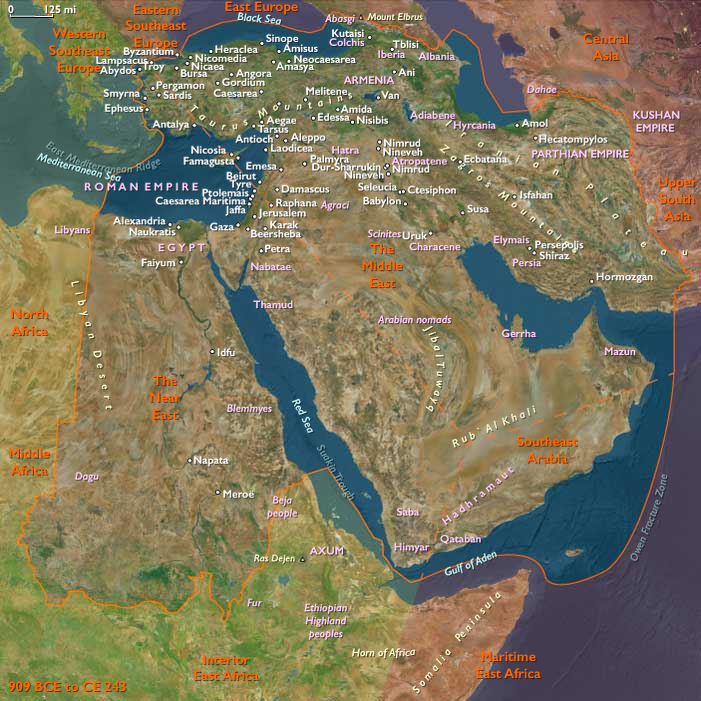
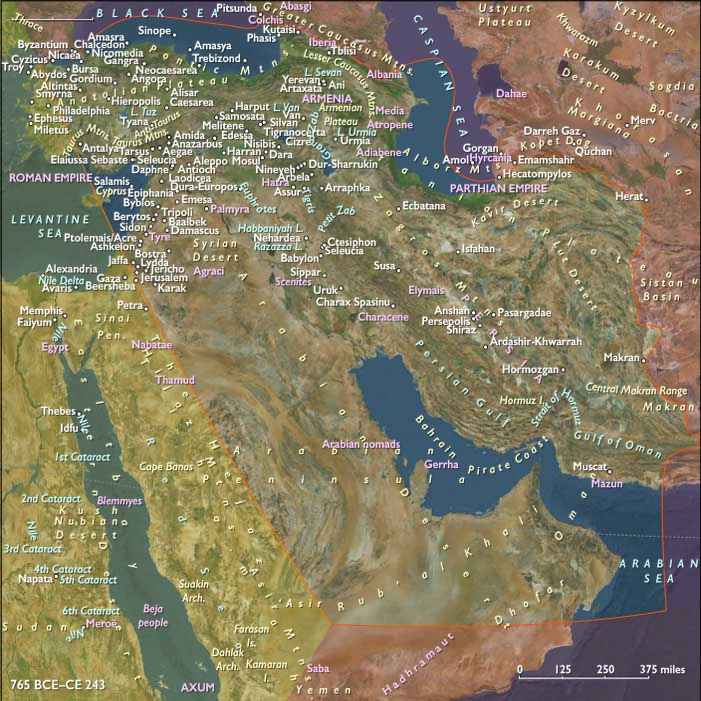
The Middle East: 52–63 CE
The Roman-Parthian Struggle for Armenia
During this era, the longstanding rivalry between Rome and Parthia over influence in Armenia escalates into open conflict. Although Armenia had remained a Roman client kingdom since the reign of Emperor Augustus, in 52/53 CE the Parthian king Vologases I capitalizes on Roman distraction and successfully installs his brother, Tiridates, on the Armenian throne, challenging Roman regional hegemony.
The timing coincides with the accession of Emperor Nero in 54 CE, who, eager to assert his imperial authority, initiates a vigorous military response. Under the command of the accomplished Roman general Gnaeus Domitius Corbulo, Rome swiftly defeats Armenian forces loyal to Tiridates. Corbulo's successful campaigns culminate in placing the pro-Roman candidate, Tigranes VI, upon the Armenian throne. Believing their mission accomplished, Roman forces withdraw, leaving behind a seemingly stable client state.
However, internal Parthian disturbances that had initially distracted Vologases are soon resolved, enabling him to redirect his full attention back to Armenia. Renewed conflict ensues, and after a protracted period of inconclusive skirmishes, the Parthians decisively defeat Roman forces at the Battle of Rhandeia in 62 CE.
In the wake of this significant defeat, Rome and Parthia agree to a diplomatic compromise: henceforth, Armenia's king must be a Parthian prince from the Arsacid dynasty, subject to formal approval by the Roman emperor. This arrangement, while acknowledging Parthian influence, preserves Roman prestige and diplomatic involvement in the region.
This conflict marks the first direct Roman-Parthian military confrontation since the disastrous campaign of Crassus in 53 BCE and Mark Antony’s ill-fated invasions nearly a century earlier. It inaugurates a prolonged series of struggles between the two empires for dominance over strategically critical Armenia.
Armenia has been a Roman client state since the days of Emperor Augustus, but in 52/53 the Parthians succeed in installing their own candidate, Tiridates, on the Armenian throne.
These events coincide with the accession of Nero to the imperial throne in Rome, and the young emperor decides to react vigorously.
The war, which is the only major foreign campaign of his reign, begins with rapid success for the Roman forces, led by the able general Gnaeus Domitius Corbulo.
They overcome the forces loyal to Tiridates, install their own candidate, Tigranes VI, on the Armenian throne, and leave the country.
The Romans are aided by the fact that the Parthian king Vologases is embroiled in the suppression of a series of revolts in his own country.
As soon as these have been dealt with, however, the Parthians turn their attention to Armenia, and after a couple of years of inconclusive campaigning, inflict a heavy defeat on the Romans in the Battle of Rhandeia.
The conflict ends soon after, in an effective stalemate and a formal compromise: a Parthian prince of the Arsacid line will henceforth sit on the Armenian throne, but his nomination has to be approved by the Roman emperor.
This conflict is the first direct confrontation between Parthia and the Romans since Crassus' disastrous expedition and Mark Antony's campaigns a century earlier, and is the first of a long series of wars between Rome and Iranian powers over Armenia.
Near East (52–63 CE): Procuratorial Rule and Rising Unrest
This era sees the Near East continuing under semiautonomous client-state governance, with Judea and Galilee operating under the tribute system imposed by Roman authorities. Jews largely accept the payment of tribute but strongly resist the imposition of any graven images within their Temple, a point of contention that periodically strains relations with Rome.
The governance of Judea and surrounding regions by Roman procurators during this period frequently leads to mismanagement, causing significant disturbances. The administration of Ventidius Cumanus had already been marked by unrest, and tensions further escalate under his successor, Felix, who takes office in 52 CE. Felix's tenure is characterized by frequent outbreaks of open rebellion, fueled by oppressive policies and insensitivity toward local customs and traditions.
Felix’s inability to balance Roman interests with local sensibilities exacerbates existing tensions, laying the groundwork for more serious rebellions. His tenure marks a significant deterioration in Roman-Jewish relations, setting the stage for greater conflicts in the ensuing decades.
Legacy of the Era
The period from 52 to 63 CE underscores the challenges of Roman provincial administration, highlighting how ineffective governance can swiftly transform manageable tensions into open revolt. The increasing unrest and rebellion during Felix's procuratorship serve as a critical precursor to the broader instability that will culminate in the Great Jewish Revolt later in the century.
Judea and Galilee have from CE 6 effectively operated as semiautonomous client-states under Roman tribute.
Jews for the most part are willing to pay tribute, although they complain when it is excessive, and absolutely refuse to allow a graven image in their Temple although some emperors have considered imposing one.
The primary tasks of the tetrarch and high priest are to collect tribute, persuade the Romans not to interfere with the Temple, and ensure that the Jews not rebel.
Disturbances in Judea during the early years of procuratorial rule are frequent and largely caused by maladministration.
Serious trouble had arisen under Ventidius Cumanus; and under the imperial freedman Felix, who in CE 52 succeeds him, rebellion becomes open, though sporadic.
Years: 51 - 51
Locations
People
Groups
- Armenian people
- Iberia, Caucasian (Kartli, Kingdom of)
- Parthian Empire
- Armenia, Kingdom of Greater
- Roman Empire (Rome): Julio-Claudian dynasty
