
Adventure arrives at Queen Charlotte Sound on …
Years: 1773 - 1773
May
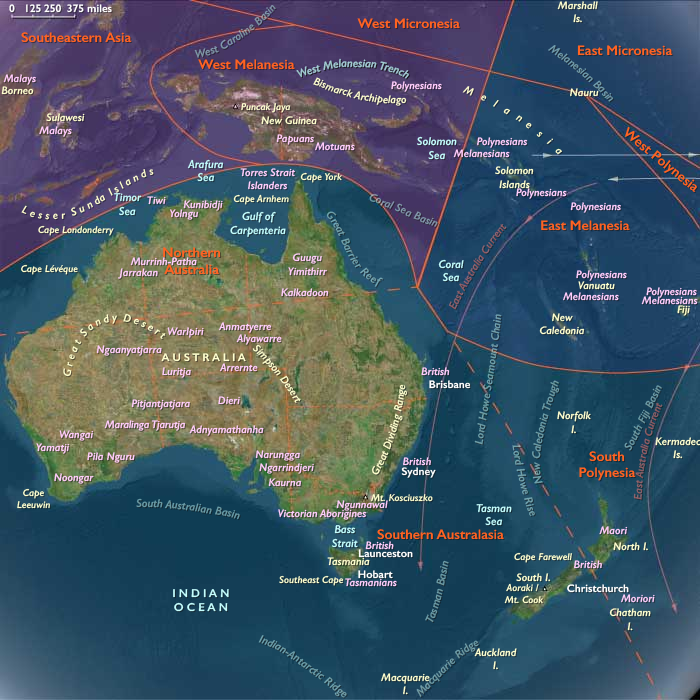
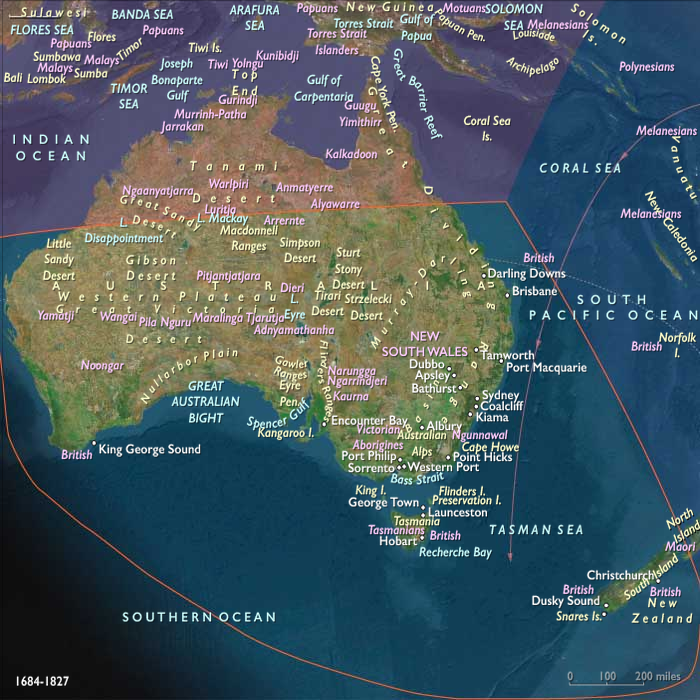
Cook continues his explorations south-eastwards, reaching 61°21′s on February 24; then, in mid-March he decides to head for Dusky Bay (now Dusky Sound) in the South Island of New Zealand where the ship rests until 30 April.
The Resolution reaches the rendezvous at Queen Charlotte Sound on May 17.
Locations
People
- Anders Sparrman
- Charles Clerke
- Georg Forster
- George Vancouver
- James Burney
- James Cook
- Jean-Baptiste Charle Bouvet de Lozier
- Joseph Banks
- Tobias Furneaux
- William Bayly
- William Hodges
- William Wales
Groups
Topics
- Exploration of Oceania, European
- Voyages of scientific exploration, European and American
- Cook, Second Voyage of James
Subjects
Regions
Subregions
Related Events
Filter results
Showing 10 events out of 12 total
Australian artist and writer Norman Lindsay, producing a vast body of work in different media, including pen drawing, etching, watercolor, oil and sculptures in concrete and bronze, shocks the world (and the Bishop of Sydney in particular) with his graphic representations of the nude female form.
East Europe (1924–1935 CE): Soviet Consolidation, Economic Transformation, and Cultural Control
Political and Military Developments
Stalin's Rise and Consolidation of Power
Following Lenin’s death in 1924, Joseph Stalin systematically consolidated power within the Soviet Union, eliminating political rivals and establishing a highly centralized and authoritarian regime. The period saw extensive political purges, heightened state surveillance, and rigid control over societal institutions.
Military Modernization and Strategic Preparedness
Under Stalin, the Soviet military underwent significant modernization, prioritizing industrial output for defense capabilities. This period featured rapid expansion and restructuring of armed forces, fortifications along western borders, and improved military infrastructure.
Economic and Technological Developments
Rapid Industrialization: The Five-Year Plans
The introduction of Stalin's ambitious Five-Year Plans significantly transformed the Soviet economy, emphasizing rapid industrialization and collectivization. Heavy industries, such as steel production, mining, and manufacturing, expanded drastically, reshaping the economic landscape.
Collectivization and Agricultural Reform
Agricultural collectivization was aggressively pursued, forcibly merging small private farms into large collective units (kolkhozes). Although intended to modernize agriculture and increase productivity, the policy led to widespread famine, notably the devastating Holodomor in Ukraine from 1932 to 1933.
Cultural and Artistic Developments
Socialist Realism and State-Controlled Culture
Cultural life came under strict state control, with Socialist Realism mandated as the official artistic doctrine. The regime dictated artistic expression to ensure alignment with ideological objectives, significantly limiting artistic freedom.
Expansion and Control of Education
Educational institutions underwent extensive reorganization, emphasizing ideological conformity, technical training, and literacy campaigns. Education became a critical tool for ideological indoctrination and workforce preparation under Soviet rule.
Settlement Patterns and Urban Development
Urban Expansion and Industrial Cities
Rapid industrialization led to significant urban expansion and the creation of numerous industrial cities and factory towns, such as Magnitogorsk and Novosibirsk. Urban planning prioritized industrial efficiency, often at the expense of residential amenities and environmental considerations.
Strategic Military Infrastructure
Development of strategic infrastructure, including fortifications and defensive installations along the western and eastern borders, accelerated during this era. These projects were crucial to Soviet military strategy and geopolitical security.
Social and Religious Developments
Intensified Social Control and Surveillance
The state intensified social regulation through extensive surveillance, secret police activities, and labor camps (Gulags). Society was tightly controlled, with dissent systematically suppressed and conformity rigidly enforced.
Aggressive Secularization and Anti-Religious Campaigns
The Soviet government aggressively pursued secularization, implementing extensive anti-religious campaigns that targeted the Russian Orthodox Church and other religious institutions. Churches were destroyed or repurposed, clergy persecuted, and religious expression severely curtailed.
Long-Term Consequences and Historical Significance
The period from 1924 to 1935 CE fundamentally reshaped Eastern Europe under Soviet influence, marked by Stalin’s authoritarian consolidation, economic transformation, and harsh social policies. These developments significantly impacted regional stability, socio-economic structures, and cultural life, leaving enduring legacies that defined the region's trajectory for decades to come.
Marc Chagall incorporates Expressionist techniques in his “Russian Wedding.”
Contimporanul, a Romanian avant-garde literary and art periodical that had first advertised itself as a "social magazine", becomes a voice for modernism in 1924, when it publishes a manifesto virulently attacking the cultural establishment.
The Bucharest International Modern Art Exhibit, an avant-garde event hosted by Contimporanul displaying works by Constantin Brancusi, Hans Arp, Paul Klee, János Mattis-Teutsch, Kurt Schwitters, Michel Seuphor, Miliţa Pătraşcu, Marcel Janco, Victor Brauner, and M. H. Maxy, opens in December 1924.
Disney Brothers' Studio, founded by Walt and Roy Disney in 1923, had made a distribution deal with New York film distributor Margaret Winkler for more live-action/animated shorts based upon Alice's Wonderland, which he had started making while in Kansas City with his close friend Ubbe Iwerks, but never got to distribute.
The new series, Alice Comedies, had been reasonably successful, and by the time the series ended in 1927, the focus was more on the animated characters, in particular a cat named Julius who resembles Felix the Cat, rather than the live-action Alice.
By 1927, Charles B. Mintz had married New York film distributor Margaret Winkler and assumed control of her business, and ordered a new all-animated series to be put into production for distribution through Universal Pictures.
The new series, Oswald the Lucky Rabbit, was an almost instant success, and the character, Oswald—drawn and created by Iwerks—became a popular figure.
The Disney studio expanded, and Walt hired back Fred Harman, Rudolph Ising, Carman Maxwell, and Friz Freleng from Kansas City.
In February 1928, Disney goes to New York to negotiate a higher fee per short from Mintz and is shocked when Mintz announces that not only he wants to reduce the fee he pays Disney per short but also that he has most of his main animators, including Harman, Ising, Maxwell, and Freleng (notably, except Iwerks, who refuses to leave Disney) under contract and will start his own studio if Disney does not accept the reduced production budgets.
Universal, not Disney, owns the Oswald trademark, and can make the films without Disney.
Disney, declining Mintz's offer, loses most of his animation staff.
After losing the rights to Oswald, Disney feels the need to develop a new character to replace him.
He bases the character on a mouse he had adopted as a pet while working in a Kansas City studio.
Iwerks reworks on the sketches made by Disney so that it is easier to animate it.
However, Mickey's voice and personality is provided by Disney.
The studio’s animated cartoon feature Steamboat Willie, the first Mickey Mouse sound cartoon (Mickey had appeared in two earlier cartoons, Plane Crazy and The Gallopin' Gaucho) premieres at New York's 79th Street Theatre in November 1928.
It is also the first Disney cartoon to feature synchronized sound.
Disney uses Pat Powers' Cinephone system, created by Powers using Lee De Forest's Phonofilm system without giving De Forest any credit.
Steamboat Willie--the title is a parody of the Buster Keaton film Steamboat Bill Jr.--is the first animated short feature film with a completely post-produced soundtrack of music, dialogue, and sound effects, although other cartoons with synchronized soundtracks had been exhibited before, notably by Max Fleischer's series Song Car-Tunes made in DeForest Phonofilm starting in May 1924, including My Old Kentucky Home (1926), and Paul Terry's Dinner Time, released September 1, 1928.
Surrealism, a cultural movement that began in the early 1920s, had developed out of the Dada activities of the Great War; the most important center of the movement is Paris.
Best known for the visual artworks and writings of the group members, Surrealist works feature the element of surprise, unexpected juxtapositions and non sequitur; however, many Surrealist artists and writers regard their work as an expression of the philosophical movement first and foremost, with the works being an artifact.
Leader André Breton is explicit in his assertion that Surrealism is above all a revolutionary movement.
The Surrealist writers and painters, influenced by psychoanalysis, explore the realms of the unconscious.
From the 1920s on, the movement has spread around the globe, eventually affecting the visual arts, literature, film, and music, of many countries and languages, as well as political thought and practice, and philosophy and social theory.
Spanish Catalan surrealist painter Salvador Dalí joins the Surrealist Group in Paris; its members include Henri Magritte, Jean Arp, Yves Tanguy, Joan Miró, de Chirico, and Max Ernst.
Film maker Luis Buñuel, in collaboration with Dali, explores surrealist cinema in his short film Un chien andalou (An Andalusian Dog).
The Central anti-Religious Museum, opened in 1929 and located in the former famous Strastnoi Monastery, in the heart of Moscow, reveals an emphasis on two points: the alleged common origin of religions, illustrated by pictures and illustrations of various ancient myths and legends, and the identification of the Orthodox Church with the Tsarist system, driven home by exhibitions of manuscripts, figures about the wealth which churches and monasteries received from the imperial family and the nobility, etc.
An exclusively anti-Jewish section is opened in 1932, showing the “stupidities of Judaism.” Aiming to convey the dignity of the proletariat, the USSR officially adopts Socialist Realism.
English painter Ben Nicholson gains international acclaim for his paintings in the Abstract style.
After his first exhibition of figurative works in London in 1922, his work had begun to be influenced by Synthetic Cubism, and later by the primitive style of Rousseau.
In London, Nicholson had met the sculptors Barbara Hepworth (to whom he will be married from 1938 to 1951) and Henry Moore.
On visits to Paris he has met Mondrian, whose work in the neoplastic style is to influence him in an abstract direction, and Picasso, whose cubism will also find its way into his work.
His gift, however, is the ability to incorporate these European trends into a new style that is recognizably his own.
He had first visited St. Ives, Cornwall in 1928 with his fellow painter Christopher Wood, where he met the fisherman and painter, Alfred Wallis.
In Paris in 1933, he makes his first wood relief, White Relief, which contained only right angles and circles.
Max Beckmann, Otto Dix, George Grosz and Oscar Kokoschka, among others, produce anti-Nazi art in Germany; suppression or exile rewards their efforts.
Beckmann, a German painter, draftsman, printmaker, sculptor, and writer, had in the 1920s been associated with the New Objectivity (Neue Sachlichkeit), an outgrowth of Expressionism that opposed its introverted emotionalism.
In the Weimar Republic of the Twenties, Beckmann had enjoyed great success and official honors.
In 1927 hehad received the Honorary Empire Prize for German Art and the Gold Medal of the City of Düsseldorf; the National Gallery in Berlin had acquired his painting The Bark and, in 1928, had purchased his Self-Portrait in Tuxedo.
In 1925 he had been selected to teach a master class at the Städelschule Academy of Fine Art in Frankfurt.
Some of his most famous students include Theo Garve, Leo Maillet and Marie-Louise Von Motesiczky.
Beckmann’s fortunes change with the rise to power of Adolf Hitler, whose dislike of Modern Art quickly leads to its suppression by the state.
In 1933, the Nazi government bizarrely calls Beckmann a "cultural Bolshevik" and dismisses him from his teaching position at the Art School in Frankfurt.
German painter and printmaker Otto Dix, noted for his ruthless and harshly realistic depictions of Weimar society and of the brutality of war, of which he is a highly-decorated veteran, had in 1924 joined the Berlin Secession; by this time he was developing an increasingly realistic style of painting that used thin glazes of oil paint over a tempera underpainting, in the manner of the old masters.
His 1923 painting The Trench, which depicted dismembered and decomposed bodies of soldiers after a battle, had caused such a furor that the Wallraf-Richartz Museum had hid the painting behind a curtain.
In 1925, the mayor of Cologne, Konrad Adenauer, had canceled the purchase of the painting and forced the director of the museum to resign.
Dix, widely considered one of the most important artists of the Neue Sachlichkeit (New Objectivity), had been a contributor to the Neue Sachlichkeit exhibition in Mannheim in 1925, which featured works by George Grosz, Max Beckmann, Heinrich Maria Davringhausen, Karl Hubbuch, Rudolf Schlichter, Georg Scholz and many others.
Dix's work, like that of Grosz—his friend and fellow veteran—is extremely critical of contemporary German society and often dwells on the act of Lustmord, or sexual murder.
He draws attention to the bleaker side of life, unsparingly depicting prostitution, violence, old age and death.
Among his most famous paintings are the triptych Metropolis (1928), a scornful portrayal of depraved actions of Germany's Weimar Republic, where nonstop revelry had been a way to deal with the wartime defeat and financial catastrophe, and the startling Portrait of the Journalist Sylvia von Harden (1926).
His depictions of legless and disfigured veterans—a common sight on Berlin's streets in the 1920s—unveil the ugly side of war and illustrate their forgotten status within contemporary German society, a concept also developed in Erich Maria Remarque's All Quiet on the Western Front.
When the Nazis come to power in Germany, they regard Dix as a degenerate artist and have him sacked from his post as an art teacher at the Dresden Academy.
Years: 1773 - 1773
May
Locations
People
- Anders Sparrman
- Charles Clerke
- Georg Forster
- George Vancouver
- James Burney
- James Cook
- Jean-Baptiste Charle Bouvet de Lozier
- Joseph Banks
- Tobias Furneaux
- William Bayly
- William Hodges
- William Wales
Groups
Topics
- Exploration of Oceania, European
- Voyages of scientific exploration, European and American
- Cook, Second Voyage of James
