
Jewish resistance to Greek cultural hegemony peaks …
Years: 165BCE - 154BCE
Jewish resistance to Greek cultural hegemony peaks during the reign of Antiochus IV (175-164), whose promotion of Hellenism culminates in his raising a statue to Zeus in the temple at Jerusalem.
This act sparks the Maccabean uprising beginning in 165.
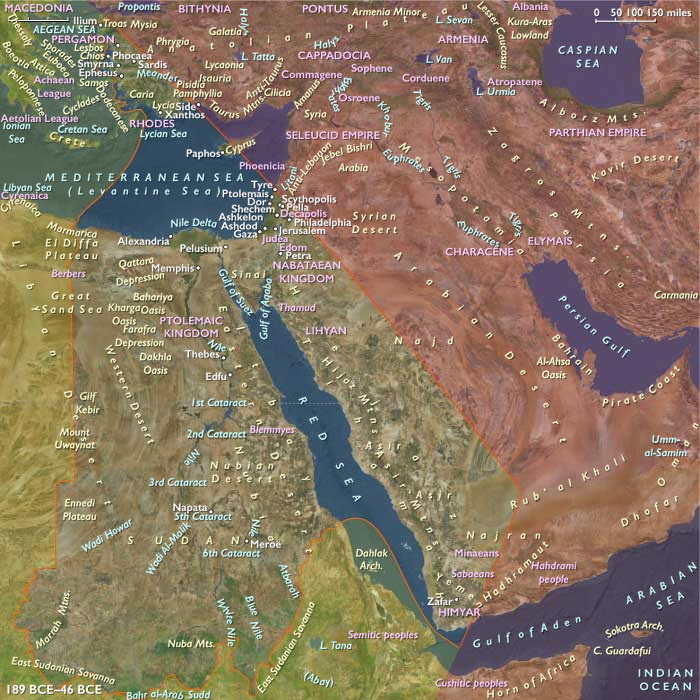
The inexorable decline of the Seleucid Empire accelerates after the death of Antiochus IV with the loss of Commagene in Syria and of Judea in Palestine.
In the narrative of I Maccabees, a book written in Hebrew by a Jewish author after the restoration of an independent Jewish kingdom, a rural Jewish priest from Modiin, Mattathias the Hasmonean, sparks a revolt against the Seleucid Empire by refusing to worship the Greek gods after Antiochus IV issues his decrees forbidding Jewish religious practice.
Mattathias kills a Hellenistic Jew who steps forward to offer a sacrifice to an idol in Mattathias' place.
He and his five sons flee to the wilderness of Judah.
After Mattathias' death about one year later in 166 BCE, his son Judah Maccabee leads an army of Jewish dissidents against the Seleucid dynasty in guerrilla warfare, which at first is directed against Hellenized Jews, of whom there are many.
The Maccabees destroy pagan altars in the villages, circumcise boys and force Jews into outlawry.
The term Maccabees as used to describe the Jewish army is taken from the Hebrew word for "hammer".
The revolt itself involves many battles, in which the Maccabean forces gain notoriety among the Seleucid army for their use of guerrilla tactics.
After the victory, the Maccabees enter Jerusalem in triumph and ritually cleanse the Temple, reestablishing traditional Jewish worship there and installing Jonathan Maccabee as high priest.
A large Seleucid army is sent to quash the revolt, but returns to Syria on the death of Antiochus.
Its commander, Lysias, preoccupied with internal Seleucid affairs, agrees to a political compromise that restores religious freedom.
People
- Antiochus IV Epiphanes
- Jonathan Apphus
- Judas Maccabee
- Lysias (Syrian Chancellor)
- Mattathias
- Wen of Han
Groups
- Polytheism (“paganism”)
- Jews
- Greeks, Hellenistic
- Seleucid Empire
- Han Dynasty (Western)
- Commagene, Kingdom of
Topics
Subjects
Regions
Subregions
Years: 165BCE - 154BCE
People
- Antiochus IV Epiphanes
- Jonathan Apphus
- Judas Maccabee
- Lysias (Syrian Chancellor)
- Mattathias
- Wen of Han
Groups
- Polytheism (“paganism”)
- Jews
- Greeks, Hellenistic
- Seleucid Empire
- Han Dynasty (Western)
- Commagene, Kingdom of
Topics
Subjects
Regions
Subregions