
Filters:
The Death and Legacy of Richard I, …
Years: 1199 - 1199
April
The Death and Legacy of Richard I, the Lionheart (1199 CE)
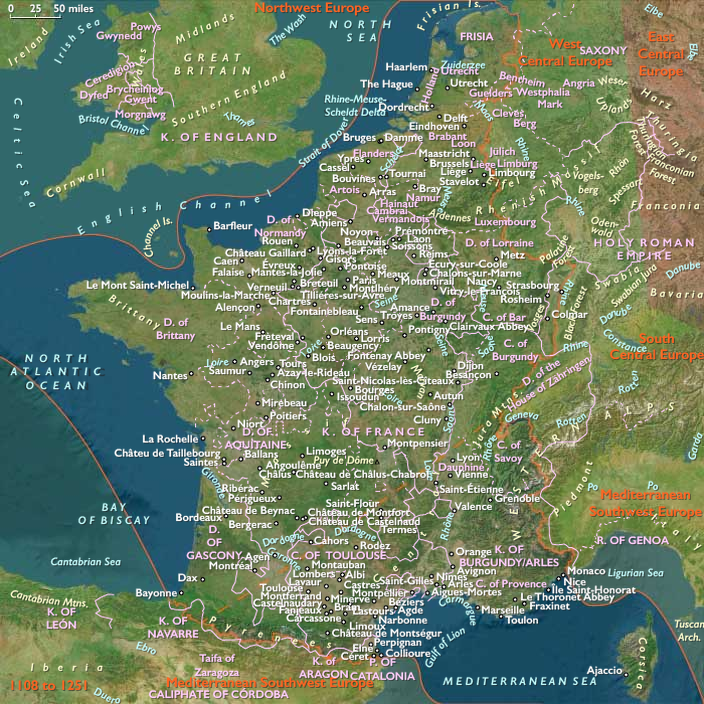
Richard I, renowned for his military prowess and crusading exploits, met his end on April 6, 1199, at the siege of Châlus-Chabrol, dying in the arms of his mother, Eleanor of Aquitaine. Though celebrated for his chivalry and battlefield skill, his reign was characterized by neglect of his kingdom, as he spent all but six months of his ten-year reign outside England, campaigning or in captivity.
Richard’s Rule: Glory in War, Neglect in Governance
- A warrior first, a ruler second, Richard excelled only in fighting, leaving the governance of England and his empire to his ministers.
- His military reputation was legendary, yet he was also immature, petulant, and politically shortsighted, failing to consolidate Angevin power against Capetian expansion.
- His constant absence drained the royal treasury, forcing England to pay a crippling ransom for his release from captivity in 1194.
Richard’s Last Act of Chivalry and Its Brutal Aftermath
- Richard’s dying act of mercy, pardoning the crossbowman who shot him, was in vain.
- As soon as Richard died, Mercadier, his ruthless mercenary captain, had the crossbowman flayed alive and hanged, in a gruesome display of medieval brutality.
The Burial of Richard I
Richard’s body was divided among three locations, following the medieval tradition of burying rulers in multiple places of significance:
- His heart was buried in Rouen, Normandy, the political center of the Angevin lands in France.
- His entrails were interred at Châlus-Chabrol, where he died.
- The rest of his body was laid to rest at the feet of his father, Henry II, in Fontevraud Abbey, Anjou, alongside his mother, Eleanor of Aquitaine.
Scientific Analysis of Richard’s Heart (2012)
- In 2012, scientists examined the preserved remains of Richard’s heart, revealing it had been embalmed with various substances, including frankincense.
- Frankincense was highly symbolic, as it was associated with both the birth and embalming of Christ, suggesting Richard wanted to be perceived as a holy warrior, akin to a martyr of the Crusades.
Richard I’s Legacy
- Glorified as a crusader king, Richard became a legendary figure in medieval romance and later folklore.
- His warfare-focused reign failed to preserve Angevin dominance in France, allowing Philip II of France to gain ground after his death.
- His shortsighted policies and excessive military spending left his brother and successor, John, a weakened realm, accelerating the collapse of Angevin power on the continent.
Though he embodied the ideals of medieval chivalry, Richard I’s reign left England heavily taxed and politically vulnerable, making him a hero in legend but a failure as a ruler.
Locations
People
- Baldwin I of Constantinople
- Eleanor of Aquitaine
- John of England
- Otto IV of Brunswick
- Philip II of France
- Richard I of England
Groups
- Navarre, Kingdom of
- Flanders, County of
- Holy Roman Empire
- France, (Capetian) Kingdom of
- Welf, House of
- Angevin Empire
- England, (Plantagenet, Angevin) Kingdom of
Topics
Commodoties
Subjects
Regions
Subregions

Years: 1199 - 1199
April
Locations
People
- Baldwin I of Constantinople
- Eleanor of Aquitaine
- John of England
- Otto IV of Brunswick
- Philip II of France
- Richard I of England
Groups
- Navarre, Kingdom of
- Flanders, County of
- Holy Roman Empire
- France, (Capetian) Kingdom of
- Welf, House of
- Angevin Empire
- England, (Plantagenet, Angevin) Kingdom of
Topics
Commodoties
Subjects
Regions
Subregions