
Rembrandt and Saskia had moved in 1639 …
Years: 1641 - 1641
Rembrandt and Saskia had moved in 1639 to a prominent house (now the Rembrandt House Museum) in the Jodenbreestraat in what is becoming the Jewish quarter; the mortgage to finance the thirteen thousand guilder purchase will be a primary cause for later financial difficulties.
He should easily have been able to pay it off with his large income, but it appears his spending always keeps pace with his income, and he may have made some unsuccessful investments.
It was here that Rembrandt frequently seeks his Jewish neighbors to model for his Old Testament scenes.
Although they are by now affluent, the couple has suffered several personal setbacks; their son Rumbartus had died two months after his birth in 1635 and their daughter Cornelia had dies at just three weeks of age in 1638.
They had a second daughter, also named Cornelia, who died in 1640 after living barely over a month.
Only their fourth child, Titus, who was born in 1641, will survive into adulthood.
Saskia will die in 1642 soon after Titus's birth, probably from tuberculosis.
Rembrandt's drawings of her on her sick and death bed are among his most moving works.
During Saskia's illness, Geertje Dircx is hired as Titus' caretaker and nurse and probably also becomes Rembrandt's lover.
She will later charge Rembrandt with breach of promise and be awarded alimony of 200 guilders a year.
Rembrandt will work o have her committed for twelve years to an asylum or poorhouse (called a "bridewell") at Gouda, after learning Geertje had pawned jewelry that had once belonged to Saskia, and which Rembrandt had given her.
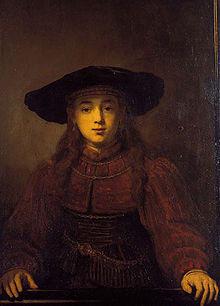
Rembrandt: The Girl in a Picture Frame, (1641) oil on canvas, 105.5 × 76 cm (41.54 × 29.92 in) Lanckoroński Collection, Warsaw Royal Castle, Warsaw
Locations
People
Groups
Topics
Subjects
Regions
Subregions
Related Events
Showing 10 events out of 32175 total
Years: 1641 - 1641
Rembrandt: The Girl in a Picture Frame, (1641) oil on canvas, 105.5 × 76 cm (41.54 × 29.92 in) Lanckoroński Collection, Warsaw Royal Castle, Warsaw
Locations
People
Groups
Topics
Subjects
Regions
Subregions