
Filters:
Austria and France, having formed an alliance …
Years: 1757 - 1757
April
Austria and France, having formed an alliance following the First Treaty of Versailles, seek to defeat the German allies in turn in 1757.
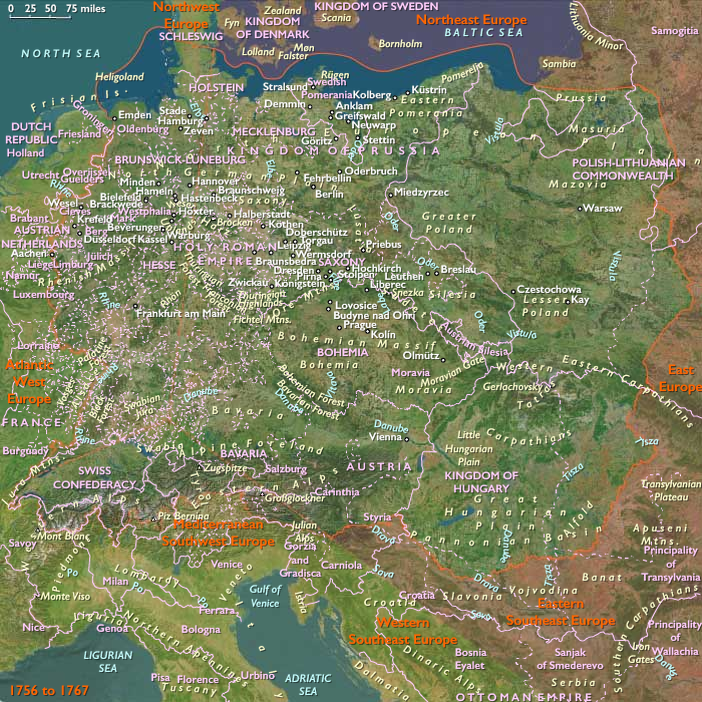
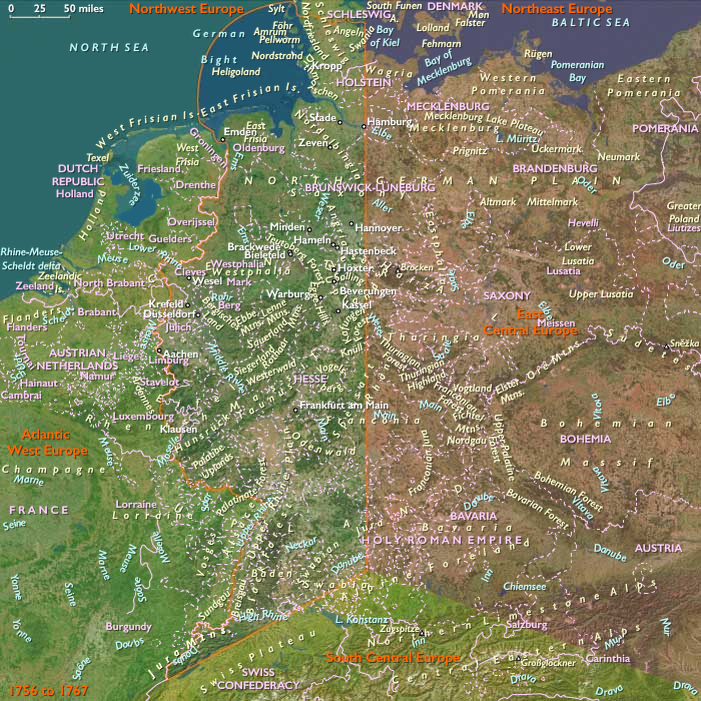
First, a major French force will sweep through Western Germany defeating and occupying Hanover, and the French will swing to attack Prussia from the west while Austria comes from the south.
France had began building up a large force known as the Army of Westphalia under Marshal Louis Charles d'Estrées.
The picture is dark for the small Kingdom of Prussia in spring 1757, with the Austrians mobilizing to attack Prussian-controlled soil and a combined French and Reichsarmee (German states) army under the Prince of Soubise approaching from the west.
The Reichsarmee is a collection of armies from the smaller German states that have banded together to heed the appeal of the Holy Roman Emperor Francis I against Frederick II.
The French, allied with Austria, Russia, Sweden and Saxony, invade Germany in April with two armies, altogether about one hundred thousand soldiers.
The French hope to draw the attention of Prussia, which is allied with Britain and Hanover, away from the Bohemian theater where Prussia and Austria will fight several battles this year (Lobositz, Prague, Kolin).
One of the two French armies under the command of Soubise marches through central Germany to join the imperial coalition army commanded by Prinz von Hildburghausen, which will have a disastrous encounter with a Prussian army at the Battle of Rossbach on November 5, 1757.
The other French army, commanded by the Duc d'Estrées, consisting of about fifty thousand infantry, ten thousand cavalry and sixty-eight cannons, advances towards the Electorate of Hanover.
As Prussia is heavily involved with its enemies Austria, Russia and Sweden and will therefore be unable able to help on the western front, this task is given to the Hanoverian Army of Observation, which has little support from Prussia, namely six Prussian battalions.
The main part of the Hanoverian Army of Observation—about sixty percent—comes from Hanover and about twenty-five percent from Hesse, with smaller additional forces from Brunswick and Prussia.
The total strength of the Hanoverian Army of Observation consists of about thirty thousand infantry, five thousand cavalry and twenty-eight guns.
Hanover refuses to defend the Rhine, which is west of the Weser.
This leaves the Prussians no choice but to abandon their fortress in Wesel and to give up the line of the Lippe in April.
First, a major French force will sweep through Western Germany defeating and occupying Hanover, and the French will swing to attack Prussia from the west while Austria comes from the south.
France had began building up a large force known as the Army of Westphalia under Marshal Louis Charles d'Estrées.
The picture is dark for the small Kingdom of Prussia in spring 1757, with the Austrians mobilizing to attack Prussian-controlled soil and a combined French and Reichsarmee (German states) army under the Prince of Soubise approaching from the west.
The Reichsarmee is a collection of armies from the smaller German states that have banded together to heed the appeal of the Holy Roman Emperor Francis I against Frederick II.
The French, allied with Austria, Russia, Sweden and Saxony, invade Germany in April with two armies, altogether about one hundred thousand soldiers.
The French hope to draw the attention of Prussia, which is allied with Britain and Hanover, away from the Bohemian theater where Prussia and Austria will fight several battles this year (Lobositz, Prague, Kolin).
One of the two French armies under the command of Soubise marches through central Germany to join the imperial coalition army commanded by Prinz von Hildburghausen, which will have a disastrous encounter with a Prussian army at the Battle of Rossbach on November 5, 1757.
The other French army, commanded by the Duc d'Estrées, consisting of about fifty thousand infantry, ten thousand cavalry and sixty-eight cannons, advances towards the Electorate of Hanover.
As Prussia is heavily involved with its enemies Austria, Russia and Sweden and will therefore be unable able to help on the western front, this task is given to the Hanoverian Army of Observation, which has little support from Prussia, namely six Prussian battalions.
The main part of the Hanoverian Army of Observation—about sixty percent—comes from Hanover and about twenty-five percent from Hesse, with smaller additional forces from Brunswick and Prussia.
The total strength of the Hanoverian Army of Observation consists of about thirty thousand infantry, five thousand cavalry and twenty-eight guns.
Hanover refuses to defend the Rhine, which is west of the Weser.
This leaves the Prussians no choice but to abandon their fortress in Wesel and to give up the line of the Lippe in April.
Locations
People
- Charles, Prince of Soubise
- Francis I, Holy Roman Emperor
- Frederick the Great
- George II of Great Britain
- Louis Charles César Le Tellier
- Louis XV of France
- Maria Theresa
- Prince Joseph of Saxe-Hildburghausen
- Prince William, Duke of Cumberland
Groups
- Austria, Archduchy of
- Brunswick-Wolfenbüttel, Duchy of
- Saxony, Electorate of
- Holy Roman Empire
- Hesse-Kassel, Landgraviate of
- Netherlands, United Provinces of the (Dutch Republic)
- France, (Bourbon) Kingdom of
- Bavaria, Electorate of
- Brunswick-Lüneburg, Electorate of (Electorate of Hanover)
- Spain, Bourbon Kingdom of
- Prussia, Kingdom of
- Britain, Kingdom of Great
- Russian Empire
Topics
Subjects
Regions
Subregions
Years: 1757 - 1757
April
Locations
People
- Charles, Prince of Soubise
- Francis I, Holy Roman Emperor
- Frederick the Great
- George II of Great Britain
- Louis Charles César Le Tellier
- Louis XV of France
- Maria Theresa
- Prince Joseph of Saxe-Hildburghausen
- Prince William, Duke of Cumberland
Groups
- Austria, Archduchy of
- Brunswick-Wolfenbüttel, Duchy of
- Saxony, Electorate of
- Holy Roman Empire
- Hesse-Kassel, Landgraviate of
- Netherlands, United Provinces of the (Dutch Republic)
- France, (Bourbon) Kingdom of
- Bavaria, Electorate of
- Brunswick-Lüneburg, Electorate of (Electorate of Hanover)
- Spain, Bourbon Kingdom of
- Prussia, Kingdom of
- Britain, Kingdom of Great
- Russian Empire
Topics
Subjects
Regions
Subregions