
Relations between East and West have long …
Years: 1048 - 1059
Relations between East and West have long been embittered by ecclesiastical differences and theological disputes.
Prominent among these are the issues of the source of the Holy Spirit (filioque), whether leavened or unleavened bread should be used in the Eucharist, the Pope's claim to universal jurisdiction, and the place of Constantinople in relation to the Pentarchy.
The East–West Schism—one of the two schisms to which the term "Great Schism" is applied (the other being the Western Schism)—is the medieval division of Chalcedonian Christianity into Eastern (Greek) and Western (Latin) branches, which will later become commonly known as the Eastern Orthodox Church and the Roman Catholic Church, respectively.
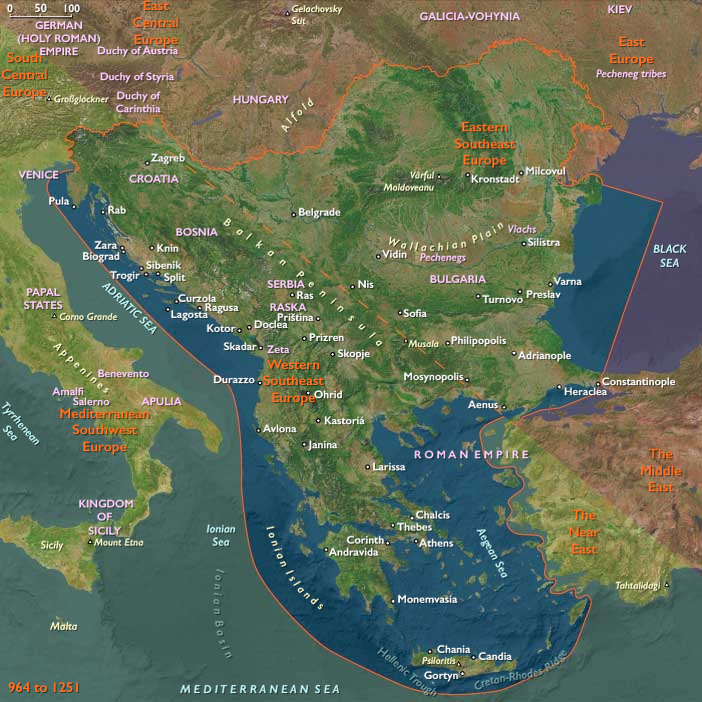
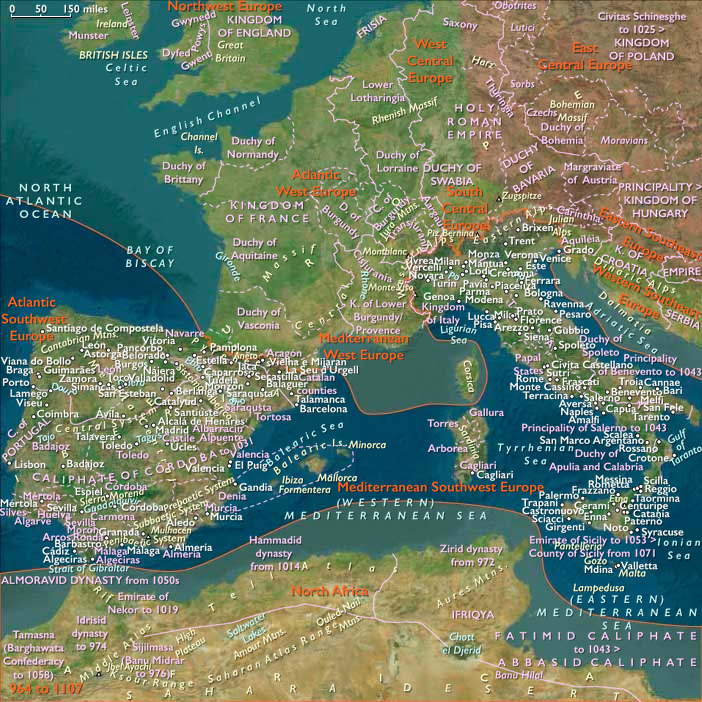
The first step is taken in the process that leads to formal schism in 1053 when Patriarch of Constantinople Michael Cerularius orders the closure of all Latin churches in Constantinople.
The Papal legate travels to Constantinople in 1054 for purposes that include refusing to Cerularius the title of "Ecumenical Patriarch" and insisting that he recognize Rome's claim to be the head and mother of the churches.
The main purpose of the papal legation is twofold: firstly, to seek help from the Eastern Emperor in view of the Norman conquest of southern Italy; secondly, to deal with recent attacks by Leo of Ohrid against the use of unleavened bread and other Western customs, attacks that have the support of Cerularius (Michael Caerularius).
Historian Axel Bayer says the legation was sent in response to two letters, one from the Emperor seeking assistance in arranging a common military campaign by the eastern and western empires against the Normans, and the other from Cerularius.
On the refusal of Cerularius to accept the demand, the leader of the legation, Cardinal Humbert, excommunicates him, and in return Cerularius excommunicates Cardinal Humbert and the other legates.
This is only the first act in a centuries-long process that eventually becomes a complete schism between the two discrete and often antagonistic confessions.
People
Groups
- Christianity, Chalcedonian
- Papal States (Republic of St. Peter)
- Roman Empire, Eastern: Macedonian dynasty
- Christians, Roman Catholic
- Christians, Eastern Orthodox
- Christians, Eastern Catholic (Uniate)
- Roman Empire, Eastern: Non-dynastic and Comnenid dynasty
- Roman Empire, Eastern: Doukid dynasty
Topics
Subjects
Regions
Subregions
Years: 1048 - 1059
People
Groups
- Christianity, Chalcedonian
- Papal States (Republic of St. Peter)
- Roman Empire, Eastern: Macedonian dynasty
- Christians, Roman Catholic
- Christians, Eastern Orthodox
- Christians, Eastern Catholic (Uniate)
- Roman Empire, Eastern: Non-dynastic and Comnenid dynasty
- Roman Empire, Eastern: Doukid dynasty
Topics
Subjects
Regions
Subregions