
The Coronation of Charles VII at Reims …
Years: 1429 - 1429
The Coronation of Charles VII at Reims and the Stalled March on Paris (July 1429)
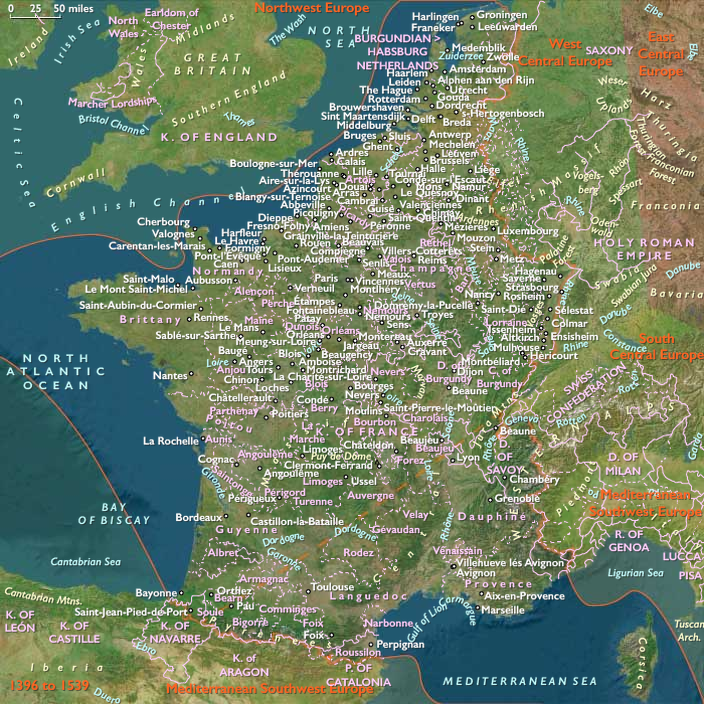
On July 16, 1429, Joan of Arc and the French army arrived at Reims, where the city opened its gates without resistance, recognizing the momentum of the French cause. The following morning, July 17, Charles VII was crowned King of France, fulfilling Joan’s divine mission and marking a critical turning point in the Hundred Years’ War.
Despite this triumph, Joan and the Duke of Alençon urged an immediate march on Paris, but the royal court, preferring diplomacy, pursued negotiations with Philip the Good, Duke of Burgundy. However, Philip used the truce as a stalling tactic, allowing him to reinforce Paris in anticipation of a French attack.
I. The Coronation at Reims (July 17, 1429)
- Joan of Arc had long insisted that Charles VII must be crowned in Reims, the traditional site of French royal coronations since 816.
- With the city welcoming the French army, Charles VII’s long-delayed coronation took place on July 17, 1429.
- Joan stood beside Charles during the ceremony, signaling that her mission had been fulfilled and reinforcing the divine legitimacy of his reign.
II. Joan’s Urging for an Immediate March on Paris
- Fresh off their victory, Joan and the Duke of Alençon wanted to strike Paris without delay, taking advantage of English and Burgundian weakness.
- Paris, still held by the Anglo-Burgundian forces, was the true prize, as its capture would cement Charles VII’s rule.
- Joan believed that God’s favor was still with the French army, and that hesitation would allow their enemies to recover.
III. The Royal Court’s Truce with Burgundy and Philip the Good’s Deception
- Instead of pressing the advantage, Charles VII’s royal advisors sought negotiations with Philip the Good, Duke of Burgundy.
- A truce was arranged, theoretically aimed at preventing further conflict between Burgundy and France.
- However, Philip the Good used the truce as a ruse, deliberately delaying negotiations while reinforcing the defenses of Paris.
- By the time Charles VII was ready to march on Paris, the city was heavily fortified, making an attack far more difficult than it would have been immediately after Reims.
IV. Consequences: A Lost Opportunity
- The coronation at Reims was a major psychological and political victory, legitimizing Charles VII’s rule.
- However, the delay in attacking Paris allowed the Anglo-Burgundian forces to regroup, weakening the French momentum.
- Joan’s frustration with the royal court’s hesitation would soon lead to her greatest military disappointment—the failed attack on Paris in September 1429.
The coronation of Charles VII at Reims (July 17, 1429) marked the high point of Joan of Arc’s military career, but the truce with Burgundy proved to be a costly mistake, allowing the enemy to strengthen Paris while the French court hesitated.
Locations
People
Groups
- Normandy, Duchy of
- Burgundy, Duchy of
- Christians, Roman Catholic
- Scotland, Kingdom of
- France, (Valois) Kingdom of
- England, (Plantagenet, Lancastrian) Kingdom of
Topics
- Hundred Years' War
- Armagnac-Burgundian Civil War
- Hundred Years' War: Resumption of the war under Henry V
- Hundred Years' War: French Victory
Commodoties
Subjects
Regions
Subregions

Years: 1429 - 1429
Locations
People
Groups
- Normandy, Duchy of
- Burgundy, Duchy of
- Christians, Roman Catholic
- Scotland, Kingdom of
- France, (Valois) Kingdom of
- England, (Plantagenet, Lancastrian) Kingdom of
Topics
- Hundred Years' War
- Armagnac-Burgundian Civil War
- Hundred Years' War: Resumption of the war under Henry V
- Hundred Years' War: French Victory
Commodoties
Subjects
Regions
Subregions