
Regiomontanus (originally named Johann Müller) had become …
Years: 1464 - 1464
Regiomontanus (originally named Johann Müller) had become a student at the university in Leipzig, Saxony, at the age of eleven.
Continuing his studies at Alma Mater Rudolfina, the university in Vienna, Austria, in 1451, he became a pupil and friend of Georg von Peuerbach.
Graduating in 1452 with a Baxchelor of Arts degree, he had been awarded his magister artium (Master of Arts) at the age of twenty-one in 1457.
It is known that he held lectures in optics and ancient literature.
Regiomontanus had continued to work with Peuerbach, learning and extending the then known areas of astronomy, mathematics and instrument making until Peuerbach's death in 1461.
In 1460, the papal legate Basilios Bessarion had come to Vienna on a diplomatic mission.
Being a humanist scholar and great fan of the mathematical sciences, Bessarion had sought out Peuerbach's company.
George of Trebizon, who is Bessarion's philosophical rival, had recently produced a new Latin translation of Ptolemy's Almagest from the Greek, which Bessarion, correctly, regarded as inaccurate and badly translated, so he had asked Peuerbach to produce a new one.
Peuerbach's Greek was not good enough to do a translation but he knew the Almagest intimately, so instead he started work on a modernized, improved abridgment of the work.
Bessarion had also invited Peuerbach to become part of his household and to accompany him back to Italy when his work in Vienna was finished.
Peuerbach had accepted the invitation on the condition that Regiomontanus could also accompany them.
However Peuerbach had fallen ill in 1461 and died only having completed the first six books of his abridgement of the Almagest.
On his deathbed, Peuerbach made Regiomontanus promise to finish the book and publish it.
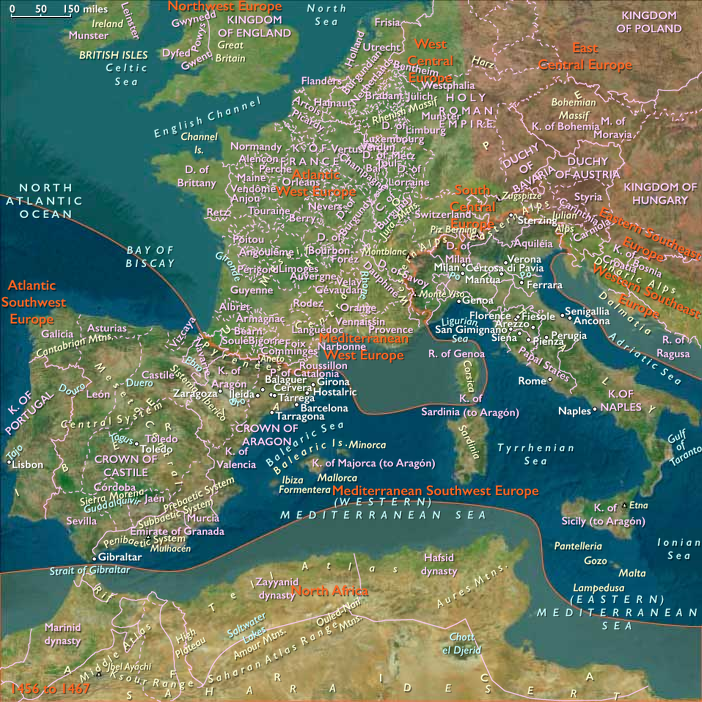
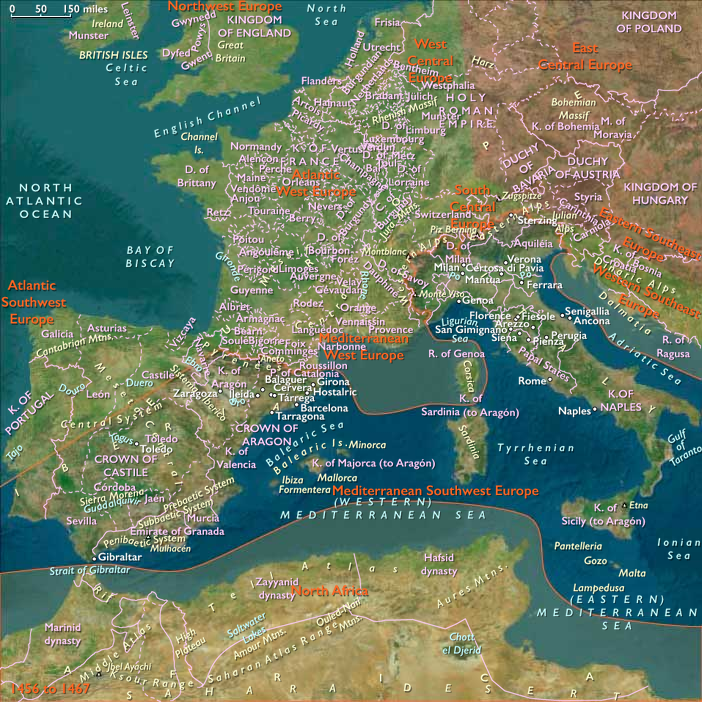
Leaving Vienna with Bessarion in 1461, Regiomontanus has spent the past four years traveling around northern Italy as a member of Bessarion's household, looking for and copying mathematical and astronomical manuscripts for Bessarion, who possesses the largest private library in Europe at this time.
Regiomontanus has also made the acquaintance of the leading Italian mathematicians of the age, such as Giovanni Bianchini and Paolo dal Pozzo Toscanelli, who had also been friends of Peuerbach during his prolonged stay in Italy more than twenty years earlier.
During his time in Italy, he completes Peuerbach's Almagest abridgment, Epytoma in almagesti Ptolemei.Regiomontanus notes that Ptolemy's lunar theory requires the apparent diameter of the Moon to vary in length much more than is actually observed.
In 1464, he completes De Triangulis omnimodus.
De Triangulis (On Triangles) is one of the first textbooks presenting the current state of trigonometry and includes lists of questions for review of individual chapters.
In it he writes: You who wish to study great and wonderful things, who wonder about the movement of the stars, must read these theorems about triangles. Knowing these ideas will open the door to all of astronomy and to certain geometric problems.
His work on arithmetic and algebra, Algorithmus Demonstratus, is among the first containing symbolic algebra.
Locations
People
Groups
Topics
Subjects
Regions
Subregions
Years: 1464 - 1464
Locations
People
Groups
Topics
Subjects
Regions
Subregions