Regiomontanus moves in 1471 to the Free …
Years: 1471 - 1471
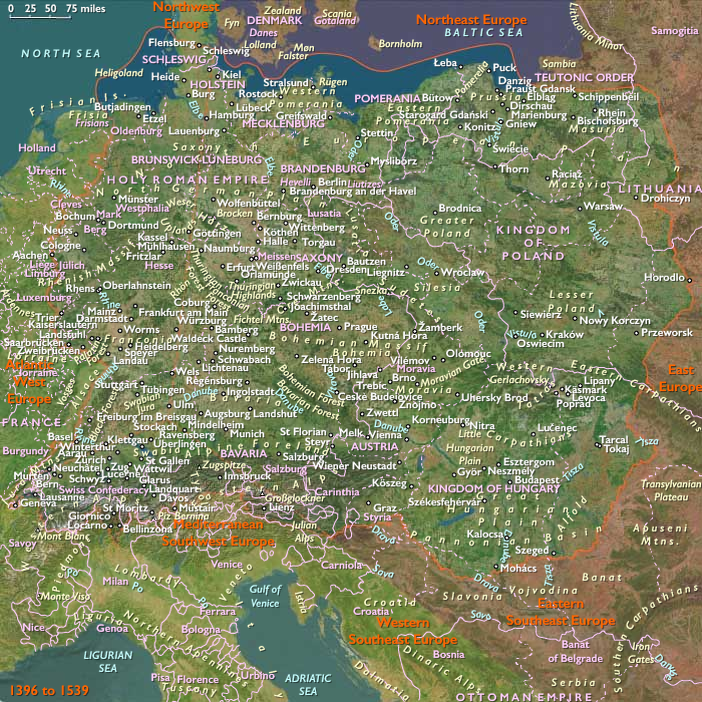
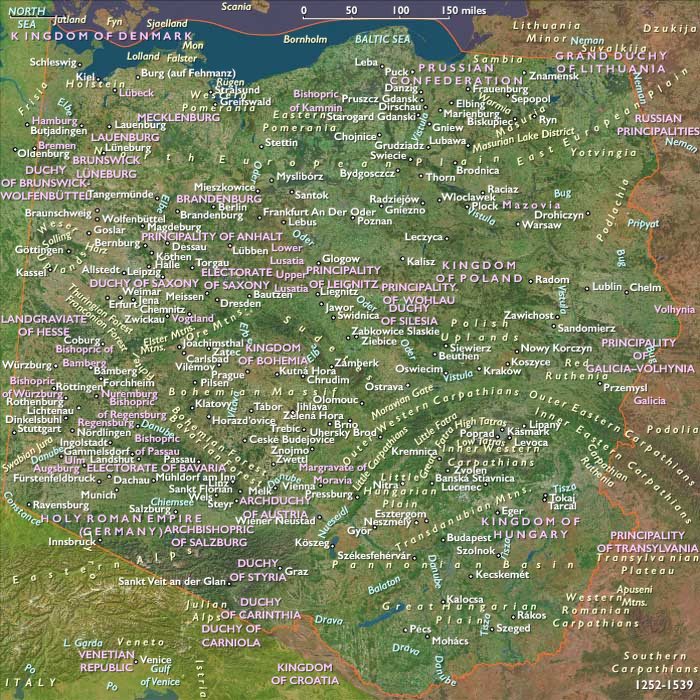
Regiomontanus moves in 1471 to the Free City of Nuremberg, in Franconia, at this time one of the Empire's important seats of learning, publication, commerce and art, where he works with the humanist and merchant Bernhard Walther.
Here he founds the world's first scientific printing press.
Locations
People
Groups
Topics
Subjects
Regions
Subregions
Related Events
Filter results
Showing 10 events out of 40913 total
Civil warfare in the kingdom of Champa has resulted in five different rulers in little more than two decades.
Lê Thánh Tông, the ruler of Dai Viet, or Annam, launches a bloody campaign against the Chams in 1471, seizing and pillaging the Cham capital of Vijaya (Binh Dinh), killing about forty thousand Chams, and capturing thirty thousand more, including fifty members of the royal family.
Champa’s king is slain and most of its territory incorporated into Vietnamese, or Annamese, territory, leaving only a small, weak Cham kingdom in the south as a buffer state between the Vietnamese and the Khmers.
Sten Sture had been elected as Lord Protector of Sweden by the Riksmöte in Arboga in May 1471.
Advocating Swedish secession from the Kalmar Union, Herr Sten as he is known, has garnered large support.
In particular his followers are to be found among the peasantry, in Stockholm and in the Bergslagen mining region.
The latter region's trade with German cities such as Lübeck had often placed its residents in conflict with Union's Danish foreign policy.
In response to the election of Sture, Christian I sails to Sweden with a military force, intending to unseat him as Lord Protector.
Mooring his ships off Skeppsholmen in Stockholm, he sets up camp on Brunkebergsåsen, a ridge a short distance north of Stockholm (at the time Stockholm is restricted to the island containing the Old Town).
On Thursday, October 10, Sten Sture and Nils Bossom Sture lead their troops north to the area which is Hötorget in Stockholm today, near Brunkeberg.
Sten Sture's battle plan is to catch Christian's troops in a vice; Sten attacks from the west, Nils from the east, and Knut Posse strike south from the city itself.
In the ensuing battle, Christian is hit in the face by musket fire.
Losing several teeth, he is forced to retire from battle.
The decisive turn of battle in favor of Sture's side occurs when Nils' troops break out of the forest north of the ridge, as Posse's troops attack from the city.
This cuts off a contingent of Danish troops at the Klara monastery north of the town.
Christian retires with his troops towards the island of Käpplingen (today the Blasieholmen peninsula); however, Sten's troops destroy the makeshift bridge Christian's troops had built, causing many to drown.
The battle ends in a victory for Sten Sture, whose power as regent of Sweden is thus secured and will remain so for the rest of his life.
According to legend, Sture had prayed to Saint George before the battle.
He later paid tribute to Saint George by commissioning a statue of Saint George and the Dragon carved by the Lübeck sculptor Bernt Notke for the Storkyrkan church in Stockholm, as an obvious allegory of Sture's battle against Christian.
An altar dedicated to Saint George was also built in the church.

The excommunicated George of Podébrady, to preserve his imperiled throne, enters into negotiations with Polish King Casimir IV, sacrificing his sons’ succession rights and naming the Polish king’s young son as his successor.
In the midst of the struggle with the papacy, the Catholic nobles, and Hungarian monarch Matthias Corvinus, the Catholic nobility’s choice for king of Bohemia, George dies on March 22, 1471.
On May 27, King Casimir’s fifteen-year-old son is chosen king of Bohemia as Uladislas (or Vladislav) II.
Matthias had been staying in Moravia when he was informed that a group of Hungarian prelates and barons had offered the throne to Casimir, a younger son of King Casimir IV of Poland.
The conspiracy had been initiated by Archbishop John Vitéz and his nephew Janus Pannonius, Bishop of Pécs, who oppose war against the Catholic Vladislaus Jagiellon.
Initially, their plan had been supported by the majority of the Estates, but nobody dares to rebel against Matthias, enabling him to return to Hungary without resistance.
Matthias holds a Diet and promises to refrain from levying taxes without the consent of the Estates and to convoke the Diet in each year.
His promises remedy most of the Estates' grievances and almost fifty barons and prelates confirm their loyalty to him on September 21.
The Ottomans have meanwhile seized the Hungarian forts along the river Neretva.
Matthias nominates the wealthy baron Nicholas Újlaki as King of Bosnia in 1471, entrusting the defense of the province to him.
Uzun Hassan, head of the Aq Qoyunlu Turkmens, proposed an anti-Ottoman alliance to Matthias but he refrained from attacking the Ottoman Empire.
Casimir Jagiellon invades on October 2, 1471.
With Bishop Janus Pannonius's support, he seizes Nyitra (now Nitra in Slovakia), but only two Hungarian barons, John Rozgonyi and Nicholas Perényi, join him.
Stephen and Radu confront each other in 1471 in Moldavia, where the latter is defeated.
Meanwhile, Genoa, which possesses several colonies in the Crimea, has begun to worry about Stephen's growing influence in the region, and orders her colonies to do whatever is needed to revenge past mischief from which the Genovese had allegedly suffered.
The colonies in turn urge the Tatars to attack Moldavia.
Later this year, the Tatars invade the country from the north, causing great damage to the land and enslaving many.
Stephen replies by invading Tatar territory with Polish assistance.
The Venetian Senate, seeking allies in its war against the Ottomans, had in 1463 sent Lazzaro Querini as its first ambassador to Tabriz, but he had been unable to persuade Uzun Hasan to attack the Ottomans.
Hasan had sent his own envoys to Venice in return.
In 1471, Querini returns to Venice with Hasan's ambassador Murad.
The Venetian Senate votes to send another to Azerbaijan, choosing Caterino Zeno after two other men decline.
Zeno, whose wife is the niece of Uzun Hasan's wife Despina Khatun, is able to persuade Hasan to attack the Turks.
Uzun Hasan invades Anatolia with the support of many Turkmen princes who had been dispossessed by Mehmed.
Hasan is successful at first, meeting the Ottomans in battle near Erzincan in 1471, but there are no simultaneous attacks by any of the western powers.
The Three Leagues is the alliance of the League of God's House, the League of the Ten Jurisdictions and the Grey League in 1471, which will lead eventually to the formation of the Swiss canton of Graubünden.
The current settlement of the Davos area started back in High Middle Ages with the immigration of Rhaeto-Romans.
Most of the lands of Graubünden had been part of the Roman province Raetia in 15 BCE.
The area later became part of the lands of the Bishopric of Chur.
A mile-high town comprising two villages, Davos-Platz and Davos-Dorf, in present Grisons canton, eastern Switzerland, it is first mentioned in written records in 1213 as Tavaus.
The barons of Vaz had allowed German-speaking Walser colonists to settle from about 1280, and conceded them extensive self-administration rights, causing Davos to become the largest Walser settlement area in eastern Switzerland.
The League of the Ten Jurisdictions, the last of the Three Leagues founded during the Middle Ages in what is now Canton Graubünden of Switzerland, was founded in Davos in 1436.
Operations in the Ottoman-Venetian War had been reduced mostly to isolated ravages and guerrilla attacks, until the Ottomans mounted a massive counteroffensive in 1470: this has Venice losing its main stronghold in the Aegean Sea, Negroponte.
The Venetians seek an alliance with the chief of the Ak Qoyunlu Turkmen confederation, with the Karamanids and with other European powers, but, receiving only limited support, can make only small-scale attacks at Antalya, Halicarnassus and Smirne.
However, the Ottomans conquer the Peloponnesus and launch an offensive in Venetian mainland, closing in on the important center of Udine.
The Turkmen, together with the Karamanian amir, are severely defeated at Terdguin, and the Republic is left alone.