
The Japanese capital was customarily moved after …
Years: 676 - 819
The Japanese capital was customarily moved after the death of an emperor, before the Taiho Code was established, because of the ancient belief that a place of death was polluted.
Reforms and bureaucratization of government led to the establishment of a permanent imperial capital at Heijokyo, or Nara, in 710. (Previously the capital had been about twenty-five kilometers south of Nara, in and around Asuka, the name given by some historians to the pre-Nara period [538-710] and art style.)
The capital at Nara, which gives its name to the new period (710-94), is styled after the grand Chinese Tang Dynasty (618-907) capital at Chang' an and is the first truly urban center in Japan.
It soon has a population of two hundred thousand, representing nearly our percent of the country's population, and some ten thousand people work in government jobs.
Locations
Groups
- Confucianists
- Japanese people
- Buddhists, Zen or Chán
- Japan, Yamato Hakuho (Late Asuka) Period
- Japan, Nara Period
Topics
Subjects
Regions
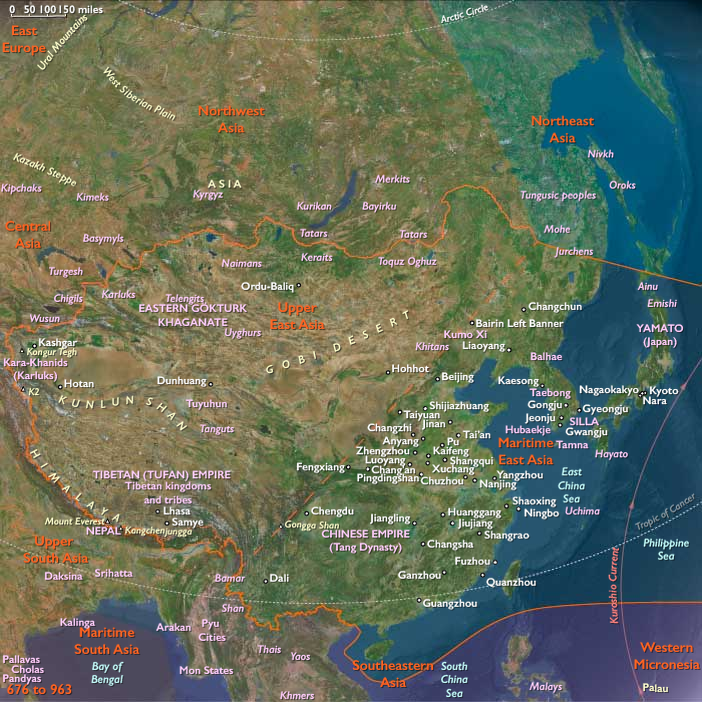
Subregions
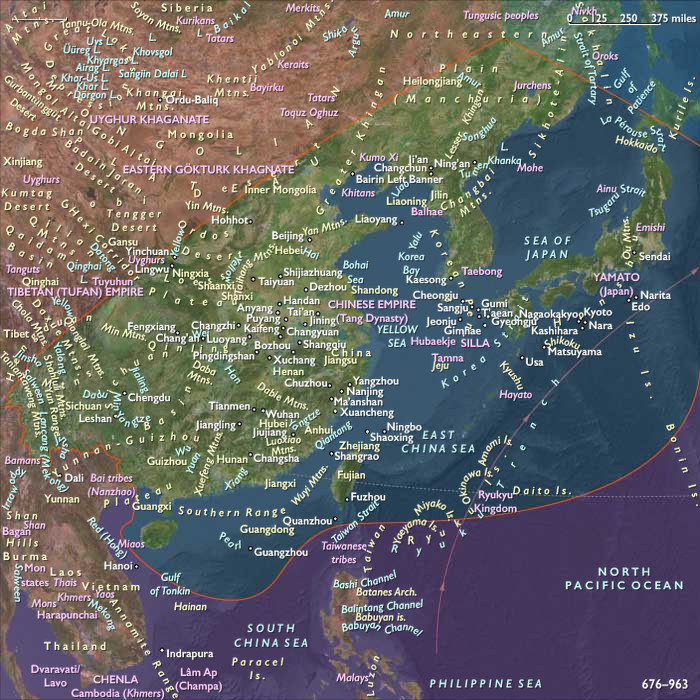
Years: 676 - 819
Locations
Groups
- Confucianists
- Japanese people
- Buddhists, Zen or Chán
- Japan, Yamato Hakuho (Late Asuka) Period
- Japan, Nara Period
Topics
Subjects
Regions
Subregions