
Rebellions break out during the winter in …
Years: 731 - 731
July
Rebellions break out during the winter in the region south of the Oxus, in Tokharistan, which has hitherto been quiescent to Muslim rule.
Junayd is forced to set out for Balkh and there disperses twenty-eight thousand of his men to quell the revolt.
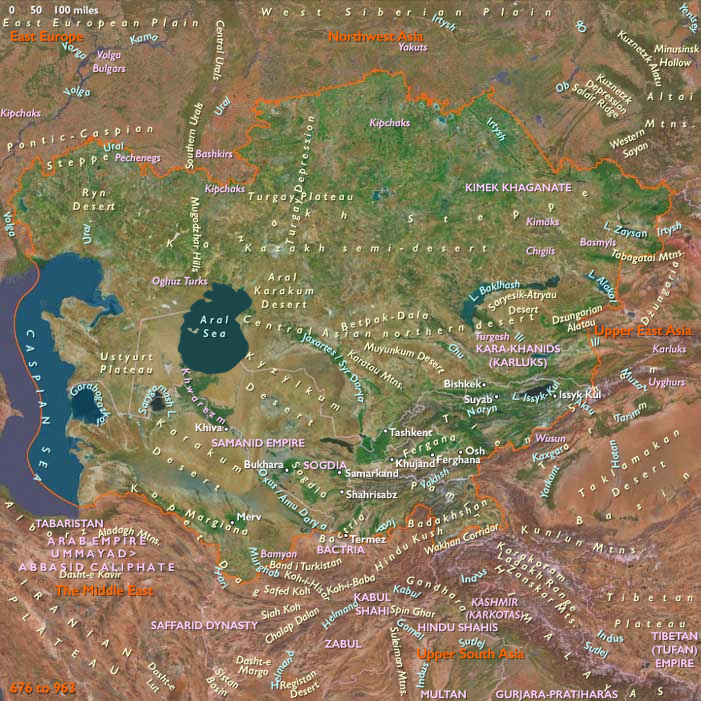
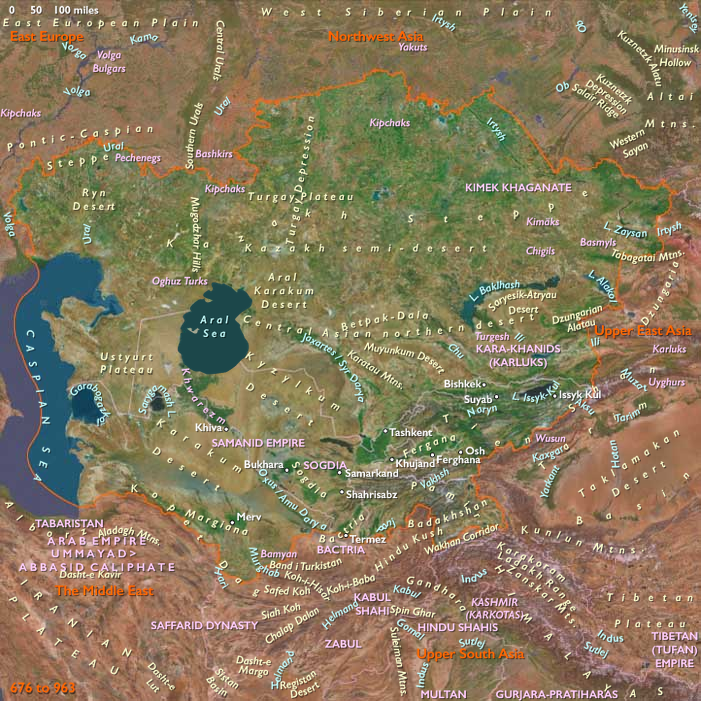
This leaves him seriously weakened when, in early 731, the Turgesh lay siege to Samarkand and appeals for aid arrive from the city's governor, Sawra ibn al-Hurr al-Abani.
Despite the opinion of the army's veteran Khurasani leaders, who counsel that he should wait to reassemble his forces and not cross the Oxus with less than fifty thousand men, Junayd resolves to march immediately to Samarkand's rescue.
Junayd cannot advance along the old Persian Royal Road, which leads from Bukhara east to Samarkand and which is held by the Turgesh.
Instead he leads his army to Kish, some seventy kilometers (forty-three miles) due south from Samarkand.
Here he receives news from his scouts that the Turgesh had sent detachments of their own to spoil the wells on his line of march.
His counselors initially suggest a route west around the mountains of the Zarafshan Range between Kish and Samarkand through the village of al-Muhtaraqah.
However, al-Mujashshir ibn Muzahim al-Sulami, one of the Khurasani leaders, advises against it since the Turgesh could easily set fire to the grass on that route, and favors a more direct approach over the steep but short (some two kilometers [1.2 miles] long) Tashtakaracha Pass, hopeful of catching the Turgesh by surprise.
Junayd follows the latter counsel, and encamps before the entrance of the pass.
The decision is unpopular with the army, largely Khurasanis who distrust the "outsider" Junayd, and some begin deserting.
Undeterred, Junayd presses on with some twenty-eight thousand men.
The subsequent Battle of the Defile between the Umayyads and the Turgesh, following the similarly costly defeat at the Battle of Marj Ardabil against the Khazars, results in additional heavy casualties for the Umayyad army, halting Muslim expansion in Central Asia for almost two decades.
As his battered army exits the defile, his officers persuade him to make camp and spend the night there.
The camp's fortifications cannot be completed before the next day, when the Turgesh renew their attack.
At this point, the Arabs are so hard-pressed that Junayd even promises the army's slaves their freedom if they will fight.
Many do so, using saddle blankets as armor.
The Turgesh attacks are repelled, and despite the heavy casualties the Umayyad army reaches Samarkand after almost three days of battle.
Locations
People
Groups
- Iranian peoples
- Arab people
- Sogdia
- Transoxiana
- Tokharistan (Kushan Bactria)
- Khorasan, Greater
- Oghuz Turks
- Islam
- Muslims, Sunni
- Khazar Khaganate
- Umayyad Caliphate (Damascus)
- Türgesh Kaganate
Topics
Commodoties
Subjects
Regions
Subregions
Years: 731 - 731
July
Locations
People
Groups
- Iranian peoples
- Arab people
- Sogdia
- Transoxiana
- Tokharistan (Kushan Bactria)
- Khorasan, Greater
- Oghuz Turks
- Islam
- Muslims, Sunni
- Khazar Khaganate
- Umayyad Caliphate (Damascus)
- Türgesh Kaganate
Topics
Commodoties
Subjects
Regions
Subregions