Razin, sailing into the Caspian Sea, has …
Years: 1669 - 1669
August
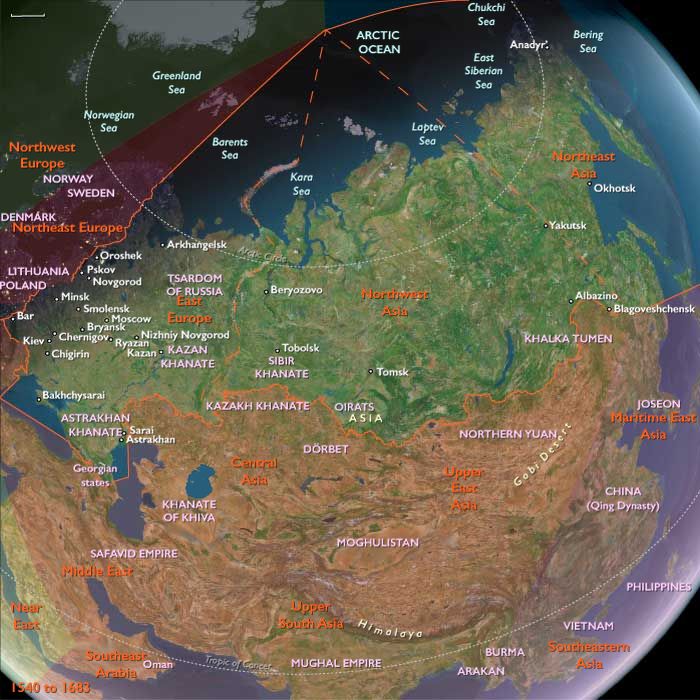
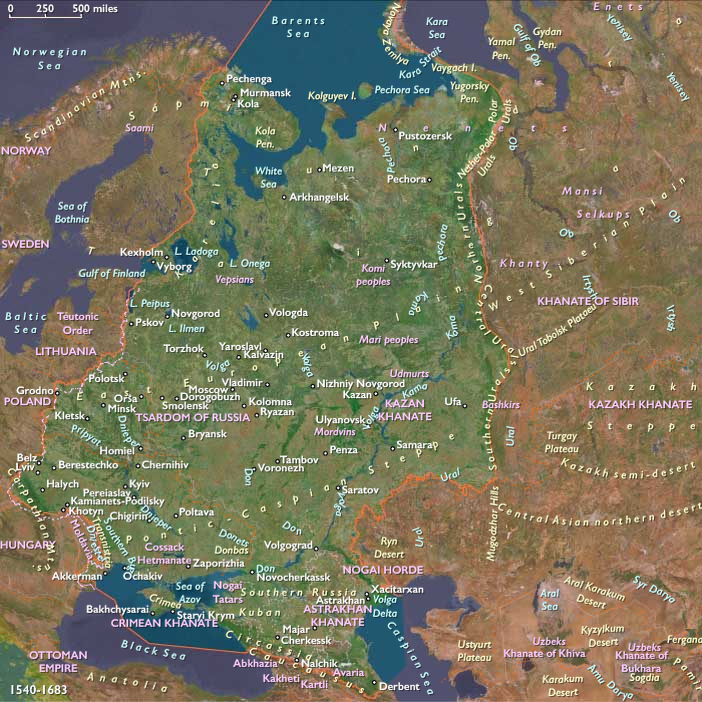
Razin, sailing into the Caspian Sea, has ravaged the Persian coasts from Derbend to Baku, massacred the inhabitants of the great emporium of Rasht, and in the spring of 1669 establishes himself on the isle of Suina, off which, in July, he annihilates a Persian fleet sent against him.
Stenka Razin, as he is generally called, has now become a potentate with whom princes did not disdain to treat.
He reappears in August 1669 at Astrakhan, here accepting a fresh offer of pardon from tsar Aleksey Mikhailovich; the common people are fascinated by his adventures.
The lawless Russian border region of Astrakhan, where the whole atmosphere is predatory and many people are still nomadic, is the natural milieu for such a rebellion as Razin's.
Locations
People
Groups
Topics
Commodoties
Subjects
Regions
Subregions
Related Events
Filter results
Showing 6 events out of 6 total
Osei Tutu (d. 1712 or 1717) becomes asantehene (king of Asante) at the end of the seventeenth century.
Under Osei Tutu's rule, the confederacy of Asante states is transformed into an empire with its capital at Kumasi.
Political and military consolidation ensue, resulting in firmly established centralized authority.
Osei Tutu is strongly influenced by the high priest, Anokye, who, tradition asserts, caused a stool of gold to descend from the sky to seal the union of Asante states.
Stools already functioned as traditional symbols of chieftainship, but the Golden Stool of Asante represents the united spirit of all the allied states and establishes dual allegiance that superimposes the confederacy over the individual component states.
The Golden Stool remains a respected national symbol of the traditional past and figures extensively in Asante ritual.
Osei Tutu permits newly conquered territories that join the confederation to retain their own customs and chiefs, who are given seats on the Asante state council.
Osei Tutu's gesture makes the process relatively easy and nondisruptive because most of the earlier conquests had subjugated other Akan peoples.
Within the Asante portions of the confederacy, each minor state continues to exercise internal self-rule, and its chief jealously guards the state's prerogatives against encroachment by the central authority.
A strong unity develops, however, as the various communities subordinate their individual interests to central authority in matters of national concern.
By the mid-eighteenth century, Asante is a highly organized state.
The wars of expansion that bring the northern states of Mamprusi, Dagomba, and Gonja under Asante influence are won during the reign of Asantehene Opoku Ware I (d. 1750), successor to Osei Tutu.
By the 1820s, successive rulers have extended Asante boundaries southward.
Although the northern expansions link Asante with trade networks across the desert and in Hausaland to the east, movements into the south bring the Asante into contact, sometimes antagonistic, with the coastal Fante, Ga-Adangbe, and Ewe peoples, as well as with the various European merchants whose fortresses dot the Gold Coast.
He, along with the Asante Queen Nanny or Nana, both plan to take over Jamaica from the British to be a separate Black country, but for themselves and not as allies.
Before being a slave, he had been a king of his village.
He himself recalled selling his rivals of the Ashanti, Nzema and Ahanta; other Akan states, off into slavery as spoils of war to the British, but ironically, he had become enslaved himself when a rival state defeated his army in battle and sold him off to Jamaica as well.
According to J.A. Jones, who claimed to have met him while being held captive by Tacky while trying to get an interview with him, in his memoirs he wrote that Tacky spoke very fluent English (which is indeed common for the ruling class of Fantes at this time).
Also according to Jones, he was discovered in a cave a year before the rebellion took place, planning with his comrades: Quaw(twi Yaw), Sang, Sobadou(twi Sobadu), Fula Jati and Quantee(twi Kwarteng). all except Fula Jati being of Akan descent.
Sometime before daybreak on a Monday in May, Tacky and his followers began the revolt and easily took over the Frontier and Trinity plantations while killing their masters.
Bolstered by their easy success, they make their way to the storeroom at Fort Haldane where the munitions to defend the town of Port Maria are kept.
After killing the storekeeper, Tacky and his men steal nearly four barrels of gunpowder and forty firearms with shot, before marching on to overrun the plantations at Heywood Hall and Esher
By dawn, hundreds of other slaves hav joined Tacky and his followers.
At Ballard's Valley, the rebels stop to rejoice in their success.
One slave from Esher decides to slip away and sound the alarm.
Obeahmen (Caribbean shamans) quickly circulate around the camp dispensing a powder that they claim will protect the men from injury in battle and loudly proclaim that an Obeahman cannot be killed.
Confidence is high.
Soon there are seventy to eighty mounted militia on their way along with some Maroons from Scott's Hall, who are bound by treaty to suppress such rebellions.
When the militia learn of the Obeahman's boast of not being able to be killed, an Obeahman is captured, killed and hung with his mask, ornaments of teeth and bone and feather trimmings at a prominent place visible from the encampment of rebels.
Many of the rebels, confidence shaken, return to their plantations.
Tacky and twenty-five or so men decide to fight on.
Tacky and his men run through the woods being chased by the Maroons and their legendary marksman, Davy.
While running at full speed, Davy shoots Tacky and cuts off his head as evidence of his feat, for which he will be richly rewarded.
Tacky's head is later displayed on a pole in Spanish Town until a follower takes it down in the middle of the night.
The rest of Tacky's men are found in a cave near Tacky Falls, having committed suicide rather than going back to slavery.
Other rebellions break out all over Jamaica, many of which are rightly or wrongly attributed to Tacky's cunning and strategy.
It will be months until peace is restored.
Over sixty white people lose their lives as well as four hundred or so black slaves, including two ringleaders who are burned alive, and two others who are hung in iron cages at the Kingston Parade, until they starve to death.
Towards the start of the rebellion, it had been discovered that slaves in Kingston had elected a female Ashanti slave named Cubah (a British misnomer of the Akan day name "Akua") the rank of 'Queen of Kingston'.
Cubah (Akua) sat in state under a canopy at their meetings, wearing a robe and a crown.
It is unknown whether there was any direct communication between Cubah's people and Tacky's but when discovered, she had been ordered to be transported from the island for conspiracy to rebel.
While at sea, she had bribed the captain of the ship to put her ashore in western Jamaica where she had joined the leeward rebels and remained at large for months.
On being recaptured, she is executed.
The British had been drawn into three earlier wars in the Gold Coast:
In the Ashanti-Fante War of 1806–07, the British had refused to hand over two rebels pursued by the Ashanti, but eventually handed one over (the other escaped).
In the Ga-Fante War of 1811, the Akwapim had captured a British fort at Tantamkweri and a Dutch fort at Apam.
In the Ashanti-Akim-Akwapim War of 1814–16, the Ashanti had defeated the Akim-Akwapim alliance.
Local British, Dutch, and Danish authorities all had to come to terms with the Ashanti.
By 1817, the Ashanti, who had an army of twenty thousand, had become the strongest power in West Africa, so the (British) African Company of Merchants had signed a treaty of friendship that recognized Ashanti claims to sovereignty over much of the coast.
The African Company of Merchants was dissolved in 1821 and the British assumed control of the Gold Coast.
By the 1820s the British had decided to support one of the other tribes, the Fante, enemies of the Ashanti.
Inland, the Ashanti kings who ruled from the Golden Stool—said to have come from their great god guardian of the Ashanti soul, "Nyame"—will not allow themselves to be governed by the British.
Economic and social friction play their part in the causes for the outbreak of violence.
The immediate cause of the war happens when a group of Ashanti kidnaps and murders an African sergeant of the Royal African Corps.
A small British group is led into a trap that result in ten killed, thirty-nine wounded and a British retreat.
The Ashanti try to negotiate but the British governor, Sir Charles MacCarthy, rejects Ashanti claims to Fanti areas of the coast and resists overtures by the Ashanti to negotiate.
This starts the First Anglo-Ashanti War, which will run until 1831.
He is accompanied by a captain and an ensign of the 2nd West India Regiment, as aides-de-camp, a surgeon of the same regiment, and J. T. Williams, his colonial secretary.
This is not the only part of his force; three other groups of infantry are in the region, one of six hundred regulars of the RACC and three thousand native levies, one of one hundred regulars and militia and two thousand levies (under Major Alexander Gordon Laing), and a third of three hundred regulars and militia and six thousand levies.
The plan is for the four groups to converge and then engage the enemy with overwhelming force.
On the night of the 20th, still without having joined forces with the other three groups, MacCarthy's force had camped by a tributary of the Pra River.
The next day, at around 2pm, they encounter a large enemy force of around ten thousand men; believing that the Ashanti army contained several disaffected groups whose chiefs are willing to defect, MacCarthy instructs the band to play the God Save the King loudly.
The Ashanti respond by approaching closer, beating war drums, and his beliefs are swiftly dispelled.
Fighting starts shortly thereafter; the two sides are separated by a sixty foot (eighteen meter)-wide stream, which the Ashanti attempt to cross by felling trees for bridges.
The British at first shoot the Ashanti who try to cross the exposed tree trunks.
However, the British forces are lightly supplied; the bearers bringing the supplies up in the rear, which include most of the gunpowder and ammunition, mostly flee after hearing the firing in the distance and encountering deserters straggling back.
Four cases of supplies arrive; the first is opened and the shot inside is distributed, but the other three are found to contain only macaroni.
As the British run out of ammunition, the Ashanti advance across the river.
Most of the Fante militia flee, and the British who stand and fight are overwhelmed in hand-to-hand combat.
MacCarthy, along with the ensign and his secretary, attempts to fall back; he is wounded by gunfire, however, and kills himself rather than be taken prisoner.
The Ashanti behead MacCarthy's body, then, out of respect for his courage, they cut out his heart and eat it.
MacCarthy's gold-rimmed skull will be later used as a drinking-cup by the Ashanti rulers.
Ensign Wetherell is killed while trying to defend MacCarthy's body, and Williams taken prisoner.
On his return, he will relate that he had only survived through being recognized by an Ashanti chief for whom he had done a small favor, and was spared; he will be held prisoner for several months, locked in a dwelling which he shares with the severed heads of MacCarthy and Wetherell, kept as trophies of war.
A treaty between the Ashanti kingdom and the British Gold Coast in 1831 will lead to thirty years of peace with the Pra River as the accepted border.
European contact with the Ivory Coast region of Africa, beginning in the 1400s, had led to trade in ivory, slaves, and other goods which has given rise to such kingdoms such as that of the Ashanti.
From 1806, the Asante Union has been in a perpetual state of war involving expansion or defense of its domain.
The Asante's exploits against native African forces make it the paramount power in the region.
Its impressive performance against the British also earns it the respect of European powers.
Far less known than its Zulu contemporaries, the Ashanti Empire is one of the few African states to decisively defeat the British Empire in not only a battle but a war.
The British had been drawn into three earlier wars.
In the Ashanti-Fante War of 1806-07, the British had refused to hand over two rebels pursued by the Asante, but eventually handed one over (the other escaped).
In the Ga-Fante War of 1811, the Akwapim had captured a British fort at Tantamkweri and a Dutch fort at Apam.
In the Ashanti-Akim-Akwapim War of 1814-16, the Ashanti had defeated the Akim-Akwapim alliance.
Local British, Dutch, and Danish authorities had all had to come to terms with the Ashanti.
In 1817 the (British) African Company of Merchants had signed a treaty of friendship that recognized Ashanti claims to sovereignty over much of the coast.
The British Gold Coast had been formed in 1821 when the British government abolished the African Company of Merchants and seized privately held lands along the coast.
The first of the Anglo-Asante Wars had begun in 1823 when Sir Charles MacCarthy, rejecting Ashanti claims to Fanti areas of the coast and resisting all overtures by the Ashanti to negotiate, led an invading force.
The Ashanti had defeated this force, killing MacCarthy and one Ensign Wetherall, taking their heads for trophies, and swept on to the coast.
However, disease had forced them back.
Major Alexander Gordon Laing had returned to Britain with news of their fate.
The Ashanti had been so successful in subsequent fighting that in 1826 they again moved on the coast.
At first they fought very impressively in an open battle against superior numbers of British allied forces, including Denkyirans.
However, the novelty of British rockets caused the Ashanti army to withdraw.

The Ashanti (Asante) do not long maintain the rather one-sided peace treaty of 1831.
In 1838, when Kwaku Dua (reigned 1838-67) succeeds Osei Yaw Akoto as asantehene (king of the Ashanti), his councilors persuade him to reopen the war against the Assin, Akim and Denkyera.
Thus the uneasy seven-year peace ends—a time during which trade has increased and Wesleyan missionary work had begun on the Gold coast, thanks to the support of George Maclean, Governor of Cape Coast from 1830.
In his efforts to achieve peace, Maclean is hindered by the Danes at Christiansborg and the Dutch at Elmina.
The former claim control of Accra and are endeavoring to establish a protectorate over Akwapim, Akim and Krobo.
The Dutch are suspected of intriguing with the Asante to resume the slave trade and of encouraging them to attack the coastal tribes again by supplying them with arms.