
Razia Sultana, ruler of the Delhi Sultanate, …
Years: 1240 - 1240
October
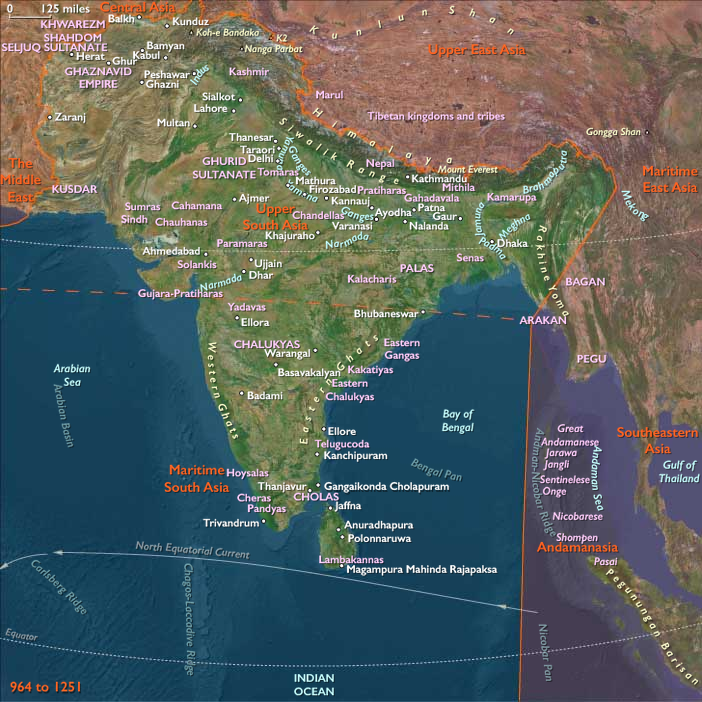
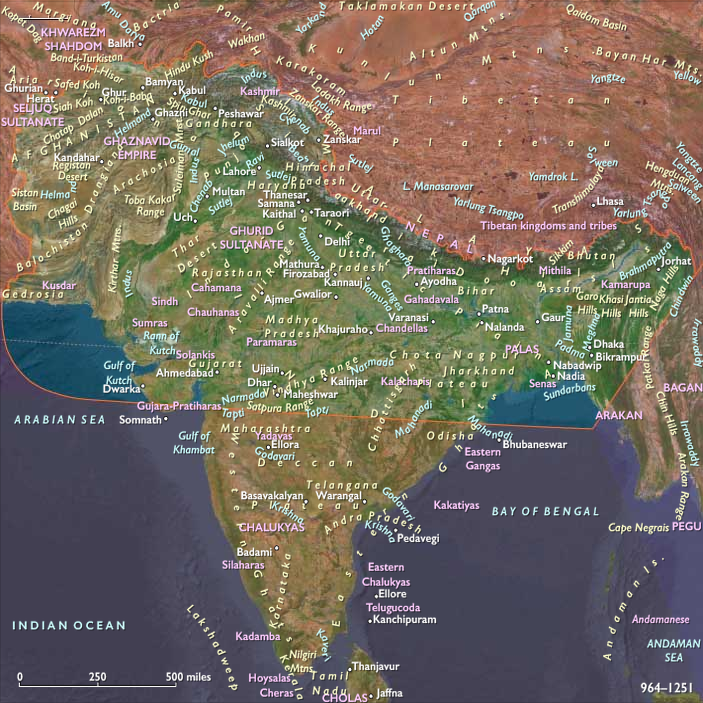
Razia Sultana, ruler of the Delhi Sultanate, had miscounted the consequences that a relationship with one of her advisers, Jamal-ud-Din Yaqut, an enslaved Abyssinian Siddi (Habshi), would have for her reign.
According to some accounts, Razia and Yaqut were lovers, other sources simply identify them as close confidants.
In any case, before long, she had aroused the jealousy of the Turkic nobility by the favoritism she displayed toward Yaqut, who was not a Turk, when she appointed him to be Superintendent of the Stables.
Eventually, a childhood friend named Malik Altunia, the governor of Bhatinda, had joined a rebellion by other provincial governors who refuse to accept Razia's authority.
A battle between Razia and Altunia had ensued, resulting in Yaqut’s death and Razia’s capture.
To escape death, Razia had agreed to marry Altunia.
Meanwhile, Razia's brother, Muizuddin Bahram Shah, had usurped the throne, declaring himself king with the support of forty chiefs.
After Altunia and Razia undertake to recover the sultanate from Bahram through battle, both Razia and her husband are defeated in October 1240).
They flee Delhi and …
Locations
People
Groups
- Hinduism
- Jat people
- Muslims, Sunni
- Gujarat, Solanki Kingdom of
- Delhi, Sultanate of (Mamluk or Ghulam Dynasty)
Topics
Commodoties
Subjects
Regions
Subregions
Related Events
Filter results
Showing 10 events out of 46884 total
Ships from Muslim ports of northwestern India, the Persian Gulf, and the Red Sea, stimulated by the increasing Mediterranean interest in the pepper and spice trade of Indonesia, increasingly arrive in the Straits of Malacca in the mid-thirteenth century, and appear at ports southward in Sumatra and Java.
The Mongols burst forth suddenly from the Eurasian Steppe.
The Empire of Nicaea, aided by the Mongol invasion, reduces both the Latin Empire and the Bulgarian Empire to the status of pawns.
The Sultanate of Rüm and of Seljuq power, fatally weakened by their war against the Khwarezm-Shah dynasty of Iran, also disintegrates, with the Mongols as agent.
The Mongol invasion of Europe in the thirteenth century involves the destruction of East Slavic principalities, such as Kiev and Vladimir, the invasion of the Kingdom of Hungary (in the Battle of Mohi) and the further fragmentation of Poland (in the Battle of Legnica).
The operations are masterminded by General Subutai and commanded by Batu Khan and Kadan, both grandsons of Genghis Khan.
Many of the conquered territories will become part of the Golden Horde empire.
Historians regard the Mongol raids and invasions as some of the deadliest conflicts in human history up through this period.
The power map of the southern and eastern Mediterranean basin becomes divided among four main dominions: Mamluk Egypt, Ayyubid Syria, the Franks of Acre and Syrian Christian beachheads, and the Levantine Christian state of Cilician Armenia.
The Mongols by 1241 have their armies riding westwards as far as the River Oder and the northeastern shore of the Adriatic, and during the Battle of Fariskur they are penetrating deep into all adjoining regions.
The Western Christians and the Cilician Armenians hope to have a grand alliance with the Mongols against the Islamic World.
The Cilician Armenians in 1247 submit to Mongol suzerainty.
Pope Innocent IV, who has fully supported the Seventh Crusade against Egypt, had in the previous year sent his Franciscan emissary Giovanni da Pian del Carpine to the Great Khan of the Mongols in Karakoram to seek an alliance against the Muslims.
He is disappointed by Güyük Khan, who tells him that he and the kings of Europe should submit to the Mongols.
Northeast Europe (1240–1251 CE): Climactic Struggles, Prussian Defeat, and Crusader Consolidation
Introduction
Between 1240 and 1251 CE, Northeast Europe witnessed the climax of intense struggles between Baltic tribes and the crusading forces of Denmark, Germany, and Sweden. The resolution of the major Prussian uprisings, ongoing territorial consolidation by crusaders, and continued Baltic resistance marked a decisive turning point, establishing a lasting crusader presence in the region.
The Prussian Uprisings: Final Confrontations
The series of Prussian rebellions against the Teutonic Knights reached a critical juncture in this era. Earlier successes had emboldened the Baltic Prussians, whose fierce resistance initially pushed the Teutonic Knights to the brink of defeat. The Prussians, supported previously by Duke Swietopolk II of Pomerania, suffered a severe setback as Swietopolk was forced into peace after military defeats.
The fragile peace treaty brokered by representatives of Pope Innocent IV soon unraveled, especially following the decisive Battle of Krücken at the end of 1249, a turning point after which the Teutonic Knights decisively reestablished control over Prussian territories. By 1251, most major Prussian clans had succumbed to Teutonic dominance, leading to widespread forced conversions, military occupation, and the embedding of a rigid crusader regime.
Danish Estonia and the Livonian Confederation
In Danish-controlled Estonia, stability and control further solidified around the capital of Reval (Tallinn), symbolized by the imposing fortress Castrum Danorum at Toompea Hill. Danish authorities expanded administrative and ecclesiastical infrastructure, strengthening the crown’s grip on its Baltic territories.
Simultaneously, the Livonian Confederation under German administration continued to thrive. The strategic city of Riga grew in prominence as a major political, economic, and ecclesiastical hub, serving as a stronghold of German power in Livonia and a vital center of crusader operations.
Continued Swedish Colonization in Finland
Sweden deepened its colonization and Christianization efforts in southern Finland, reinforcing a distinct identity that would diverge culturally and politically from the Baltic tribes further south. The solidification of Swedish control during this era significantly influenced Finland's future trajectory, aligning it more closely with Scandinavian structures.
Baltic Resistance and Its Aftermath
While the Estonians, Latvians, and other Baltic tribes remained determined to resist foreign domination, their capacity for sustained rebellion diminished due to relentless crusader military pressure and fortified settlements. The defeat of the Prussians symbolized the broader Baltic struggle; despite heroic resistance, Baltic tribes were increasingly forced into subjugation or retreat, marking a shift towards enduring crusader authority.
Economic and Urban Flourishing
Economic development flourished within crusader-controlled cities, notably Reval (Tallinn) and Riga, as these urban centers matured into major commercial and maritime hubs. Visby on Gotland retained its commercial prominence, further integrating Northeast Europe into wider European economic networks.
Ecclesiastical Authority and Cultural Integration
Ecclesiastical institutions, especially under the Teutonic Knights and other German monastic orders, established extensive networks of churches, monasteries, and dioceses. This facilitated cultural assimilation and systematic Christianization of local populations. The dominance of ecclesiastical authorities cemented Latin Christianity’s profound influence over the region.
Legacy of the Era
The era from 1240 to 1251 CE marked a definitive moment in Northeast Europe's history. The conclusive suppression of the Prussian uprisings, the firm establishment of crusader control in Estonia, Livonia, and Prussia, and continued Swedish colonization in Finland laid enduring foundations. The region emerged from this tumultuous era firmly integrated into Latin Christendom, profoundly shaping its cultural, political, and religious identity for centuries to come.
The Prussian uprisings are two major and three smaller uprisings by the Prussians, one of the Baltic tribes, against the Teutonic Knights that take place in the thirteenth century during the Northern Crusades.
The crusading military order, supported by the Popes and Christian Europe, seeks to conquer and convert pagan Prussians.
In the first ten years of the crusade, five of the seven major Prussian clans fall under control of the less populous Teutonic Knights.
However, Prussians rise against their conquerors on five occasions.
The first uprising is supported by Polish duke Swietopolk II of Pomerania.
The Prussians are successful at first, reducing the Knights to only five of their strongest castles.
Conversely, Duke Swietopolk suffers a series of military defeats and is eventually forced to make peace with the Teutonic Knights.
With Duke Swietopolk’s support for the Prussians broken, a prelate of Pope Innocent IV then negotiates a peace treaty between the Prussians and the Knights.
However, this treaty will never be honored or enforced, especially after the Battle of Krücken at the end of 1249.
East Central Europe (1240–1251 CE): Mongol Invasion and Aftermath, Rebuilding under Béla IV, Polish Fragmentation after Legnica, Bohemian Stability, and Austria’s Babenberg Decline
Between 1240 and 1251 CE, East Central Europe—including modern-day Poland, Czechia, Slovakia, Hungary, and eastern regions of Germany and Austria east of 10°E and north of the defined southeastern boundary—experienced unprecedented turmoil, upheaval, and profound transformation due to the devastating Mongol invasion (1241–1242). The invasion dramatically reshaped regional power dynamics, political structures, and demographic landscapes. Hungary and Poland bore the brunt of Mongol destruction but subsequently entered phases of rebuilding and political realignment. Bohemia remained relatively stable under Wenceslaus I Přemysl, while Austria faced significant instability and dynastic decline following the end of the Babenberg dynasty. These developments had profound, lasting effects on regional governance, settlement patterns, and cultural identities.
Political and Military Developments
Devastating Mongol Invasion (1241–1242)
-
In 1241, Batu Khan’s Mongol armies swept across East Central Europe, causing catastrophic destruction. Major battles included the decisive defeats at Legnica (Poland) and Mohi (Hungary) in 1241, leading to mass casualties, widespread destruction, and significant territorial devastation.
-
Poland’s fragmented duchies suffered severely, notably in Silesia, where Duke Henry II the Pious fell at Legnica. Hungarian forces under King Béla IV (r. 1235–1270) were decisively defeated at Mohi, resulting in temporary royal exile and massive demographic losses.
Hungarian Reconstruction under Béla IV
-
Following the Mongol withdrawal in 1242, Béla IV initiated extensive reconstruction, fortification programs, and administrative reforms to rebuild Hungary’s political stability and security. He fostered new fortified towns and encouraged immigration and settlement to replenish population losses.
-
Béla IV’s recovery efforts fundamentally reshaped Hungary’s political structures, significantly increasing urban fortification and royal administrative reforms.
Polish Fragmentation Intensifies after Legnica
-
After the Battle of Legnica (1241) and the death of Henry II the Pious, Poland’s political fragmentation intensified. Silesia splintered further among Henry’s heirs, exacerbating regional rivalry and undermining previous unity efforts.
-
Silesian duchies, Greater Poland, Masovia, and Lesser Poland operated independently, deepening political decentralization and reducing unified governance.
Continued Stability in Bohemia under Wenceslaus I
-
Bohemia, under King Wenceslaus I (r. 1230–1253), managed to avoid direct Mongol devastation. Wenceslaus capitalized on this stability, continuing territorial consolidation, strengthening administrative governance, and maintaining regional political influence within the Holy Roman Empire.
Austrian Babenberg Dynasty Ends
-
In 1246, the Babenberg dynasty ended abruptly with the death of Duke Frederick II the Quarrelsome in battle. Austria plunged into dynastic uncertainty and instability, triggering a prolonged succession crisis that would reshape the duchy’s future within Central Europe.
Imperial Influence and Regional Instability
-
Emperor Frederick II’s (r. 1212–1250) declining authority in his final years contributed to regional instability, affecting political alliances and complicating dynastic succession disputes, notably in Austria and neighboring regions.
Economic and Technological Developments
Devastation and Economic Disruption from Mongol Invasions
-
The Mongol invasions caused severe economic disruption, widespread destruction of trade networks, agricultural devastation, and depopulation, especially in Hungary and Poland. Recovery efforts gradually restored commerce, though long-term impacts remained significant.
Reconstruction, Settlement, and Technological Advances
-
Post-invasion recovery saw significant rebuilding, settlement initiatives, and urban fortifications. Agricultural productivity and technological innovations—including improved fortification methods—played crucial roles in regional reconstruction.
Cultural and Artistic Developments
Hungarian Cultural Resilience and Reconstruction
-
Despite severe destruction, Béla IV strongly supported cultural restoration. Ecclesiastical architecture, manuscript illumination, and scholarly institutions gradually revived, reflecting Hungary’s resilient cultural identity and intellectual traditions.
Polish Cultural Continuity amid Fragmentation
-
Poland maintained significant cultural resilience, with monasteries and ecclesiastical institutions preserving cultural continuity, scholarship, and artistic traditions despite intensified fragmentation and political decentralization.
Bohemian Cultural Flourishing under Wenceslaus I
-
Bohemia, unaffected directly by the Mongol invasion, continued cultural and artistic development under Wenceslaus I. Prague’s significance as a center of manuscript production, ecclesiastical architecture, and scholarly activity notably increased.
Settlement and Urban Development
Hungarian Reconstruction and Urban Fortification under Béla IV
-
Béla IV initiated extensive rebuilding and urban fortification programs. New and existing towns, including Buda, Esztergom, and Visegrád, were substantially fortified, transforming Hungary’s urban landscape to better resist future invasions.
Continued Bohemian Urban Stability and Expansion
-
Bohemia’s urban centers, particularly Prague, remained stable, prospering commercially and culturally. Fortifications were reinforced strategically, and urban infrastructure continued developing, further enhancing regional prominence.
Austrian Instability and Urban Uncertainty
-
Following the Babenberg dynasty’s end (1246), Austrian urban growth temporarily slowed due to political uncertainty and dynastic instability. However, key centers like Vienna maintained essential administrative and economic functions, preserving continuity despite challenges.
Social and Religious Developments
Ecclesiastical Institutional Strength and Reconstruction
-
Ecclesiastical institutions played crucial roles in post-Mongol reconstruction, societal cohesion, and intellectual revival. Monasteries, bishoprics, and religious orders significantly influenced governance, education, and social recovery across East Central Europe.
Aristocratic Power, Social Transformation, and Urban Fortification
-
Aristocratic influence intensified due to the weakened royal authority from the Mongol invasion’s devastation. Nobility and local aristocrats played prominent roles in rebuilding, fortification, and regional governance, reshaping social and political structures.
Long-Term Consequences and Historical Significance
The era 1240–1251 CE was a transformative period for East Central Europe, marked by catastrophic destruction from the Mongol invasions and significant political realignments. Hungary under Béla IV undertook substantial reconstruction efforts, significantly altering its defensive strategies and urban landscapes. Poland faced deepened fragmentation following Legnica, hindering unified governance. Bohemia maintained political stability under Wenceslaus I, emerging with enhanced regional prominence. Austria’s Babenberg dynasty’s end introduced prolonged dynastic uncertainty. Collectively, these developments profoundly reshaped regional political, economic, social, and cultural structures, laying foundations for future medieval identities, governance patterns, and enduring legacies.
The Mongol Invasion of Poland from late 1240 to 1241 culminates in the Battle of Legnica, where the Mongols defeat an alliance that includes forces from fragmented Poland and members of various Christian military orders, led by Henry II the Pious, the Duke of Silesia.
The first invasion's intention is to secure the flank of the main Mongolian army attacking the Kingdom of Hungary.
The Mongols neutralize any potential help to King Bela from the Poles and the military orders (including the Teutonic knights in Prussia).
The Kingdom of Hungary, for a year after the Mongol invasion (1242), does not exist.
The War of the Thuringian Succession is a military conflict over a successor to the last Landgrave of Thuringia in present-day Germany.
Eastern Southeast Europe (1240–1251 CE): Fragmentation, Rivalries, and Shifting Alliances
Settlement and Migration Patterns
Continued Decline of the Latin Empire
Between 1240 and 1251 CE, the Constantinople-based Latin Empire further deteriorated under constant territorial pressures from surrounding Greek successor states and the Second Bulgarian Empire. Latin populations continued their retreat into shrinking enclaves or assimilated with local communities.
Expansion of Greek Influence
The Empire of Nicaea solidified its territories in Asia Minor and advanced closer to reclaiming Constantinople, becoming the principal Greek successor state. Simultaneously, the Despotate of Epirus maintained its hold in northwestern Greece, competing with Nicaea for influence over Greek populations.
Bulgarian Territorial Adjustments
The Second Bulgarian Empire, despite earlier successes under Tsar Ivan Asen II, faced internal challenges and external pressures following his death in 1241. These dynamics altered territorial control, causing localized population movements and resettlements within the empire.
Economic and Technological Developments
Economic Fragmentation and Localization
As centralized control weakened further, economic activity increasingly fragmented, leading to localized trade networks. Cities such as Thessalonica, under Epirus, and Adrianople, under Nicaean influence, became key centers of regional commerce.
Strengthened Fortifications and Defensive Systems
The ongoing conflicts spurred significant defensive enhancements. Major urban centers and strategic fortresses throughout Bulgaria, Epirus, and Nicaea received substantial fortification improvements, emphasizing the militarization of regional economies and urban planning.
Cultural and Artistic Developments
Byzantine Cultural Revival
Byzantine traditions continued to flourish prominently within the Empire of Nicaea, significantly influencing religious art, architecture, and literature. Nicaea emerged as a vibrant cultural center, laying important foundations for future Byzantine revival.
Bulgarian Cultural Resilience
Despite internal political turbulence, Bulgarian cultural production continued robustly. Artistic and religious traditions, including manuscript illuminations and monumental church architecture, persisted, reflecting strong Byzantine influences adapted to Bulgarian national identity.
Social and Religious Developments
Orthodox Ecclesiastical Authority
Orthodox Christianity reinforced its dominance in reclaimed Greek territories and Bulgarian lands, diminishing Latin ecclesiastical presence. Orthodox patriarchates and bishoprics played essential roles in consolidating regional identities and social coherence.
Internal Bulgarian Church Dynamics
Within Bulgaria, the Orthodox Church navigated internal political shifts following Ivan Asen II’s death, maintaining its independence and pivotal societal role. Church institutions served as stabilizing forces amid political uncertainties.
Political Fragmentation and Regional Rivalries
Weakening Latin Authority
The Latin Empire experienced severe political fragmentation, becoming increasingly dependent on external alliances for survival. Its internal governance deteriorated significantly, reducing its geopolitical relevance in regional affairs.
Rising Rivalries Among Greek States
Intensifying rivalries between the Empire of Nicaea and the Despotate of Epirus shaped regional politics. These Greek states competed fiercely for dominance over formerly Byzantine territories, significantly affecting the broader balance of power.
Bulgarian Political Instability
Following Tsar Ivan Asen II's death, Bulgaria entered a period of internal division and shifting alliances. The weakening of central authority allowed neighboring powers to exploit Bulgaria’s vulnerabilities, leading to territorial and political instability.
Long-Term Consequences and Historical Significance
The period from 1240 to 1251 CE saw substantial political fragmentation, shifting alliances, and intensified regional rivalries. These developments significantly shaped Eastern Southeast Europe's political landscape, influencing future dynamics leading up to the eventual Byzantine restoration in Constantinople and shaping enduring national and religious identities.
Louis IX of France leads the Seventh Crusade, the last major offensive undertaken by the crusaders against Egypt, from 1248.
King Louis, along with thousands of his troops, is captured and defeated at the Battle of Fariskur by the Egyptian army led by the Ayyubid Sultan Turanshah and supported by the Bahariyya Mamluks led by Faris ad-Din Aktai, Baibars al-Bunduqdari, Qutuz, Aybak and Qalawun.
The king is ransomed for approximately fifty thousand gold bezants, a sum equal to the entire annual revenue of France.
Turanshah is assassinated at Fariskur itself shortly after the battle and the Mamluks become the new rulers of Egypt.
Mediterranean Southwest Europe (1240–1251 CE): Reconquista Successes, Imperial Decline, and Mendicant Influence
The era 1240–1251 CE in Mediterranean Southwest Europe is characterized by decisive Reconquista victories in Iberia, deepening political conflicts in northern Italy, and continued growth of mendicant religious orders.
Decisive Reconquista Advances in Iberia
The Christian kingdoms of Castile, León, and Aragon achieve substantial territorial gains against the weakened Almohad Caliphate. Under the leadership of Ferdinand III of Castile and León and James I of Aragon, Christian forces capture crucial cities, including Córdoba in 1236 (fully consolidated by the 1240s) and Seville in 1248. These successes dramatically reduce Almohad territories and establish firm Christian dominance over large areas of southern Iberia, setting the stage for the near-total reconquest of the peninsula.
Imperial Decline and Communal Ascendancy in Italy
Northern Italy witnesses escalating conflicts between Emperor Frederick II and the independent city-states of the Lombard League. Persistent communal resistance, coupled with Frederick’s political and military difficulties, notably weakens imperial authority. Cities such as Milan, Alessandria, and Florence reinforce their autonomy, establishing powerful precedents for urban self-governance and communal liberty that shape future political developments.
Influence and Expansion of Mendicant Orders
The Dominican and Franciscan Orders continue their rapid expansion throughout Europe, further solidifying their roles as pivotal spiritual, intellectual, and social institutions. They significantly influence education by establishing important theological schools and universities, including contributions to the rise of the University of Paris as a major intellectual center. Their presence deeply affects religious practices, social attitudes, and intellectual traditions across the region.
Scholarly Activity and Cultural Exchange
Scholarly activities flourish, with ongoing translation efforts and intellectual exchanges, particularly in Toledo and emerging universities in Italy. Arabic and Greek scientific and philosophical texts continue to be translated into Latin, greatly enriching Western intellectual culture and laying crucial groundwork for the later European Renaissance.
Economic Strength of Maritime Republics
The maritime republics of Venice and Genoa maintain robust commercial prosperity and naval power. Their extensive trading networks support continued economic growth, cultural exchanges, and urban expansion throughout the Mediterranean.
Legacy of the Era
The era 1240–1251 CE significantly influences Mediterranean Southwest Europe through critical Reconquista victories, the weakening of imperial control in Italy, and the enduring cultural and intellectual influence of the mendicant orders. Together, these developments substantially shape the region’s subsequent medieval and early modern historical trajectories.
Years: 1240 - 1240
October
Locations
People
Groups
- Hinduism
- Jat people
- Muslims, Sunni
- Gujarat, Solanki Kingdom of
- Delhi, Sultanate of (Mamluk or Ghulam Dynasty)
Topics
Commodoties
Subjects
Regions
Subregions