
Raynald of Châtillon, released in 1176 from …
Years: 1181 - 1181
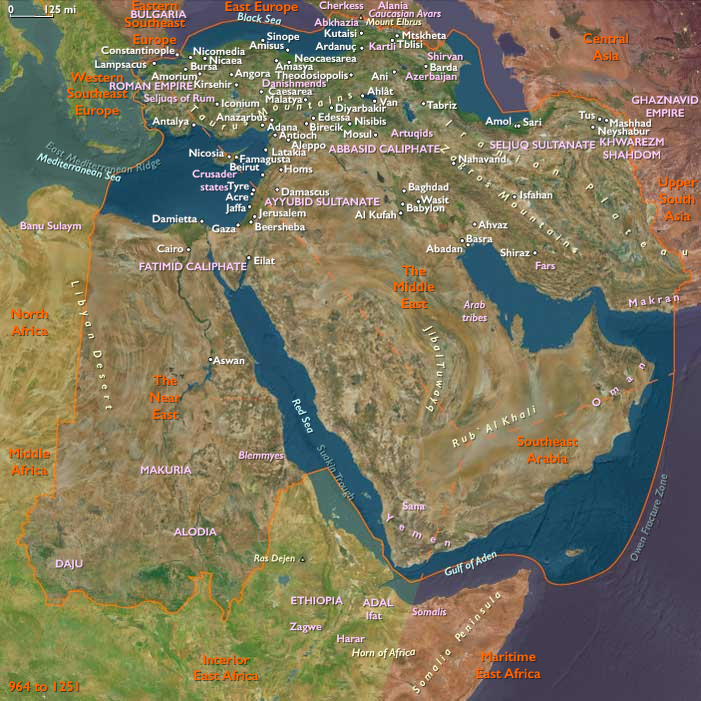
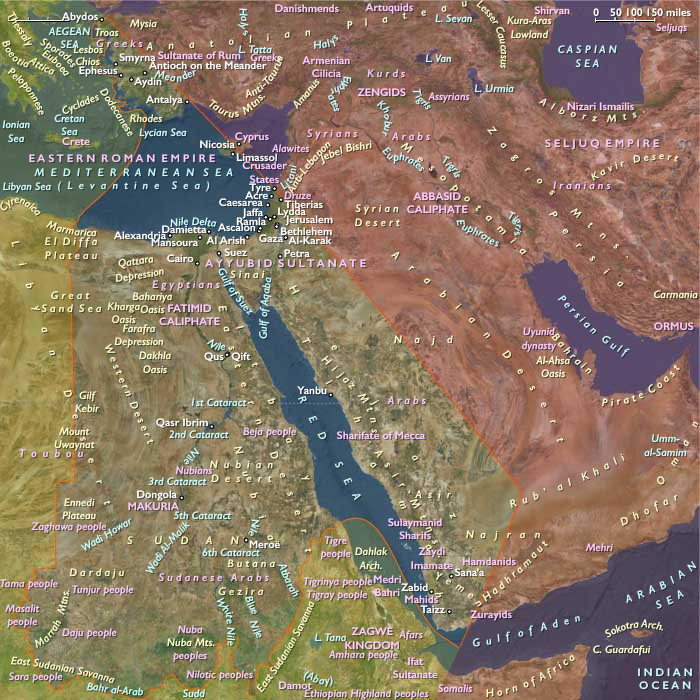
Raynald of Châtillon, released in 1176 from sixteen years of Muslim captivity, had returned to Jerusalem and in 1177 married Stephanie, widow of the Lord of Outre-Jourdain (east and south of the Dead Sea), thus becoming prince of Krak du Désert (Kerak) and of Montréal.
Raynald's new strongholds control Muslim trade routes, and in the summer of 1181 he plunders a Muslim caravan, thus violating the truce of 1180.
When Saladin asks the king of Jerusalem to make Raynald restore the plunder, Raynald’s refusal ignites war.
Locations
People
- Amalric II of Jerusalem
- Baldwin IV of Jerusalem
- Baldwin V of Jerusalem
- Guy of Lusignan
- Raymond III of Tripoli
- Raynald of Châtillon
- Richard I of England
- Saladin
- Sibylla
Groups
- Arab people
- Armenian people
- Kurdish people
- Greeks, Medieval (Byzantines)
- Muslims, Sunni
- Muslims, Shi'a
- Syrian people
- Flemish people
- Abbasid Caliphate (Baghdad)
- French people (Latins)
- Christians, Roman Catholic
- Christians, Eastern Orthodox
- Armenia, Baronry of Little, or Lesser
- Roman Empire, Eastern: Komnenos dynasty, restored
- Antioch, Principality of
- Jerusalem, Latin Kingdom of
- Palestine, Frankish (Outremer)
- Italians (Latins)
- Tripoli, County of
- Jaffa and Ascalon, County of
- Egypt, Ayyubid Sultanate of
Topics
Commodoties
Subjects
Regions
Subregions
Related Events
Filter results
Showing 10 events out of 37 total
The early years of Ottokar, a younger son of King Vladislav II of Bohemia, had passed amid the anarchy which prevailed everywhere in the country.
After several struggles in which he had taken part, he had been recognized as ruler of Bohemia by Holy Roman Emperor Henry VI in 1192.
He was, however, soon overthrown for joining a conspiracy of German princes to bring down the Hohenstaufen monarchy.
In 1197, Ottokar had forced his brother, Duke Vladislaus III Henry, to abandon Bohemia to him and to content himself with Moravia.
Taking advantage of the German civil war between the Hohenstaufen claimant Philip of Swabia and the Welf candidate Otto IV, Ottokar declares himself hereditary King of Bohemia in 1198.
This title is supported by Philip of Swabia, who needs Czech military support against Otto.
Richard I’s War Against Philip II and His Victories in France (1194–1198 CE)
Determined to defend Angevin territories from Philip II’s encroachment, particularly in the Vexin and Berry, Richard I of England devoted his military expertise and vast resources to waging war against the French king. Through a combination of strategic alliances and military victories, Richard turned the tide against Philip, severely weakening the Capetian position in northern France.
Richard’s Anti-Capetian Alliance
To counter Philip’s ambitions, Richard forged a broad coalition of allies:
- Baldwin IX, Count of Flanders – Strengthened Angevin influence in the north.
- Renaud, Count of Boulogne – Provided additional support against Philip’s forces.
- Sancho VI of Navarre (his father-in-law) – Launched raids into southern France, distracting Philip.
- Otto IV of Germany (his nephew) – Richard secured the Welf inheritance in Saxony, ensuring Otto was elected Holy Roman Emperor in 1198, creating an additional threat to Philip’s eastern flank.
By strengthening the Welf faction in the Holy Roman Empire, Richard weakened Philip’s diplomatic influence in Europe, making it harder for him to focus on the Angevin war.
Richard’s Military Victories Over Philip
-
Battle of Fréteval (1194)
- Shortly after Richard’s return from captivity, he rallied forces in Normandy and ambushed Philip at Fréteval.
- Philip fled the battlefield, leaving behind his entire archive of financial audits and documents, a devastating logistical loss.
-
Battle of Gisors / Courcelles (1198)
- Richard won a decisive victory against Philip’s forces.
- It was during this battle that Richard is said to have adopted the motto "Dieu et mon Droit" ("God and my Right"), symbolizing his belief that he owed allegiance only to God, not to Philip or the Emperor.
- This phrase remains the motto of the British monarchy to this day.
Impact of Richard’s Campaigns
- Richard successfully reversed Philip’s early territorial gains, reclaiming much of Normandy and the Vexin.
- His military success left Philip militarily and politically vulnerable, unable to expand as he had hoped.
- By securing Otto IV’s election, Richard turned the Holy Roman Empire into an Angevin ally, further isolating Philip in Europe.
Despite Philip’s earlier advances, by 1198, Richard had gained the upper hand, and the war was tilting in favor of the Angevins. However, his unexpected death in 1199 would dramatically alter the balance of power in the Capetian-Plantagenet struggle.
The Holy Roman Empire has become a patchwork of petty principalities.
The various city-states of northern Italy are, by this time, in no way subject to their ostensible Emperor.
The German princes and the pope had together in 1196 rejected Henry’s proposed plan to make the imperial crown a hereditary office, but following Henry’s death, the pro-Hohenstaufen princely majority, with the backing of Henry’s brother Duke Philip of Swabia, recognizes Henry’s three-year-old son, Frederick II, as their future king;.
Preferring, however, an adult ruler, they choose Philip on March 6, 1198, and later—irregularly—crown him king.
The anti-Hohenstaufen minority on June 9 elects Henry the Lion’s son, Otto of Brunswick, as king of Germany, in opposition to Philip.
Civil war between the two factions ensues.
The Fatal Wounding of Richard I at Châlus-Chabrol (March 25, 1199)
In March 1199, Richard I of England was in the Limousin, engaged in suppressing a revolt led by Viscount Aimar V of Limoges. Despite it being Lent, Richard devastated Aimar’s lands with fire and sword, as recorded by Ralph of Coggeshall (Chronicon Anglicanum, p. 94). His campaign led him to besiege the small, lightly defended castle of Châlus-Chabrol, where he suffered the wound that would ultimately claim his life.
The Siege of Châlus-Chabrol and the Crossbowman's Shot
- Some chroniclers claim that Richard attacked Châlus-Chabrol because a local peasant had uncovered a treasure hoard of Roman gold, which Richard demanded as feudal overlord.
- On the evening of March 25, 1199, Richard was walking around the castle perimeter, unarmored, personally inspecting the work of his sappers.
- Although crossbow bolts were being fired sporadically from the castle walls, they were largely ignored.
- Richard was particularly amused by one defender, a man who was using a frying pan as a shield while shooting his crossbow at the besiegers.
- As Richard applauded the man’s defiance, another crossbowman struck him in the left shoulder, near the neck.
- Retreating to his tent, Richard attempted to pull the bolt out himself but failed.
- A surgeon later removed it carelessly, mangling the King’s arm in the process.
- The wound quickly became infected and gangrenous.
The Capture and Pardon of the Crossbowman
- Knowing he was dying, Richard ordered the crossbowman to be brought before him.
- The shooter’s identity is uncertain, with chroniclers referring to him as Pierre (or Peter) Basile, John Sabroz, Dudo, or Bertrand de Gurdon (from Gourdon).
- Some accounts claim the shooter was a boy, who declared that Richard had killed his father and two brothers, and that he had shot the King in an act of vengeance.
- Expecting execution, the young man was shocked when Richard pardoned him, reportedly saying:
"Live on, and by my bounty behold the light of day."
- Richard ordered the boy to be released and given one hundred shillings.
Richard’s Final Acts and Succession
- As death approached, Richard settled his affairs:
- He bequeathed all his territories to his brother John.
- His jewels were left to his nephew, Otto IV of Germany.
- Despite his act of mercy, after Richard’s death, Mercadier, his loyal captain, flouted the King’s order and had the crossbowman flayed alive and hanged.
Legacy of Richard’s Death
- Richard died on April 6, 1199, at the age of 41, at Châlus-Chabrol.
- His death caused a succession crisis, as John faced rival claims from Arthur of Brittany.
- The Capetians under Philip II took advantage of the turmoil, accelerating the collapse of Angevin control in France.
- Richard’s death at the hands of a lowly crossbowman was ironic, given his legendary military career and battlefield prowess.
The death of Richard the Lionheart marked the end of an era, ushering in a period of instability that would ultimately favor the Capetian monarchy over the Angevins.
The Death and Legacy of Richard I, the Lionheart (1199 CE)
Richard I, renowned for his military prowess and crusading exploits, met his end on April 6, 1199, at the siege of Châlus-Chabrol, dying in the arms of his mother, Eleanor of Aquitaine. Though celebrated for his chivalry and battlefield skill, his reign was characterized by neglect of his kingdom, as he spent all but six months of his ten-year reign outside England, campaigning or in captivity.
Richard’s Rule: Glory in War, Neglect in Governance
- A warrior first, a ruler second, Richard excelled only in fighting, leaving the governance of England and his empire to his ministers.
- His military reputation was legendary, yet he was also immature, petulant, and politically shortsighted, failing to consolidate Angevin power against Capetian expansion.
- His constant absence drained the royal treasury, forcing England to pay a crippling ransom for his release from captivity in 1194.
Richard’s Last Act of Chivalry and Its Brutal Aftermath
- Richard’s dying act of mercy, pardoning the crossbowman who shot him, was in vain.
- As soon as Richard died, Mercadier, his ruthless mercenary captain, had the crossbowman flayed alive and hanged, in a gruesome display of medieval brutality.
The Burial of Richard I
Richard’s body was divided among three locations, following the medieval tradition of burying rulers in multiple places of significance:
- His heart was buried in Rouen, Normandy, the political center of the Angevin lands in France.
- His entrails were interred at Châlus-Chabrol, where he died.
- The rest of his body was laid to rest at the feet of his father, Henry II, in Fontevraud Abbey, Anjou, alongside his mother, Eleanor of Aquitaine.
Scientific Analysis of Richard’s Heart (2012)
- In 2012, scientists examined the preserved remains of Richard’s heart, revealing it had been embalmed with various substances, including frankincense.
- Frankincense was highly symbolic, as it was associated with both the birth and embalming of Christ, suggesting Richard wanted to be perceived as a holy warrior, akin to a martyr of the Crusades.
Richard I’s Legacy
- Glorified as a crusader king, Richard became a legendary figure in medieval romance and later folklore.
- His warfare-focused reign failed to preserve Angevin dominance in France, allowing Philip II of France to gain ground after his death.
- His shortsighted policies and excessive military spending left his brother and successor, John, a weakened realm, accelerating the collapse of Angevin power on the continent.
Though he embodied the ideals of medieval chivalry, Richard I’s reign left England heavily taxed and politically vulnerable, making him a hero in legend but a failure as a ruler.
Philip of Swabia, assisted in the German civil war that began in 1198 by southern Germans and by France, clashes with the Welf Otto of Brunswick, aided by northern Germans, the archbishop of Cologne, and the English.
Philip’s pro-Hohenstaufen, anti-Welf faction becomes known as the Waiblingens, from the name of the Hohenstaufen castle.
The new pope, Innocent III, maneuvers behind the scenes, pretending neutrality until Otto in 1201 agrees—insincerely—to donate Italian lands to the papacy.
East Central Europe (1204–1215 CE): Andrew II’s Hungarian Ascendancy, Bohemian Royal Consolidation under Ottokar I, Polish Regional Power under Henry the Bearded, and Austria’s Stability under Leopold VI
Between 1204 and 1215 CE, East Central Europe—including modern-day Poland, Czechia, Slovakia, Hungary, and eastern regions of Germany and Austria east of 10°E and north of the defined southeastern boundary—experienced significant political realignments, territorial consolidation, and cultural developments. Hungary entered a vibrant era under King Andrew II, Bohemia solidified Přemyslid royal authority under Ottokar I, Poland’s fragmentation continued but saw growing regional strength under Henry the Bearded in Silesia, and Austria prospered under Leopold VI of the Babenberg dynasty. These developments significantly influenced regional stability, economic expansion, and cultural flourishing.
Political and Military Developments
Hungarian Stability and Expansion under Andrew II
-
In 1205, following King Emeric’s death, his brother Andrew II (r. 1205–1235) ascended Hungary’s throne, ushering in a politically active and culturally vibrant reign. Andrew pursued ambitious foreign and domestic policies, seeking greater political influence across East Central Europe and actively engaging in Crusades.
-
His governance significantly strengthened Hungary’s regional standing, despite occasional internal disputes and aristocratic challenges.
Bohemian Royal Authority Strengthened under Ottokar I
-
King Ottokar I Přemysl (r. 1197–1230) reinforced royal authority, stabilizing Bohemia after previous dynastic conflicts. His strong leadership earned recognition of hereditary royal status from the Holy Roman Empire in the Golden Bull of Sicily (1212), enhancing Přemyslid autonomy and political prestige.
-
Ottokar’s reign marked significant administrative reform, territorial consolidation, and increased Bohemian political influence within imperial affairs.
Polish Fragmentation and Silesian Power under Henry the Bearded
-
Poland’s political fragmentation persisted with principalities operating autonomously. The most prominent was Silesia under Duke Henry I the Bearded (r. 1201–1238), who consolidated power, enhanced economic prosperity, and fostered diplomatic alliances.
-
Henry’s leadership elevated Silesia as the strongest of Poland’s regional duchies, significantly influencing broader Polish and Central European politics.
Austrian Stability and Prosperity under Leopold VI
-
Duke Leopold VI of Austria (r. 1198–1230) ensured political stability, territorial security, and economic prosperity within Austria. His rule strengthened urban centers, fortified regional influence, and reinforced Austria’s prominence in the Holy Roman Empire.
-
Leopold VI actively supported crusading efforts, fostering diplomatic relations across Europe and enhancing Austria’s international prestige.
Imperial Authority under Otto IV and Frederick II
-
The period featured contested imperial succession between Otto IV (r. 1198–1215) and Frederick II (r. 1212–1250), affecting regional politics. East Central European rulers navigated shifting imperial alliances, notably Bohemia under Ottokar I, whose support for Frederick II strengthened his position and royal autonomy.
Economic and Technological Developments
Prosperous Regional Economies and Expanded Trade
-
Economic prosperity continued through robust trade networks connecting Baltic, Western Europe, and Mediterranean markets. Major urban centers—Prague, Vienna, Esztergom, Kraków, and Wrocław—thrived commercially, becoming vital hubs of regional trade.
Agricultural Innovations and Population Growth
-
Agricultural productivity increased due to widespread adoption of advanced techniques, such as improved plows, crop rotation, and land management practices, supporting significant urbanization and population expansion.
Cultural and Artistic Developments
Hungarian Cultural and Artistic Flourishing under Andrew II
-
Andrew II patronized extensive ecclesiastical foundations, artistic endeavors, and intellectual developments, greatly enhancing Hungarian cultural life. Manuscript production, ecclesiastical architecture, and scholarly activities flourished, influenced by Western European and Byzantine traditions.
Bohemian Intellectual and Cultural Revival under Ottokar I
-
Bohemia’s cultural prominence significantly increased, particularly in Prague, driven by royal patronage of monastic scholarship, manuscript illumination, and architectural projects. Prague became an influential cultural and intellectual center within Central Europe.
Silesian Cultural and Economic Vitality under Henry the Bearded
-
Duke Henry the Bearded fostered cultural and economic vitality in Silesia, promoting monasteries, urban development, and artistic patronage. His support solidified Silesia’s role as a prominent cultural and commercial region within fragmented Poland.
Settlement and Urban Development
Urban Expansion in Hungary under Andrew II
-
Hungarian urban centers, notably Esztergom and Buda, expanded significantly, benefiting from improved fortifications, administrative organization, and flourishing commerce. This urban development reflected Andrew’s effective governance and economic policies.
Bohemian Town Consolidation and Growth
-
Under Ottokar I, Prague and other Bohemian urban centers experienced notable growth, infrastructure improvements, and commercial expansion. Prague’s prominence as a regional economic and administrative center was significantly enhanced.
Austrian Urban Prosperity and Infrastructure Development
-
Austria’s towns, particularly Vienna, experienced considerable prosperity under Leopold VI, supported by infrastructure enhancements, fortified settlements, and growing regional trade connections, reinforcing Austria’s economic strength and political influence.
Social and Religious Developments
Expansion and Strengthening of Ecclesiastical Structures
-
Ecclesiastical institutions expanded significantly, shaping regional governance, education, and cultural identities. Monasteries and bishoprics played critical roles in societal cohesion, intellectual development, and cultural continuity across East Central Europe.
Dynastic and Aristocratic Governance Structures
-
Aristocratic authority and dynastic leadership remained pivotal. Hungarian royal strength under Andrew II, Přemyslid consolidation in Bohemia, Austrian stability under Leopold VI, and Silesian prominence under Henry the Bearded emphasized the critical role of nobility and dynastic influence in regional governance.
Long-Term Consequences and Historical Significance
The era 1204–1215 CE represented a decisive period of regional consolidation and political realignment in East Central Europe. Andrew II’s reign solidified Hungarian regional prominence, Ottokar I secured lasting Přemyslid royal authority and autonomy in Bohemia, Henry the Bearded elevated Silesia within fragmented Poland, and Austria prospered under Leopold VI’s strong rule. These developments significantly shaped regional political identities, economic patterns, and cultural traditions, profoundly influencing East Central Europe’s medieval trajectory and future historical developments.
The Anglo-French War and the Battle of Bouvines (1214): A Turning Point in the Struggle for French Dominance
The war between John, King of England, and Philip II of France was one phase in the broader struggle between the Plantagenets and the Capetians over control of English-ruled territories in France. This conflict, which had begun in 1154 with Henry II’s accession, reached a decisive moment at the Battle of Bouvines on July 27, 1214, where Philip II inflicted a crushing defeat on England and its allies.
The Anglo-French War: Context and Rivalry (1154–1214)
- The war was part of a longer conflict over Plantagenet-controlled lands in France, including Normandy, Anjou, Maine, and Aquitaine.
- It intensified after 1202, when Philip II declared John’s French lands forfeit, leading to the Capetian conquest of Normandy in 1204.
- By 1214, John, desperate to reclaim his lost territories, formed an anti-French coalition with:
- Otto IV, Holy Roman Emperor.
- Ferdinand, Count of Flanders.
- Other discontented vassals of Philip II.
The Battle of Bouvines (July 27, 1214): Philip’s Decisive Victory
- Philip II faced a two-front war, with:
- John leading an invasion of western France, advancing from Aquitaine into Anjou.
- Otto IV and the coalition armies attacking in northern France.
- Philip prioritized defending the north, personally leading his forces against Otto and the Flemish-German coalition at Bouvines.
- The battle was a decisive Capetian victory, with:
- Otto IV fleeing the battlefield, his imperial authority permanently weakened.
- Ferdinand of Flanders captured, crippling Flemish opposition to Philip.
- John’s hopes of reclaiming Normandy shattered, forcing him to retreat to England.
Impact of the Battle of Bouvines
-
Secured Philip II’s Dominance in France
- The battle confirmed Capetian control over Normandy, ensuring that English kings would never regain it.
- Philip was now undisputed ruler of northern France, marking a turning point in the decline of Angevin power on the continent.
-
Weakened John’s Rule in England
- The defeat at Bouvines discredited John, leading to noble rebellion in England.
- This crisis culminated in 1215 with the signing of Magna Carta, limiting royal authority and setting the foundation for English constitutional law.
-
Elevated Capetian France as Europe’s Leading Power
- Philip’s victory strengthened the French monarchy, paving the way for the centralization of royal power.
- France emerged as the dominant force in medieval Europe, ending centuries of Plantagenet dominance in France.
The Long-Running Anglo-French Conflict (1154–1242)
- The war, though effectively decided at Bouvines, did not fully end English ambitions in France.
- It continued until 1242, when Louis IX of France decisively defeated Henry III of England at the Battle of Taillebourg, finally securing French control over former Angevin lands.
The Battle of Bouvines (1214) was the defining moment in Philip II’s campaign to dismantle the Angevin Empire, marking the beginning of the end of English territorial claims in northern France and the rise of Capetian France as the dominant power in Europe.
Maastricht Becomes a City Under Dual Sovereignty (1204 CE)
By 1204, the city of Maastricht, located on the Meuse River in what is now the southeastern Netherlands, had developed into a unique condominium—a city of dual authority under international law. This meant that two separate states of the Holy Roman Empire, the Prince-Bishopric of Liège and the Duchy of Brabant, held joint sovereignty over Maastricht.
That same year, the German Emperor granted Maastricht city rights, formally recognizing its urban status and self-governing privileges.
Maastricht’s Unique Political Structure
- The Prince-Bishop of Liège controlled Maastricht due to its ecclesiastical importance, as Liège had been a major religious center since Carolingian times.
- The Dukes of Brabant asserted control because of Maastricht’s strategic location along the Meuse, making it vital for trade and military access.
- As a condominium, Maastricht was effectively ruled by two overlords, each with separate rights and responsibilities, a rare political arrangement in medieval Europe.
Maastricht’s City Rights (1204)
-
The Holy Roman Emperor granted Maastricht city rights, providing:
- Legal autonomy and municipal governance.
- The right to hold markets, strengthening its role as a commercial hub.
- Fortification privileges, allowing it to build defensive walls.
-
The city’s status as a joint possession of Liège and Brabant meant that it developed distinct civic institutions, blending religious and secular influences.
Significance of Maastricht’s Status
- Economic Growth – Receiving imperial city rights in 1204 allowed Maastricht to expand its trade networksalong the Meuse River.
- Political Complexity – The dual authority system created a delicate balance between the Prince-Bishops of Liège and the Dukes of Brabant, shaping the city’s political history for centuries.
- Military and Strategic Importance – As a border city, Maastricht became a contested stronghold in later conflicts between the Dutch, Spanish, French, and Germans.
The recognition of Maastricht as a city in 1204 solidified its role as a major center of commerce and governance in the Holy Roman Empire, with its unusual condominium status shaping its legal and political development for centuries to come.
The election of Otto of Brunswick, the son of Henry the Lion, Duke of Bavaria and Saxony, and Matilda Plantagenet of England, as King of the Germans in 1198 had pulled the empire into the conflict between England and France, since the rival king, Philip, Duke of Swabia, elected earlier in the same year and irregularly, had allied himself with France, and Otto was being supported by England.
Pope Innocent had announced in 1200-01 that he recognized Otto as the only legitimate king.
Otto had promised in return to support the pope's interests in Italy.
Otto's situation has worsened in the ensuing years, because he loses England's financial support after England's defeat by France.
Many of his allies change sides to Philip, including his brother Henry.
Adolph, archbishop of Cologne, reverses his loyalties and in January 1205 crowns Philip King of Germany at Aachen.
Years: 1181 - 1181
Locations
People
- Amalric II of Jerusalem
- Baldwin IV of Jerusalem
- Baldwin V of Jerusalem
- Guy of Lusignan
- Raymond III of Tripoli
- Raynald of Châtillon
- Richard I of England
- Saladin
- Sibylla
Groups
- Arab people
- Armenian people
- Kurdish people
- Greeks, Medieval (Byzantines)
- Muslims, Sunni
- Muslims, Shi'a
- Syrian people
- Flemish people
- Abbasid Caliphate (Baghdad)
- French people (Latins)
- Christians, Roman Catholic
- Christians, Eastern Orthodox
- Armenia, Baronry of Little, or Lesser
- Roman Empire, Eastern: Komnenos dynasty, restored
- Antioch, Principality of
- Jerusalem, Latin Kingdom of
- Palestine, Frankish (Outremer)
- Italians (Latins)
- Tripoli, County of
- Jaffa and Ascalon, County of
- Egypt, Ayyubid Sultanate of
