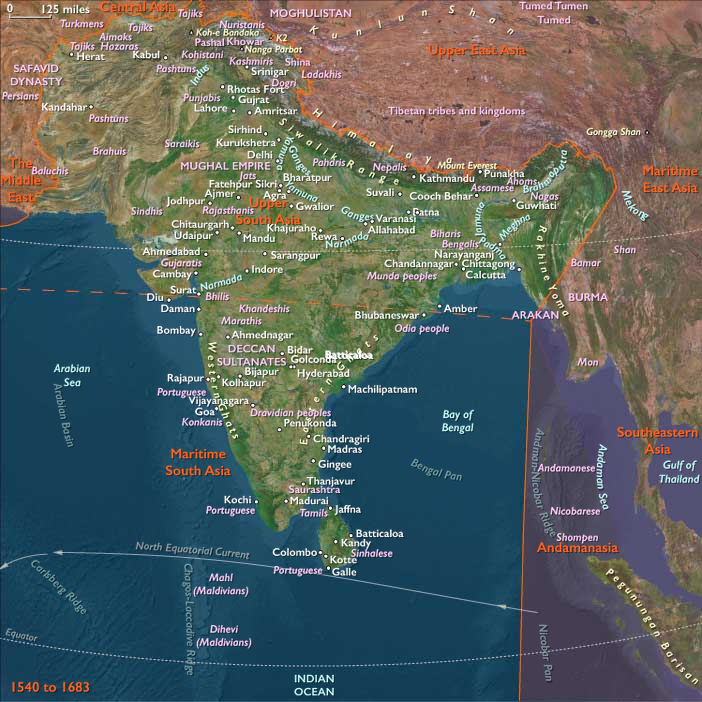
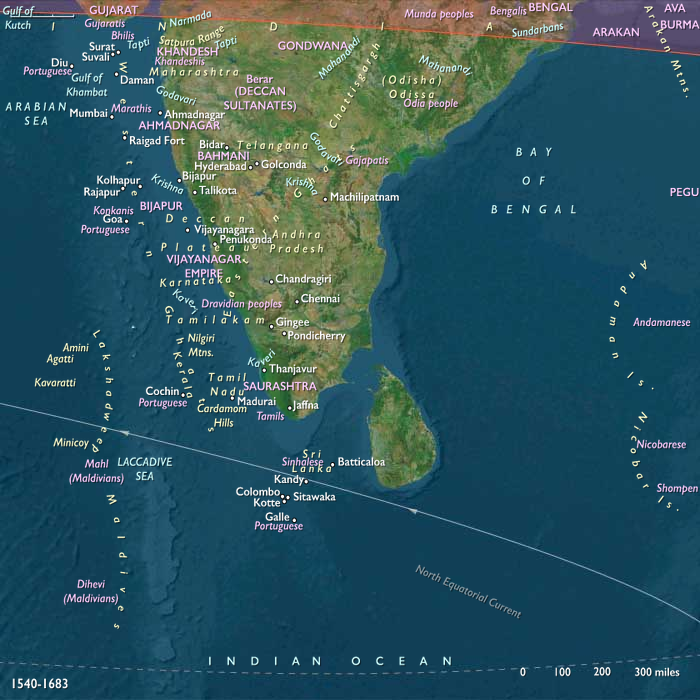
Rajasinha's defense of his kingdom's borders is …
Years: 1591 - 1591
Rajasinha's defense of his kingdom's borders is made more difficult by the Portuguese invasion of the northern Jaffna Kingdom in 1591.
Locations
People
Groups
- Sinhalese people
- Jaffna, or Aryacakravarti, Tamil Kingdom of
- Kozhikode, or Calicut, Kingdom of
- Kotte, Sinhalese Kingdom of
- Kandy, Sinhalese Kingdom of
- Sitawaka, Sinhalese Kingdom of
- India, Portuguese State of
- Portugal, Habsburg (Philippine) Kingdom of
Topics
Commodoties
Subjects
Regions
Subregions
Related Events
Filter results
Showing 10 events out of 34418 total
Joseon's King Seonjo, after sending envoys to the Japanese government and determining from their observations that Hideyoshi poses no threat, snubs Hideyoshi’s second request.
Border strife between Austrian and Ottoman Hungary, intermittent since the earliest Austro-Turkish War, becomes more violent during 1591.
The Sinan Pasha Mosque in Damascus, Syria, built with an alternating course of black and white stone in 1590 by the eponymous Ottoman-appointed governor of Damascus, stands on the site of an older mosque called the Mosque of Basal to the southwest of the walled city.
The donor, Sinan Pasha, had also served as the governor of Cairo and as the grand vizier to the sultan, and is known for his role in the Ottoman conquest of Yemen.
A city has grown up around Golconda fort in south-central India, but lack of space for expansion in the had prompted Mohammed Quli, the fifth Sultan of the Qutb Shahi dynasty, to call his advisers to search for a new virgin wooded elevated land site near a river, and one devoid of any man-made structures or monuments.
The city concept is planned on a gridron pattern with an iconic monument as the main foci.
Built from 1589 on the Musi River five miles (eight kilometers) east of Golconda in 1589, the planned site had been named as the City of Hyder after the title of the Fourth Caliph Ali, although many people believe that the city of "Hyderabad" was named after the people as their residence as "City of the Brave" from the Persian words "Hyder/Haider" (Persian and Urdu meaning lion or brave) and "Abad/Abaad" (Persian and Urdu meaning abode or populated) after their having survived the plague epidemic that had ravaged Golkonda.
There is another urban myth and folklore, probably apocryphal, that the Sultan had named it after his wife Hyder Mahal (it is unlikely, however, that he would given his spouse a male name or title).
The Sultan in 1591 orders the construction of the Charminar, a tall structure from which to survey the urban development and to keep watch over the river banks flooding the nearby areas, the source of grave epidemics of the kind the recent end of which this tower structure is built to commemorate.
The first dry crossing of Venice’s Grand Canal had been a pontoon bridge built in 1181 by Nicolò Barattieri and called the Ponte della Moneta, presumably because of the mint that stood near its eastern entrance.
The development and importance of the Rialto market on the eastern bank had increased traffic on the floating bridge, so it was replaced in 1255 by a wooden bridge.
This structure had two inclined ramps meeting at a movable central section, that could be raised to allow the passage of tall ships.
The connection with the market eventually led to a change of name for the bridge.
Two rows of shops had been built during the first half of the fifteenth century along the sides of the bridge.
The rents bring an income to the State Treasury, which helps maintain the bridge.
Maintenance was vital for the timber bridge, which had partly burnt in the revolt led by Bajamonte Tiepolo in 1310.
It had collapsed in 1444 under the weight of a crowd watching a boat parade and it again in 1524.
The idea of rebuilding the bridge in stone had been first proposed in 1503, with several projects considered over the following decades: the authorities had in 1551 requested proposals for the renewal of the Rialto Bridge, among other things.
Plans were offered by famous architects such as Jacopo Sansovino, Palladio and Vignola, but all involved a Classical approach with several arches, which was judged inappropriate to the situation.
Even the great Michelangelo was considered as designer of the bridge.
Antonio da Ponte wins a competition in 1587 for a design for a permanent bridge over the Grand Canal at the busy Rialto.
The earlier works of the Venetian architect-engineer are entirely unknown to us, though he has undoubtedly been the builder of many previous structures.
His broad, single-arch span, covered with arcaded shops, at once becomes one of the city's foremost monuments, renowned as an architectural and engineering achievement of the Renaissance.
Finally completed in 1591, it is remarkably similar to the wooden bridge it succeeded: two inclined ramps lead up to a central portico, and on either side of the portico the covered ramps carry rows of shops.
In the construction of this work Antonio is helped by his nephew Antonio Contino, who will also later design the famous Bridge of Sighs (Ponte dei Sospiri).
The engineering of the bridge is considered so audacious that architect Vincenzo Scamozzi predicts future ruin.
The bridge, the oldest of the four bridges spanning the Grand Canal, has defied its critics to become one of the architectural icons of Venice.

The Teatro all'antica ("Theater in the style of the ancients") in Sabbioneta, northern Italy, the first free-standing, purpose-built theater in the modern world, is constructed in 1588 and 1590 by the celebrated Vicentine architect Vincenzo Scamozzi under a commission from Duke Vespasiano I Gonzaga, as part of Gonzaga's effort to turn his tiny Ducal seat into an idealized classical city.
The importance that theater has come to hold, as a sign of the civilized society that the Duke is trying to create, is indicated by the prestigious location that had been reserved for the theater in the principal street of the town, the Via Giulia, and by the fact that a separate building has been erected to hold the theater.
This prestige location has a cost, however, in the form of a cramped and narrow setting that could be successfully converted into a theater only by the considerable ingenuity of one of the Renaissance's most gifted architects.
After the Teatro Olimpico in Vicenza, the Teatro all'antica is the second-oldest surviving indoor theater in theater in the world (and is, along with that theater and the Teatro Farnese in Parma, one of only three Renaissance theaters still in existence.)
Giordano Bruno—philosopher, mathematician and astronomer–is an Italian Dominican friar best known as a proponent of the infinity of the universe.
His cosmological theories go beyond the Copernican model in identifying the sun as just one of an infinite number of independently moving heavenly bodies: he is the first man to have conceptualized the universe as a continuum where the stars we see at night are identical in nature to the Sun.
Having moved in 1586 from France, where he has fallen from favor, to Germany, where he had failed to obtain a teaching position at Marburg but been granted permission to teach at Wittenberg, where he has lectured on Aristotle for the past two years.
With a change of intellectual climate there he is no longer welcome, however, nd had gone in 1588 to Prague, where he had obtained three hundred taler from Rudolf II, but no teaching position.
Bruno had gone on to serve briefly as a professor in Helmstedt, but had had to flee again when he is excommunicated by the Lutherans, continuing the pattern of Bruno's gaining favor from lay authorities before falling foul of the ecclesiastics of whatever hue.
During this period he has produced several Latin works, dictated to his friend and secretary Girolamo Besler, including De Magia (On Magic), Theses De Magia (Theses On Magic) and De Vinculis In Genere (A General Account of Bonding).
All these appear to have been transcribed or recorded between 1589 and 1590 by Besler (or Bisler).
He also publishes De Imaginum, Signorum, Et Idearum Compositione (On The Composition of Images, Signs and Ideas, 1591).
The year 1591 finds Bruno in Frankfurt.
Apparently, during the Frankfurt Book Fair, he receives an invitation to Venice from the patrician Giovanni Mocenigo, who wishes to be instructed in the art of memory, and also hears of a vacant chair in mathematics at the University of Padua.
Apparently believing that the Inquisition might have lost some of its impetus, he returns to Italy.
He is wrong about the Inquisition.
The eastward-moving Spanish colonists arrive in the La Rioja region to find the Diaguita culture, one of the most advanced Pre-Columbian cultures in Argentina.
The Diaguita culture had developed between the eighth and sixteenth centuries in what are now the provinces of Salta, Catamarca, La Rioja and Tucumán in northwestern Argentina, and in the Atacama and Coquimbo regions of northern Chile.
They have sophisticated architectural and agricultural techniques, including irrigation, and are known for their ceramic art.
They prefer the colors white, red and black.
They mostly do not build large settlements, but are sedentary farmers raising maize, pumpkins and beans, and herd animals such as llamas.
They reflect the Andean culture they shared with the Inca.
They worship the Sun, thunder and lightning.
Around the time of the Easter celebrations of 1591, approximately nine thousand of the estimated eleven thousand indigenous people living in the surrounding area attack the stronghold of La Padercitas in La Rioja as a protest to the poor treatment they receive from the Spanish settlers.During this time the Spanish settlers look to San Francisco Solano, in present Buenos Aires province, to reestablish the peace.
Juan Ramírez de Velazco, Governor of the Territories of Tucumán of the Viceroyalty of Peru, on May 20, 1591, establishes the city presently known as La Rioja as Todos los Santos de la Nueva Rioja in 1591 in homage to the region of La Rioja in Spain.
La Rioja is today the capital city of the Argentine province of La Rioja, located on the east of the province.
Agnes Sampson, also known as the "Wise Wife of Keith,” is on January 28, 1591, finally strangled and burned as a witch.
Judar Pasha had reached Songhai territory after a four-month journey, with his forces largely intact.
After seizing and razing the salt mines of Taghaza, he advanced on the Songhai capital of Gao.
Songhai ruler Askia Ishaq III, in response to the Moroccan incursion, raises a large army that includes some ninety-seven hundred to thirty thousand infantry infantry and twelve thousand five hundred to eighteen thousand cavalry.
Aksia Ishaq also brings along a herd of one thousand cattle, which he plans to use as a screening force for his infantry.
The Songhai army awaits Judar's force near Tondibi, a village just north of Gao.
Though the Songhai have a powerful cavalry, they lack the Moroccans’ gunpowder weapons, which will turn the tide of the battle.
The armies meet in March of 1591.
After an initial cavalry skirmish, Judar maneuvers his arquebusiers into place and opens fire with both arquebuses and cannons.
The noise and tremendous initial damage begins a cattle stampede behind the Songhai position.
Faced with gunfire ahead and a stampede behind, the Songhai army flees, ending the battle.
Years: 1591 - 1591
Locations
People
Groups
- Sinhalese people
- Jaffna, or Aryacakravarti, Tamil Kingdom of
- Kozhikode, or Calicut, Kingdom of
- Kotte, Sinhalese Kingdom of
- Kandy, Sinhalese Kingdom of
- Sitawaka, Sinhalese Kingdom of
- India, Portuguese State of
- Portugal, Habsburg (Philippine) Kingdom of