Raja Raja’s ascension to the Cholan throne …
Years: 985 - 985
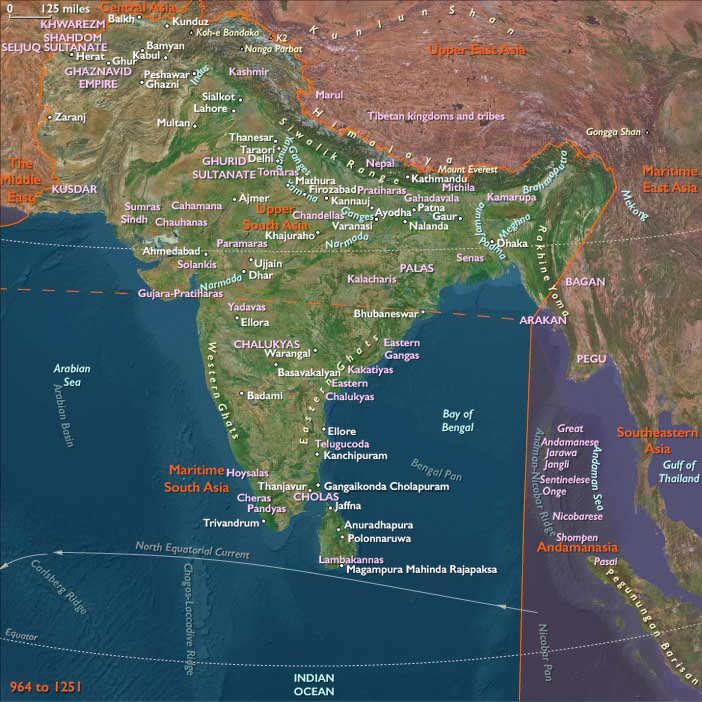
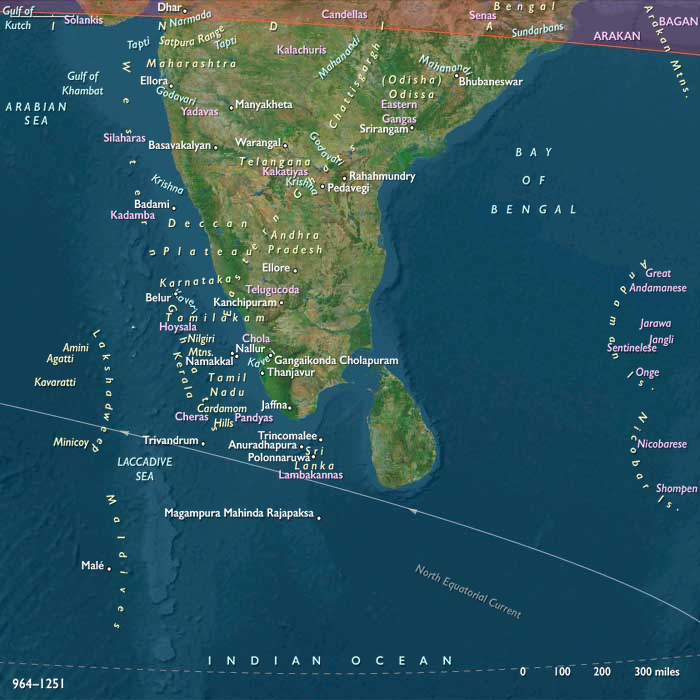
Raja Raja’s ascension to the Cholan throne in 985 heralds the beginning of the Cholas’ so-called “middle period.”
Locations
People
Groups
Topics
Subjects
Regions
Subregions
Related Events
Filter results
Showing 10 events out of 52307 total
Vladimir’s campaigns have by 985 won Kievan Russia control of the entire area from Poland to the Volga River.
Henry II, released from captivity after Otto's death, tries once again to usurp the German throne, abducting the infant Otto III.
Although he fails in his attempt to gain control of Germany, he does regain Bavaria.
The first known states to hold power in Silesia had been those of Greater Moravia at end of the ninth century and Bohemia early in the tenth century.
The alliance between Poland and Bohemia had been overturned between 977 and 985.
Poland has participated in invasions led by the German Empire against Bohemia, and in 985 or 990 acquires Silesia at Bohemia’s expense.
The German resettlement of the east is a slow process that centers around the Danube.
The margravate of Leopold I had originally coincided with the present-day Wachau valley, and whose eastern boundary was the Traisen river near Sankt Pölten east of Krems.
With the Magyar threat largely reduced following their defeat at the Battle of Lechfeld in 955, Leopold has focused on securing his holdings from internal threats and dissensions.
In 984, he had engaged in the reduction of the fortress at Melk, which was still controlled by supporters of the late margrave.
Once Melk was secured, Leopold most likely used it as his residence, founding a monastery there for twelve secular priests.
By 987, Leopold has extended the boundary of his margravate to the east as far as the Wienerwald.
(The German name for Austria will only be first mentioned as Ostarrichi in a famous document of 996.)
Basil Lekapenos, an illegitimate son of the emperor Romanos I Lekapenos, had been castrated when young.
In about 945, around the time his father was deposed, Basil had been appointed parakoimomenos by Emperor Constantine VII, his brother-in-law.
He had retained this position under emperors Romanos II, Nikephoros II, and John Tzimisces.
As head of the Imperial administration, he has amassed a large personal fortune.
Reportedly, this had led to tension with John Tzimisces shortly before the Emperor's death in 976.
According to some sources, Basil had poisoned the Emperor.
He continues in office in the early reign of Basil II but in 985 the young Emperor—wishing to assume the government himself after being dominated by regents and caretaker emperors for thirty years—accuses him of sympathizing with the rebel Bardas Phokas and removes Basil from power.
All his lands and possessions are confiscated and all laws issued under his administration are declared null and void.
Basil Lekapenos himself is exiled and dies shortly afterwards.
Seeking to protect the lower and middle classes, Basil II makes ruthless war upon the system of immense estates which had grown up in Asia Minor and which his predecessor, Romanos I, had endeavored to check.
Sharaf al-Dawla poses the largest threat to Samsam al-Dawla, despite the power of Fakhr al-Dawla.
He recovers Buyid Oman, which had earlier seceded to Samsam al-Dawla.
Saffar ibn Quddawiyah, a Daylamite chief, revolts against the authority of Samsam in 985, joining with Shirdil.
Saffar leads a force against Samsam to Baghdad, but Samsam’s superior numbers result in Saffar’s defeat.
The Jews of Palestine, Syria, and Persia at this time are reportedly occupied as dyers, tanners, cobblers, butchers and bankers, whereas the Christians are the scribes and physicians.
Al-Magdes, a Jerusalem-born Muslim traveler, reports in 985 that Christians and Jews outnumber Muslims in Jerusalem.
Nikon was born in Pontus (modern northeastern Turkey) or in Argos, of Armenian or Greek origin.
When he was young, Nikon had gone to a monastery known as Khrysopetro ("Golden Stone") located on the borders of Pontus and Paphlagonia, where he spent twelve years, living an ascetic life of prayer and penance, so extreme that his brothers had tried to persuade him to lessen his regimen.
His abbot, impressed by his spiritual conferences and worried that his newly returned father would draw him from the ascetic life, had sent him out into the world to preach.
After his departure, he traveled to Asia Minor and preached repentance there for three years before moving on.
Following the expulsion of the Arabs from Crete in 961 by Nikephoros Phokas, he had become active as a missionary preacher on the island, struggling to return recent converts of Islam back to Christianity.
The area had been a Muslim emirate since the 820s, and in that time Christianity in the area had weakened, many former Christians having converted to Islam.
Even those who had remained faithful to Christianity had somewhat lost contact with the living tradition, churches and monasteries having fallen into decay.
The people in the region were, as quoted from Nikon's biography, not Islamic, but rather Christians who had been corrupted "by time and long fellowship with the Saracens."
Nikon was forced to change his tactics on Crete, now having to use his wit to lead his listeners to repentance, rather than just preaching the message of repentance.
It was there that he acquired the nickname metanoite (Greek for "penitent/repent") for his habit of using it as a preface to all his sermons.
After spending five years on Crete, Nikon had gone on to Epidauros, Athens, and Euboea.
He had then traveled to Thebes and Corinth, and finally down into the Peloponnese, particularly to Sparta, where he constructs three churches and a monastery and continues his preaching and teachings, which are reportedly confirmed by miracles.
The Peloponnese is represented as a land full of demons, of which Nikon is constantly struggling against.
Upon being approached in 985 to try to stop a plague of pestilence, Nikon refuses until the Jews are expelled so he “would not be contaminated by their customs...or religion.”