Ragnall, descending on York in 919, takes …
Years: 919 - 919
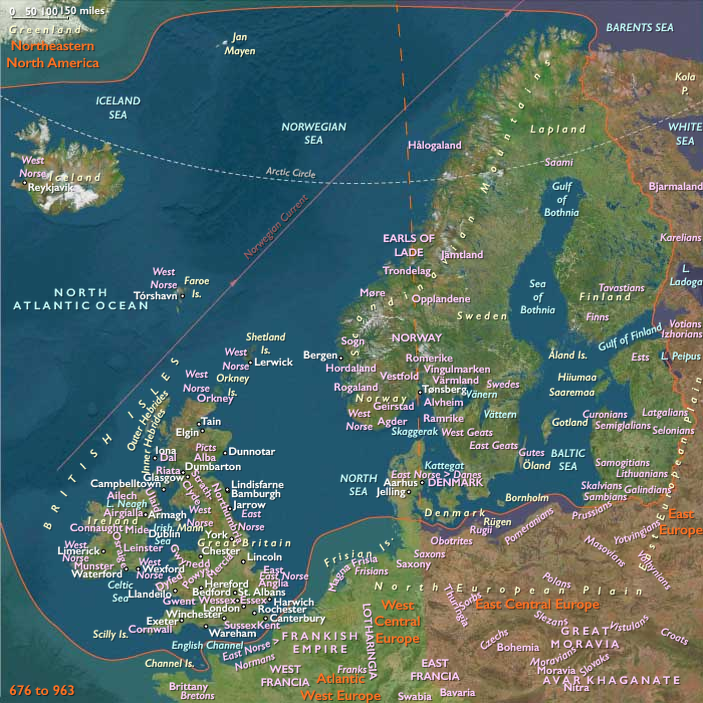
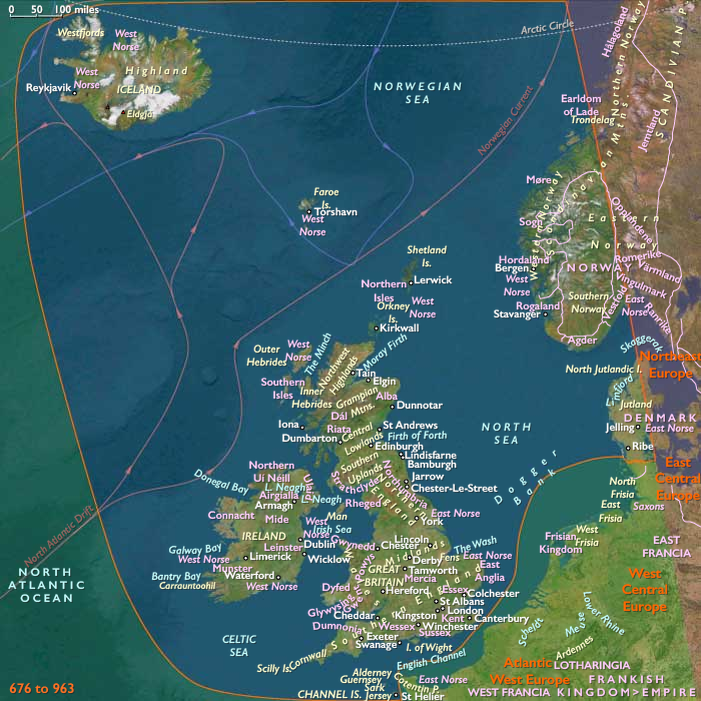
Ragnall, descending on York in 919, takes the city and has himself proclaimed king.
The Bernicians remain under him, though Ealdred of Northumbria and Dyfnwal II, king of Strathclyde, do homage to the king of England.
Locations
People
Groups
- Britons (historical)
- Angles
- Irish people
- Anglo-Saxons
- Wessex, English Kingdom of
- Britain, Medieval
- Vikings
- Danes (Scandinavians)
- Norse
- Ireland, medieval
- Strathclyde, British Kingdom of
- York, Scandinavian (Norse)
Topics
Commodoties
Subjects
Regions
Subregions
Related Events
Filter results
Showing 10 events out of 53314 total
Rumors have begun to circulate that Leo Phokas, whose army lies encamped across the Bosporus from Constantinople, and his brother-in-law Constantine the Paphlagonian are planning to seize the throne from the young emperor Constantine VII.
Zoe herself (according to Steven Runciman) may have planned to marry the general and solidify her own position.
The Emperor's tutor, however, a certain Theodore, had turned to Romanos Lekapenos; although the admiral carries a great share of the blame for the failure of the Bulgarian campaign, Romanos remains a powerful factor as his fleet is intact and ready at hand.
The parakoimomenos Constantine tries to neutralize this threat by disbanding the fleet, but he is arrested by Lekapenos when he arrives to supervise the discharge of the crews.
With this stroke, Zoe loses all control of the situation, and at Theodore's urging, the young Emperor appoints the Patriarch Nicholas Mystikos as regent.
The Patriarch's first act is to dismiss Phokas from his post as Domestic and replace him with John Garidas.
Phokas tries to secure his position by forcing the Patriarch to appoint some of his relatives to command the Hetaireia, the imperial bodyguard.
The Patriarch at first agrees, but almost immediately dismisses them.
At this point, Phokas turns to Lekapenos and offers him a marriage alliance.
Lekapenos agrees and concludes a pact with him, allowing Phokas to return to his troops at Chrysopolis.
Pjokas apparently believes that Lekapenos, in view of his lowly origins, could never possibly put forward a credible claim for the imperial throne.
Events prove that he had severely miscalculated his new ally: on March 25, 919, Lekapenos manages to gain entrance to the imperial palace, occupies it and secures his appointment as magistros and commander of the Hetaireia.
A few weeks later, he marries his daughter Helena to the young Emperor and assumes the title of basileopator, becoming the virtual ruler of the Empire.
Phokas is now sent a letter, in the Emperor's name, in which he is bidden not to react to these events.
Inevitably, the outmaneuvered general rises in revolt, but fails to secure the loyalty of his troops: they begin to desert to the imperial camp, especially after a letter from the young Constantine VII, which acclaims Lekapenos as his protector and denounces Phokas's rebellion, reaches the rebel camp and is read aloud to them.
Eventually, Phokas is forced to flee, but is captured and blinded by the Emperor's agents in Bithynia.
Following the discovery of a plot by some of his friends a few months later, Phokas suffers a final humiliation, being paraded through the streets of Constantinople on a mule.
His fate hereafter is unknown.
Lekapenos engineers a coup to depose Zoe in August 919 and confines her to the monastery of St Euphemia-in-Petrium.
The Abbasid army had been defeated by Yusuf near Ardabil in 918, but the Sajid ruler is defeated in 919.
Yusuf is captured and brought back to Baghdad, where he will be imprisoned for the next three years.
The Alamanni had been defeated in 496 by King Clovis I, brought under Francia, and governed by dukes who were dependent on the Frankish kings.
In the seventh century, the people had converted to Christianity, bishoprics had been founded at Augsburg and Konstanz, and in the eighth century abbeys at Reichenau Island and Saint Gall.
The Alamanni had gradually thrown off the Frankish yoke, but in 730 Charles Martel had again reduced them to dependence, and his son Pepin the Short had abolished the tribal duke and ruled the duchy by county palatines, or kammerboten.
At this time the Duchy of Swabia, which was divided into gaus or counties, took the shape which it will retain throughout the Middle Ages.
It is bounded by the Rhine, Lake Constance, the Lech River and the Duchy of Franconia.
The Lech, separating Alamannia from the Duchy of Bavaria, does not form, either ethnologically or geographically, a very strong boundary, and there is a good deal of intercommunion between the two people.
During the later and weaker years of the Carolingian Empire the counts had become almost independent, and a struggle for supremacy has taken place between them and the Bishopric of Constance.
The chief family in Alamannia is that of the counts of Raetia, who are sometimes called margraves, and one of whom, Burchard I, was called duke of the Alaminnia.
Erchanger, originally a missus dominicus in Swabia, had allied with Bishop Solomon III of Constance due their common political goals.
Erchanger is at this time striving for ever greater power in Swabia alongside Burchard I and Burchard II, his son, who had taken part in the early wars over Swabia.
His family being from Franconia, Burchard II had founded the monastery of St Margarethen in Waldkirch to extend his family's influence into the Rhineland.
Erchanger plays a conspicuous part in the downfall of the elder Burchard, who is convicted of high treason and executed, in 911.
On his father's arrest and execution, Burchard II and his wife, Regelinda, daughter of Count Eberhard I of Zürich, had gone to Italy: either banished by Count Erchanger or voluntarily exiling themselves to their relatives over the Alps.
With the fall of the Burchards, Erchanger and his younger brother Berthold became the most powerful counts in the tribe.
Erchanger and King Conrad I of Germany had fallen out in 913, but Erchanger married off his sister Cunigunda, whose husband, Luitpold, had just died, to the king.
With this diplomatic marriage, Erchanger became the king's representative in Swabia.
With this, his alliance with Bishop Solomon had broken and the bishop had opposed his rise.
Seeing his income diminished by the bishop, Erchanger had imprisoned Solomon in 914.
Conrad had opposed this and freed the bishop, exiling Erchanger.
Burchard II had meanwhile returned from exile and had taken control over his father's property.
In 915, he had joined Erchanger and Arnulf, Duke of Bavaria, in battle against the Magyars.
Then Burchard and Erchanger had turned on King Conrad I and, at the Battle of Wahlwies in the Hegau, had defeated him.
Erchanger had been proclaimed duke.
However, at a high court in Hohenaltheim in September 916, Erchanger had been condemned to a monastery for offenses against king and bishop.
After Erchanger was killed on the instructions of the king on January 21, 917, Burchard had seized all his lands and in 919 is recognized as duke by King Henry I.

Magyar Raid on Alsace (917): The Eastern Frankish Kingdom Under Attack
In 917, the Magyars, nomadic warriors from the Hungarian plains, launch a raid into Alsace, continuing their devastating incursions into East Francia. This attack is part of a broader wave of Magyar invasions that threaten the crumbling Carolingian realm in the early 10th century.
Context: The Magyar Raids into East Francia
- The Magyars had emerged as a dominant force in Central Europe, taking advantage of the fragmentation of East Francia following the death of Louis the Child (911).
- Lacking a strong central ruler, East Francia was vulnerable to external attacks, and the Magyars frequently raided into Bavaria, Swabia, and Lotharingia.
- The raid on Alsace in 917 follows previous incursions into Germany, Italy, and Burgundy, as the Magyars exploit weak defenses along the Rhine frontier.
The Raid on Alsace
- The Magyars, known for their swift horse-mounted warfare, penetrate deep into Alsace, targeting towns, monasteries, and trade routes.
- The raiders plunder villages and religious sites, taking slaves and loot before retreating to their strongholds in the Hungarian plains.
- The East Frankish nobility struggles to mount a coordinated defense, as the kingdom is divided among powerful dukes, each focused on securing their own territories.
Consequences of the 917 Magyar Raid
-
Continued Weakness of East Francia
- The raid highlights the vulnerability of the eastern frontier, as local rulers fail to repel the invaders effectively.
- The Carolingian system of decentralized rule makes a unified military response difficult, allowing the Magyars to raid almost at will.
-
The Need for Stronger Defenses
- The attacks lead to greater reliance on local ducal leadership, particularly in Bavaria, Swabia, and Franconia, which begin to fortify their regions.
- This foreshadows the rise of the Ottonian dynasty, which will later develop military strategies to counter the Magyar threat.
-
Prelude to Further Magyar Raids
- The Magyar raid of 917 is one of many incursions into East Francia and signals continued instability in the region.
- Their attacks will intensify throughout the 920s and 930s, culminating in the Battle of Lechfeld in 955, where they will finally be defeated by Otto I of Germany.
Conclusion: The Growing Magyar Threat
The 917 raid on Alsace demonstrates the ongoing weakness of the East Frankish kingdom, which is unable to effectively resist the Magyars. The fragmentation of Carolingian authority ensures that these raids will continue, pushing East Francia toward military reform and centralized ducal leadership, ultimately paving the way for the rise of the Holy Roman Empire.
The Decline of Charles the Simple’s Rule and the Rise of Opposition (917–919)
By 917–919, the reign of Charles the Simple, King of West Francia, is increasingly undermined by internal discontent among the nobility. His favoritism toward Hagano, a petty noble of Lotharingian origin and a relative of his first wife, Frederuna, creates widespread resentment among the aristocracy.
The Rise of Hagano and Noble Resentment
- Hagano gains Charles' favor following the death of Queen Frederuna in 917, despite being of minor noble status (mediocris).
- By 918, he is the king’s most trusted advisor, wielding influence over court politics and royal patronage.
- The West Frankish aristocracy despises him, largely because Charles begins transferring monastic beneficesfrom powerful nobles to Hagano, thereby weakening their influence.
- This results in Charles losing noble support, making him increasingly isolated and unable to effectively rule.
The Breakdown of Royal Authority (919)
- The nobility’s dissatisfaction culminates in open defiance in 919, when the West Frankish barons refuse to aid Charles in repelling a Magyar invasion.
- Lotharingian discontent grows, and one of its most powerful nobles, Gilbert (son of Reginar I of Hainaut), shifts his loyalty to Henry the Fowler, King of East Francia.
- According to Flodoard, Gilbert is even elected "prince" (princeps) by the Lotharingian aristocracy, effectively removing Lotharingia from Charles’ control.
- Robert of Neustria, another leading noble, makes an independent treaty with the Vikings, ignoring the king’s authority.
The Beginning of the End for Charles the Simple
- Charles’ alienation of the nobility, particularly by favoring Hagano at their expense, leads to his inability to govern effectively.
- His weakening authority paves the way for open rebellion, and within a few years, his rule will collapse entirely.
- Lotharingia is lost to Henry the Fowler, and West Francia itself becomes unstable, setting the stage for dynastic conflict.
Conclusion: A King Undone by Favoritism and Noble Defiance
Charles the Simple’s loyalty to Hagano and his willingness to alienate his powerful vassals cost him both Lotharingia and the support of the West Frankish nobility. His failure to unite his realm against external threats, including the Magyars and Vikings, ensures that his downfall is only a matter of time.
The Collapse of Brittany and the Viking Conquest (919)
After decades of internal conflict and external threats, Brittany succumbs to Viking domination in 919, with the region's nobility fleeing to Francia and England, leaving the land under the control of Rognvald, a Viking leader who establishes Nantes as his capital.
Background: Breton Expansion and Internal Struggles
- After the death of Charlemagne, Breton expansion intensifies, with the region increasingly asserting independence from West Francia.
- In 850, Nominoë, ruler of Brittany, invades and conquers Nantes and Rennes, establishing Breton control over the Frankish-controlled Breton March.
- Following the Battle of Jengland (851) and the Treaty of Angers, the Breton March is integrated into Brittany, marking a high point of Breton sovereignty.
Eighty Years of Breton Civil Strife and Viking Raids
- Despite its independence, Brittany is destabilized by internal power struggles among its warlords.
- Rival nobles often turn to Viking allies to gain an advantage, leading to repeated Norse incursions.
- One of the most catastrophic Viking attacks occurs on June 24, 843, when the Norse sack Nantes and kill Bishop Gohard, an event described in the Chronicle of Nantes:
- "The city of Nantes remained for many years deserted, devastated, and overgrown with briars and thorns."
The Final Collapse: Viking Conquest of Brittany (919)
- By 919, Breton defenses have completely collapsed, and the remaining Breton nobility flee to Francia and England, abandoning their homeland.
- Rognvald, a Viking warlord, establishes Nantes as his new capital, consolidating Norse rule over Brittany.
- The Viking occupation represents the complete breakdown of Breton autonomy, reversing the gains of Nominoë and his successors.
Consequences of the Viking Conquest of Brittany
-
Brittany is No Longer Independent
- The Breton ruling class is exiled, leaving Viking chieftains in control.
- This is the first time in nearly a century that Brittany is completely dominated by a foreign power.
-
Nantes Becomes a Viking Stronghold
- Under Rognvald’s rule, Nantes serves as the center of Norse power in Brittany.
- From here, the Vikings launch further raids into Frankish territories.
-
Future Efforts to Reclaim Brittany
- In the coming decades, exiled Breton nobles in Francia and England will attempt to reclaim their homeland, leading to the eventual reconquest of Brittany in the mid-10th century.
Conclusion: A Temporary Viking Victory
The Viking conquest of Brittany in 919 marks a low point in Breton history, as internal conflict, noble rivalries, and external invasions culminate in the region’s total collapse. However, the exiled Bretons will not remain idle, and efforts to restore Breton rule will eventually lead to a resurgence of independence later in the century
The reign of Conrad, Franconian king of the Germans, has been a continuous and generally unsuccessful struggle to uphold the power of the kingship against the growing power of the leading Saxon, Bavarian, and Swabian families—rulers of the other so-called stem duchies.
His military campaigns against Charles the Simple to regain the Duchy of Lorraine with the Imperial city of Aachen had ben failures, Archbishop Ratbod of Trier in 913 even becoming West Frankish chancellor.
Conrad's realm has furthermore been exposed to the continuous raids of the Hungarians since the disastrous defeat of the Bavarian forces at the 907 Battle of Pressburg, leading to a considerable decline in his authority.
His attempt to mobilize the East Frankish episcopate, led by Archbishop Unni of Bremen, to his cause at the 916 synod of Hohenaltheim has not been enough to compensate.
After several clashes of arms, Conrad at least has been able to come to terms with Duke Henry of Saxony.
The rebellious Swabian dukes Erchanger (executed in 917) and Burchard II, however, have been continuous threats, as has he Bavarian duke Arnulf the Bad.
Severely injured at one of his fights with Arnulf, Conrad dies on December 23, 918 at his residence Weilburg Castle.
He is buried in Fulda Cathedral.
The death of Conrad, a champion of Carolingian power, marks the end of the revived Roman Empire established in 800 by Charlemagne.
Conrad on his deathbed, according to the Res gestae saxonicae by chronicler Widukind of Corvey, had persuaded his younger brother Eberhard to offer the crown to Henry the Fowler, the duke of Saxony and one of his principal opponents, since he considers Henry to be the only prince capable of holding the German kingdom together in the face of internal rivalries among the dukes and the continuous Hungarian raids.
It is, however, not until May 919, when Eberhard and the other Frankish nobles accept Conrad's advice, and Henry is elected king, as Henry I, at the Reichstag of Fritzlar.
On his accession, Henry quickly forces the tribal duchies of Bavaria and Swabia to acknowledge him.
Eberhard, who had succeeded Conrad as Duke of Franconia, will remain loyal to King Henry.
Edward the Elder in 919 builds Bedford’s first known fortress, on the south side of the River Ouse, and here receives the area's submission.
Henry I, on his accession as king of Eastern Francia, had quickly fortified Magdeburg against the Magyars and Slavs.
Years: 919 - 919
Locations
People
Groups
- Britons (historical)
- Angles
- Irish people
- Anglo-Saxons
- Wessex, English Kingdom of
- Britain, Medieval
- Vikings
- Danes (Scandinavians)
- Norse
- Ireland, medieval
- Strathclyde, British Kingdom of
- York, Scandinavian (Norse)