
Rachel Ruysch, who had been inducted into …
Years: 1715 - 1715
September
Rachel Ruysch, who had been inducted into the painters' guild in The Hague in 1701, had been invited in 1708 to work for the court in Düsseldorf and serve as court painter to Johann Wilhelm, Elector Palatine; she will remain working for him and his wife from until the prince's death in 1716.
Ruysch will live eighty-five years and her dated works establish that she had painted from the age of fifteen until she was an octogenarian.
About a hundred paintings by her are known.
The background of the paintings are usually dark.
Ruysch is also noted for her paintings of detailed and realistic crystal vases.
Born in The Hague, Ruysch had moved to Amsterdam when she was three when her father Frederik Ruysch, a famous anatomist, and botanist, was appointed a professor there.
He has gathered a huge collection of rarities in his house.
She had assisted her father decorating the prepared specimen in a liquor balsamicum with flowers and lace.
Ruysch had been apprenticed at fifteen to Willem van Aelst, a prominent Delft painter, known for his flower paintings.
In 1693 she had married a portrait painter, Juriaen Pool (1666–1745), with whom she has ten children.
Her sister Pieternel is married to Jan Munnicks, a young man who draws flowers in the Hortus Botanicus Amsterdam.
Ruysch is extremely pious.
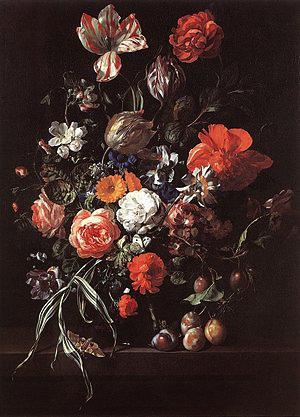
Rachel Ruysch, "Still-Life with Bouquet of Flowers and Plums", 1704, Royal Museums of Fine Arts of Belgium
Locations
People
Groups
Topics
Subjects
Regions
Subregions
Related Events
Showing 10 events out of 28354 total
Years: 1715 - 1715
September
Rachel Ruysch, "Still-Life with Bouquet of Flowers and Plums", 1704, Royal Museums of Fine Arts of Belgium
Locations
People
Groups
Topics
Subjects
Regions
Subregions