Rabia Basri, recognized by the Muslim community …
Years: 801 - 801
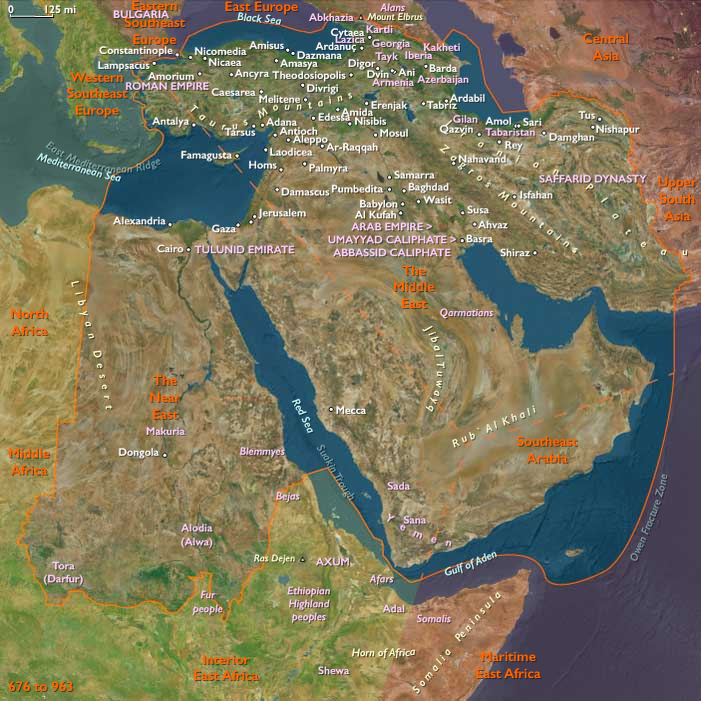
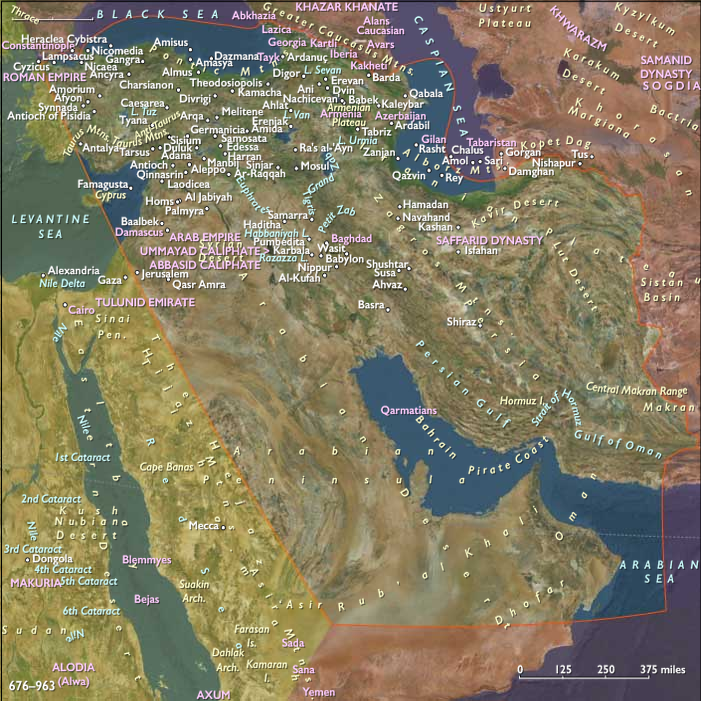
Rabia Basri, recognized by the Muslim community as a Sufic saint not long after her death in 801, calls upon her coreligionists to love God "for his own sake," not out of hope for paradise or terror of hell.
Locations
People
Groups
Subjects
Regions
Subregions
Related Events
Filter results
Showing 10 events out of 54857 total
Bahlul Ibn Marzuq had rebelled in Zaragoza in 798 against the Arab-Muslim central government of Muslim Al-Andalus.
He rebels in Zaragoza against the government of Al-Andalus in 798, and in 800 had conquered Huesca from the Banu Salama.
His rebellion carries popular support, especially after public backing by theologian Ibn al-Mughallis.
The emir sends the Huesca native, general Amrus ibn Yusuf, and Huesca and …
…Zaragoza are retaken around 801.
Charles invades the rebellious papal territory of Benevento in 801 to bring it under his control.
The Franks, under King Charles’s son Louis the Pious, to whom his father has assigned the Franks’ southwestern front, had laid siege to Barcelona in 800.
Local Christian rulers aid the Franks and, after a series of struggles, Louis occupies Barcelona (with Ausona) on December 28, 801, thus securing Frankish power in the borderland between the Franks and the Moors.
The newly appointed Count of Barcelona, one Bera, now becomes the principal representatives of Frankish authority in the Spanish March, or Marca Hispanica, a buffer zone beyond the province of Septimania, created by Charles I in 795 as a defensive barrier between the Umayyad Moors of Al-Andalus and the Frankish Kingdom.
The March includes various outlying smaller territories, each ruled by a lesser miles with his armed retainers and who theoretically owes allegiance through the Count to the Emperor.
The rulers are called counts; when they govern several counties they often take the name duke.
Counties formed in the ninth century at the eastern end of the Pyrenees as an appanages of the Counts of Barcelona include …
…Cerdanya, …
…Girona and …
…Urgell.
Jayavarman II, according to an older established interpretation, was supposed to be a prince who lived at the court of the Sailendra dynasty in Java (today's Indonesia) and brought back to his home the art and culture of the Javanese Sailendran court to Cambodia.
At this time, Sailendras allegedly rule over Java, Sumatra, the Malay Peninsula and parts of Cambodia.
This classical theory was revisited by modern scholars, such as Claude Jacques and Michael Vickery, who noted that Khmer called chvea the Chams, their close neighbors.
Moreover, Jayavarman's political career began at Vyadhapura (probably Banteay Prei Nokor) in eastern Cambodia, which make more probable long time contacts with them (even skirmishes, as the inscription suggests) than a long stay in distant Java.
Finally, many early temples on Phnom Kulen shows both Cham (e.g., Prasat Damrei Krap) and Javanese influences (e.g., the primitive "temple-mountain" of Aram Rong Cen and Prasat Thmar Dap), even if their asymmetric distribution seems typically Khmer.
Jayavarman appears to have been of aristocratic birth, beginning his career of conquest in the southeast of present-day Cambodia.
After he eventually returned to his home, the former kingdom of Chenla, he quickly built up his influence, conquered a series of competing kings, and in 790 became king of a kingdom called "Kambuja" by the Khmer.
In the following years he extended his territory and eventually established his new capital of Hariharalaya near the modern Cambodian town of Roluos.
He thereby laid the foundation of Angkor, which is to arise some fifteen kilometers to the northwest.
In 802, he declares himself Chakravartin, in a ritual taken from the Indian-Hindu tradition, thereby becoming not only the divinely appointed and therefore uncontested ruler, but also simultaneously declares the independence of his kingdom from Java.
The foundation of Hariharalaya near present day Roluos is the first settlement in what will later become the empire of Angkor.
Despite this key role in Khmer history, few firm facts survive about Jayavarman.
No inscriptions authored by him have been found, but he is mentioned in numerous others, some of them written long after his death.

Abbasid caliph Harun al-Rashid declares, in the so-called Meccan Document of 802, that his two sons, Muhammed al-Amin and Allah al-Ma'mun, should rule the Muslim empire after his death, with the imperial title held by al-Amin and the rule of Khorasan and the eastern half of the caliphate under al-Ma'mun.
Charles begins in the early ninth century to issue a new kind of land grant, the aprisio, which reallocates land previously held by the imperial crown fisc in deserted or abandoned areas.
This includes special rights and immunities that allow considerable independence from the imperial control.
Historians have interpreted the aprisio both as an early form of feudalism and in economic and military terms as a mechanism to entice settlers to a depopulated border region.
Such self-sufficient landholders will aid the Counts in providing armed men to defend the Frankish frontier.
Aprisio grants (the first ones are in Septimania) are given personally by the Carolingian king, so that they reinforce loyalty to central power, to counterbalance the local power exercised by the Marcher Counts.