Qumran, rebuilt after the earthquake of 31 …
Years: 68 - 68
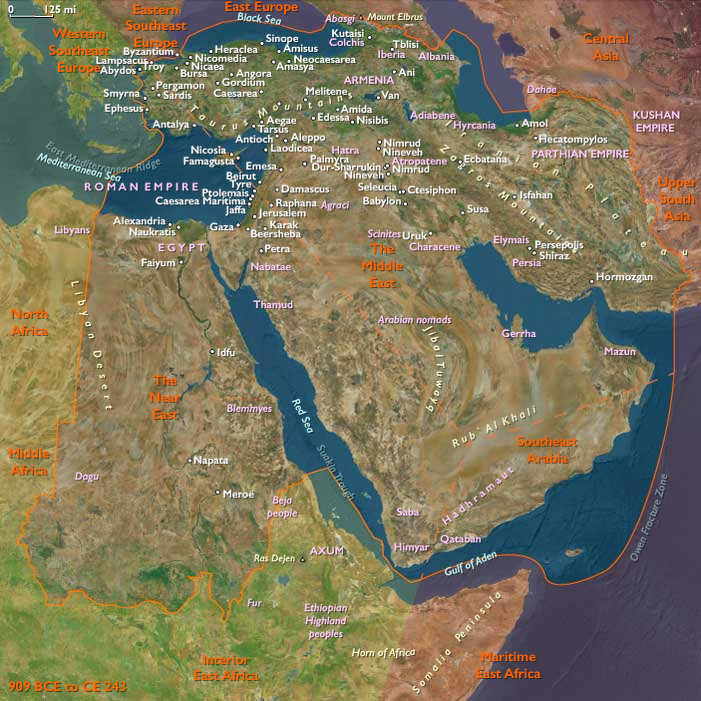
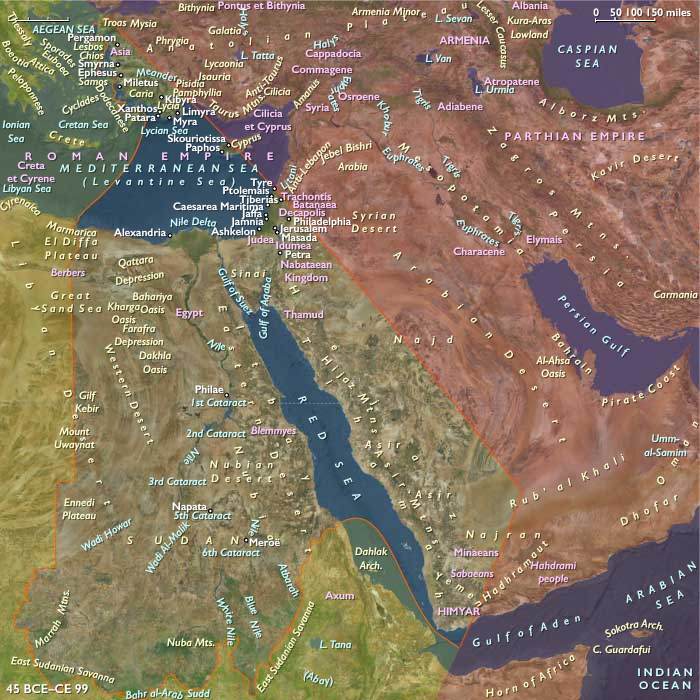
Qumran, rebuilt after the earthquake of 31 BCE, is in 68 destroyed by the Romans, who leave a garrison here.
Locations
People
Groups
- Jews
- Greeks, Hellenistic
- Galilee, Roman province of
- Judea (Roman province)
- Roman Empire (Rome): Julio-Claudian dynasty
Topics
Commodoties
Subjects
Regions
Subregions
Related Events
Filter results
Showing 10 events out of 61633 total
Buddhism is introduced to China in 68.
Chinese Buddhists create their own types of pagodas; one derived from an indigenous structure, the other from the spired towers of Hindu shrines in India (whose name is derived from the Sanskrit term “Bhagavatipagoda,” "divine female”).
The former, the ting pagoda, is rectangular in plan and consists of several levels of open pavilions, each with its own upward-curving roof.
Josephus, while under the patronage of Vespasian, wrote that after the Roman Legio X Fretensis accompanied by Vespasian destroyed Jericho on June 21, 68, he took a group of Jews who could not swim (possibly Essenes from Qumran), fettered them, and threw them from boats into the Dead Sea to test its legendary buoyancy.
The Jews shot back up out of the water and floated calmly on top of the sea.
Jewish rebels driven out of Galilee rebuild Joppa (Jaffa), which had been destroyed earlier by Cestius Gallus.
Surrounded and cut off by the Romans, they rebuild the city walls, and use light flotilla to demoralize commerce and interrupt the grain supply to Rome from Alexandria.
Vespasian’s army in 68 destroys Jaffa and punishes other rebel cities as he pushes southward toward Jerusalem.
Simon ben Giora stays safe from the Jewish authorities in Masada until Ananus ben Ananus is killed in the Zealot Temple Siege, after which he leaves the fortress for the hill country and proclaims liberty for those in slavery, and a reward to those already free.
Gathering power quickly as more people and influential men join him, he soon dares to venture into the flatlands, constructs a fort in a village called Nain, and stores food and booty in caves.
It is obvious that he is preparing to attack Jerusalem.
Simon first attacks Idumea, however, and his intimidating army meets no real resistance.
He marches into Hebron, robs the grain stores of towns and villages, and plunders the countryside in order to feed his vast troops.
He is now followed by forty thousand people not including his soldiers.
Zealot control of Jerusalem is confined to the inner court of the city and the Temple itself.
Outnumbered and isolated by Ananus' troops surrounding the Temple, Eleazar’s control of the Temple is seriously threatened from the winter of 67 to the spring of 68.
When John of Giscala enters Jerusalem, there is growing unrest.
Ananus, having incited the people to rise up against the Zealots, who are robbing the people and using the Temple of Jerusalem as their base of operations, begins to recruit for armed conflict.
The Zealots, learning of this, sally forth from the Temple quarter, attacking all in their way.
Ananus quickly organizes the people against them.
The skirmish begins with the belligerents throwing rocks at one another, then javelins, then finally hand-to-hand combat with swords ensues.
Eventually the Zealots retreat to the inner court of the Temple, and six thousand of Ananus’s men hold the first (outer) court.
According to Josephus, John of Giscala, who secretly seeks to rule Jerusalem, had cultivated a friendship with Ananus.
Suspected of being a spy, John is made to swear an "oath of goodwill" to Ananus and the people, after which Ananus sends John into the inner court, to speak with the Zealots on his behalf.
John desperately needed Eleazar's funds to supply his followers, and Eleazar requires the protection of John's large entourage to fend off Ananus.
John immediately turns coat, "as if his oath had been made to the zealots," telling them that they are in imminent danger, and cannot survive a siege.
He tells them that they have two options: 1) to surrender, in which case they would either face execution, vigilantism, or retribution for the "desperate things they had done"; or 2) to ask for outside assistance.
John tells the Zealots that Ananus had sent ambassadors to Vespasian to ask him to come take the city.
This in fact was not true, but persuades them that they cannot endure a siege without help.
The messengers manage to sneak out of the Temple and successfully deliver their message to the rulers of the Idumeans, who are greatly alarmed, and quickly raise an army of twenty thousand to march on Jerusalem, "in order to maintain the liberty of their metropolis."
Upon receiving word that twenty thousand Idumeans are marching on Jerusalem, ben Hanan orders the gates shut against them, and the walls guarded.
Jesus, one of the elder high priests, makes a speech from the walls, denouncing the Zealots as robbers and telling the Idumeans to throw down their arms.
Simon, son of Cathlas, one of the Idumean commanders, quiets the tumult of his own men and answers: "I can no longer wonder that the patrons of liberty are under custody in the temple, since there are those that shut the gates of our common city to their own nation, and at the same time are prepared to admit the Romans into it; nay, perhaps are disposed to crown the gates with garlands at their coming, while they speak to the Idumeans from their own towers, and enjoin them to throw down their arms which they have taken up for the preservation of its liberty...." (Josephus; The Jewish War, Book IV).
That night a thunderstorm blows over Jerusalem, and the Zealots sneak from the Temple to the gates, and cut the bars of the gates with saws, the sound masked by the sound of the wind and thunder.
They open the gates of Jerusalem to the Idumeans, who all upon the guards and make their way to the Temple.
They slaughter Ananus' forces there, killing him as well.
After freeing the Zealots from the Temple, they massacre the common people.
Eventually, after learning that Vespasian had never been contacted by Ananus, the Idumeans repent and leave the city.
Great classical constructions are built of which a few remain. A great amphitheater, Pula Arena, has been constructed between 27 BCE and CE 68, much of it still standing to this day.
The Romans also supply the city with a water supply and sewage systems.
They fortify the city with a wall with ten gates, a few of which still remain: the triumphal Arch of the Sergii, the Gate of Hercules (in which the names of the founders of the city are engraved) and the Twin Gates.
Caius Julius Vindex, governor of Gallia Lugdunensis, rebels against Nero's tax policy in late 67 or early 68, Lucius Verginius Rufus, the governor of Germania Superior, is ordered to put down Vindex's rebellion.
In an attempt to gain support from outside his own province, Vindex calls upon Servius Sulpicius Galba, the governor of Hispania Tarraconensis, to join the rebellion and further, to declare himself emperor in opposition to Nero.
Verginius' forces easily defeat those of Vindex at the Battle of Vesontio in May 68, and the latter commits suicide.
However, after putting down this one rebel, Verginius' legions attempt to proclaim their own commander as emperor.
Verginius refuses to act against Nero, but the discontent of the legions of Germany and the continued opposition of Galba in Spain does not bode well for Nero.
Nero has retained some control of the situation, but support for Galba increases despite his being officially declared a public enemy.
The prefect of the Praetorian Guard, Gaius Nymphidius Sabinus, also abandons his allegiance to the Emperor and comes out in support of Galba.
In response, Nero flees Rome with the intention of going to the port of Ostia and from there to take a fleet to one of the still-loyal eastern provinces.
However, he abandons the idea when some army officers openly refuse to obey his commands, responding with a line from Vergil's Aeneid: "Is it so dreadful a thing then to die?"
Nero then toys with the idea of fleeing to Parthia, throwing himself upon the mercy of Galba, or to appeal to the people and beg them to pardon him for his past offenses "and if he could not soften their hearts, to entreat them at least to allow him the prefecture of Egypt".
Suetonius reports that the text of this speech was later found in Nero's writing desk, but that he dared not give it from fear of being torn to pieces before he could reach the Forum.
Nero returns to Rome and spends the evening in the palace.
After sleeping, he awakens at about midnight to find the palace guard had left.
Dispatching messages to his friends' palace chambers for them to come, he receives no answers.
Upon going to their chambers personally, he finds them all abandoned.
When he calls for a gladiator or anyone else adept with a sword to kill him, no one appears.
He cries, "Have I neither friend nor foe?" and runs out as if to throw himself into the Tiber.(Suetonius, The Lives of Twelve Caesars, Life of Nero, 47)
Returning, Nero seeks for some place where he can hide and collect his thoughts.
An imperial freedman offers his villa, located four miles outside the city.
Traveling in disguise, Nero and four loyal servants reach the villa, where Nero orders them to dig a grave for him.
At this time, a courier arrives with a report that the Senate has declared Nero a public enemy and that it is their intention to execute him by beating him to death.
At this news, Nero prepares himself for suicide.
Losing his nerve, he first begs for one of his companions to set an example by first killing himself.
At last, the sound of approaching horsemen drives Nero to face the end.
However, he still cannot bring himself to take his own life but instead he forces his private secretary, Epaphroditos, to perform the task.
Nero's famous last words from this moment are "Qualis artifex pereo" or in English "What an artist dies in me!"
When one of the horsemen enters, upon his seeing Nero all but dead he attempts to stop the bleeding in vain.
Nero dies on June 9, 68, the anniversary of the death of Octavia.
He is buried in the Mausoleum of the Domitii Ahenobarbi, in what is now the Villa Borghese (Pincian Hill) area of Rome.
With his death, the Julio-Claudian dynasty ends.
Chaos ensues in the Year of the Four Emperors.
Galba, praetor in CE 20, consul in 33, and governor of Aquitania respected by Augustus and Tiberius, had earned a reputation in the provinces of Gaul, Germania, Africa and Hispania (Iberia, comprising modern Spain and Portugal) for his military capability, strictness and impartiality.
On the death of Caligula, he had refused the invitation of his friends to make a bid for the empire, and loyally served Claudius.
For the first half of Nero's reign he had lived in retirement, until 61, when the emperor bestowed on him the province of Hispania Tarraconensis.
Following Nero's death, Nymphidius Sabinus seeks to seize power before the arrival of Galba, but he cannot win the loyalty of the Praetorian guard and is killed.
Upon Galba's approach to the city in October at the head of a single legion, VII Galbiana, later known as VII Gemina, he is met by unarmed soldiers presenting demands; Galba replies by having his troops kill a great many many of the petitioners.

Julius Vindex, the Roman legate of Gaul, had led his Gallic legions in a revolt against Nero upon the emperor’s return in 68 from his extended Greek jaunt,
Servius Sulpicius Galba, praetor in CE 20, consul in 33, and governor of Aquitania respected by Augustus and Tiberius, had earned a reputation in the provinces of Gaul, Germania, Africa and Hispania (Iberia, comprising modern Spain and Portugal) for his military capability, strictness and impartiality.
On the death of Caligula, he had refused the invitation of his friends to make a bid for the empire, and loyally served Claudius.
For the first half of Nero's reign he had lived in retirement, until 61, when the emperor bestowed on him the province of Hispania Tarraconensis.
In the spring of 68, Galba is informed of Nero's intention to put him to death, and of the insurrection of Julius Vindex in Gaul.
He is at first inclined to follow the example of Vindex, but the defeat and suicide of the latter renews his hesitation.
The news that Nymphidius Sabinus, the Praetorian Prefect, had given him his favor revives Galba's spirits.
He has only dared until now to call himself the legate of the senate and Roman people; after Nero's suicide, he assumes the title of Caesar.
Accompanied by Marcus Salvius Otho, the thirty-seven-year-old governor of Lusitania, Galba marches straight for Rome.
Years: 68 - 68
Locations
People
Groups
- Jews
- Greeks, Hellenistic
- Galilee, Roman province of
- Judea (Roman province)
- Roman Empire (Rome): Julio-Claudian dynasty