
Qatar falls in 1797 to the Sa'udi-Wahhabis, …
Years: 1797 - 1797
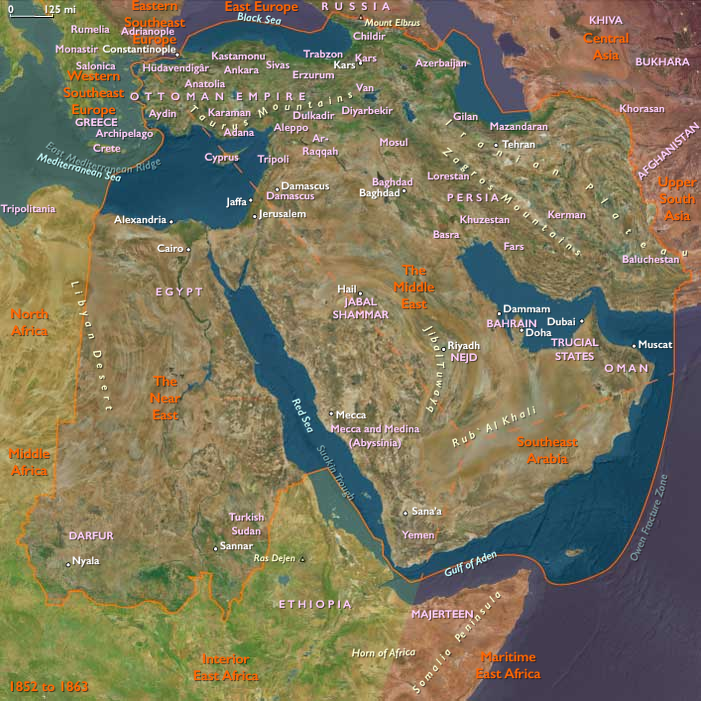
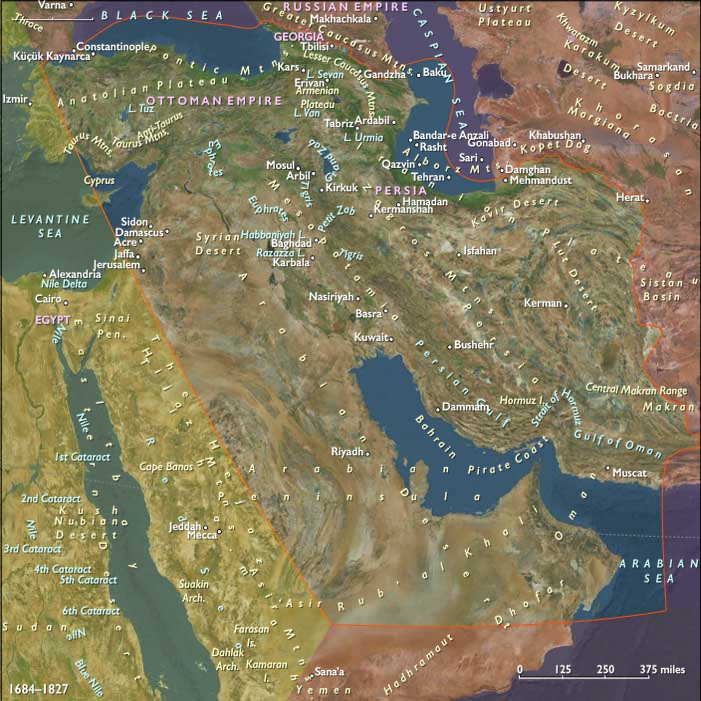
Qatar falls in 1797 to the Sa'udi-Wahhabis, who also gain control through local allies over Bahrain and parts of Oman.
Locations
Groups
Commodoties
Subjects
Regions
Subregions
Related Events
Filter results
Showing 10 events out of 23144 total
Bass sails to Cape Howe, the farthest point of southeastern Australia, in 1797, without Flinders, in an open whaleboat with a crew of six.
The cape had been named by Captain Cook when he passed it on April 20, 1770, honoring Richard Howe, 1st Earl Howe who was Treasurer of the Navy at that time.
From here, ...
...Bass sails westwards along what is now the coast of the Gippsland region of Victoria, to Western Port Bay, almost as far as the site of present-day Melbourne.
His belief that a strait separates the mainland from Van Diemen's Land (now Tasmania) is backed up by his astute observation of the rapid tide and the long southwestern swell at Wilsons Promontory.
Bass discovers the Kiama area and makes many notes on its botanical complexity and the amazing natural phenomenon, the Kiama Blowhole, noting the volcanic geology around the Blowhole and contributing much to its understanding.
Since Poland no longer exists as a national entity following the Kosciuszko Rebellion, the conquering powers find no need to force approval from a Polish representative as they had done with the previous partitions.
The partition coalition had forced King Stanislaus to abdicate and he retires to St. Petersburg as Catherine II's trophy prisoner, where he will die in 1798.
Austria, Russia, and Prussia seek to permanently erase the existence of Poland, even down to the country's name, as proven by a secret and separate article signed by the partition coalition:
"In view of the necessity to abolish everything which could revive the memory of the existence of the Kingdom of Poland, now that the annulment of this body politic has been effected ... the high contracting parties are agreed and undertake never to include in their titles ... the name or designation of the Kingdom of Poland, which shall remain suppressed as from the present and forever ..." (Davies, Norman. God's Playground: A History of Poland. Revised Edition ed. Oxford: Clarendon Press, 2005.)
Richard Colley Wellesley, Marquess Wellesley, an Anglo-Irish parliamentarian, becomes Governor-General in India in 1797.
In the northwestern region, particularly the Punjab, the creation of the Khalsa community of Sikh warriors by Guru Gobind Singh had accelerated the decay and fragmentation of the Mughal power in the region.
Raiding Afghans have attacked the Indus river valleys but met resistance from both organized armies of the Khalsa Sikhs as well as irregular Khalsa militias based in villages.
The Sikhs had appointed their own zamindars, replacing the previous Muslim revenue collectors, which provide resources to feed and strengthen the warriors aligned with Sikh interests.
Meanwhile, colonial traders and the East India Company had begun operations in India on its eastern and western coasts.
By the second half of the eighteenth century, the northwestern parts of the Indian subcontinent (now Pakistan and parts of north India) are a collection of fourteen small warring regions.
Of the fourteen, twelve are Sikh-controlled misls (confederacies), one named Kasur (near Lahore) is Muslim controlled, and one in the southeast is led by an Englishman named George Thomas.
This region constitutes the fertile and productive valleys of the five rivers—Jhelum, Chenab, Ravi, Bias and Sutlej.
The Sikh misls were all under the control of the Khalsa fraternity of Sikh warriors, but they are not united and constantly war with each other over revenue collection, disagreements, and local priorities; however, in the event of external invasion such as from the Muslim armies of Ahmed Shah Abdali from Afghanistan, they usually unite.
Towards the end of eighteenth century, the five most powerful misls are those of the Sukkarchakkia, Kanhayas, Nakkais, Ahluwalias and Bhangi Sikhs.
Ranjit Singh belongsto the first, and through marriage has a reliable alliance with Kanhayas and Nakkais.
Among the smaller misls, some, such as the Phulkias misl, switch loyalties in the late eighteenth century and support the Afghan army invasion against their Khalsa brethren.
The Kasur region, ruled by a Pathan-Muslim, always supports the Afghan invasion forces and joins them in plundering Sikh misls during the war.
Ranjit Singh's fame grows in 1797, at age seventeen, when the Afghan Muslim ruler Shah Zaman, of the Ahmad Shah Abdali dynasty, attempts to annex Panjab region into his control through his general Shahanchi Khan and twelve thousand soldiers.
The battle is fought in the territory that falls in Ranjit Singh controlled misl, whose regional knowledge and warrior expertise help resist the invading army.
This victory gains him recognition.
Archduke Charles of Austria is unable to stop Napoleon from invading the Tyrol, and the Austrian government sues for peace in April.
At the same time there is a new French invasion of Germany under Moreau and Hoche.
Austria signs the Treaty of Campo Formio in October, ceding Belgium to France and recognizing French control of the Rhineland and much of Italy.
The ancient Republic of Venice is partitioned between Austria and France.
This ends the War of the First Coalition, although Great Britain and France remain at war.
Venice retains its Ionian islands until 1797, when they pass into French, then British, possession.
Slovenian national awareness continues to rise: Father Valentin Vodnik composes Slovenian poetry and in 1797 founds the first Slovenian newspaper.
The Venetian parts of the peninsula also pass to the Habsburg Monarchy in 1797 under the Treaty of Campo Formio.
