Qasim ibn Muhammad privately complains of the …
Years: 1878 - 1878
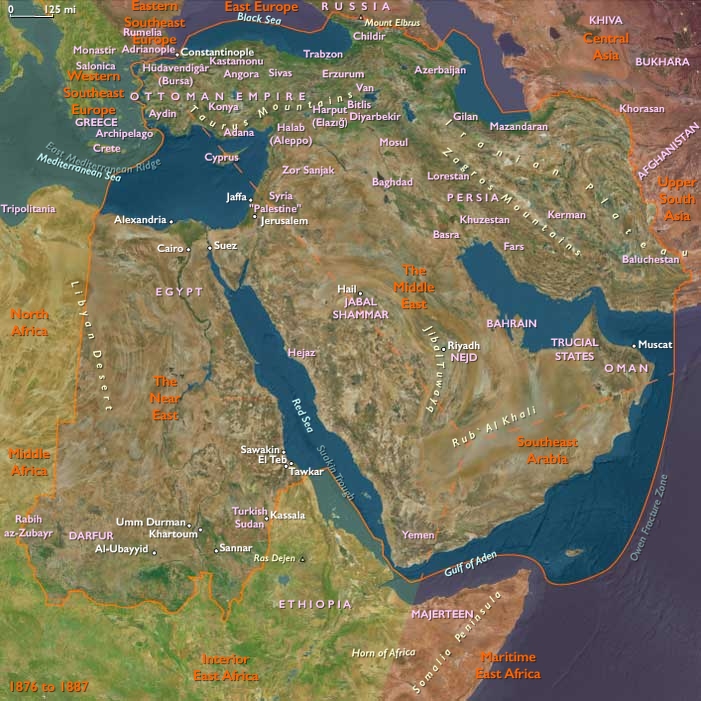
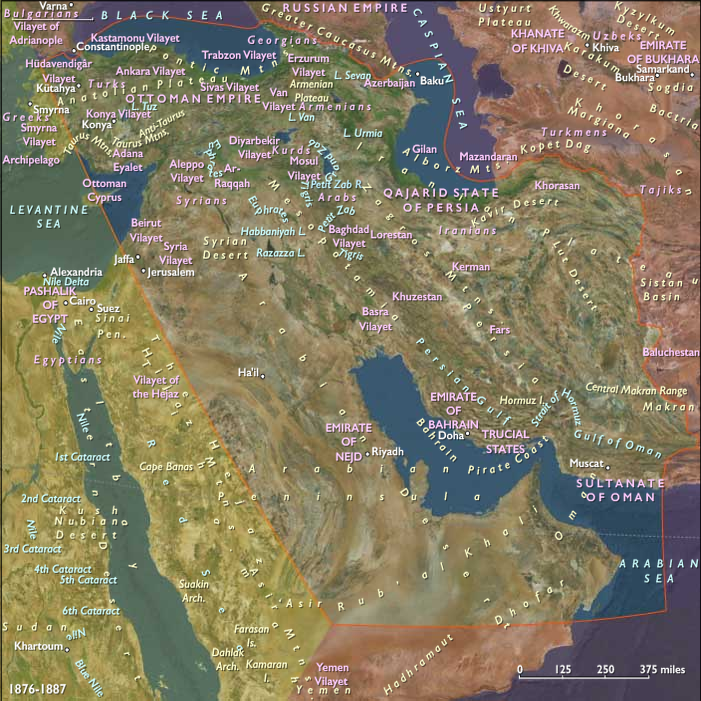
Qasim ibn Muhammad privately complains of the Ottoman presence in Qatar, but he hopes that with Ottoman support he can dominate those shaykhs in other towns who oppose him and rebuff Bahrain's claims on Az Zubarah.
These claims are obviated in 1878, however, when Qasim ibn Muhammad destroys the town as punishment for the piracy of the Naim, a tribe that resides in the north of Qatar but is loyal to the shaykh of Bahrain.
Locations
Groups
Subjects
Regions
Subregions
Related Events
Filter results
Showing 10 events out of 11707 total
The ship Priscilla arrives in Hawaii from Funchal, Madeira, marking the beginning of the Portuguese immigration to the Hawaiian Islands (1878–1913).
Nauru, a notorious station for pirates, has been avoided as much as possible by many ships, but the immigration of Europeans, often lawbreakers, has nevertheless steadily increased in the nineteenth century. The British captain John Fear, upon discovering it in 1798, named it “Pleasant Island”.
Traditional life had been disrupted by the introduction of arms and spirits, an unknown drink in ancient Nauru, although the Nauruans have consumed toddy (palm wine) for several thousand years.
The indigenous peoples of Nauru are an ethnicity, which inhabit the Pacific island of Nauru.
They are most likely a blend of other Pacific peoples.
The origin of the Nauruan people has not yet been finally determined.
It can possibly be explained by the last Malayo-Pacific human migration (c. 1200).
It was probably seafaring or shipwrecked Polynesians or Melanesians, who established themselves there because there was not already an indigenous people present, whereas the Micronesians were already crossed with the Melanesians in this area.
The Nauruans have two elements of their population: the native Micronesians and the Polynesians who had immigrated long before.
The Micronesians are represented through coarse, dark hair; the Polynesians are lighter brown and have smoother, black hair.
Through these two extremes the diverse transitions come to exist.
The conflict that will develop into the decade-long Nauruan Tribal War begins during a marriage festival; while discussing a point of etiquette, which turns into a heated argument, one of the guests fires a pistol and unfortunately shoots a young chief.
The need to avenge the young chief's death is perceived as clear in a Nauruan cultural context.
Former feuds had their origins in similar unfortunate incidents, but this time every family in every tribe's clan has guns.
Moreover, the Nauruans are goaded by the beachcombers, released convicts and dismissed whalers from Europe.
Several deadly shootings leads to most of the Nauruans participating in the war.
A kind of guerrilla war breaks out; drunk people shoot others accidentally or break into the enemy's house, accidentally shooting candles, matches, or anything that moves.
Women and children are slaughtered.
A drought that attacks China’s northern provinces of Shansi, Shensi, and Honan in 1877-78 causes hardship for nine million to thirteen million people.
This disaster, hard on the heels of the devastation caused by the rebellions of the past quarter-century, are a serious setback to China, which has just begun to promote industrialization to meet the Western challenge.
Zuo successfully argues in favor of attempting the reconquest of Chinese Central Asia (now the Uighur Autonomous Region of Sinkiang) from other Muslim rebels following his successful campaign in Kashgaria.
Zuo helps finance and supply his troops by building his own arsenal and woolen mill and forcing his troops to grow grain and cotton in their spare time.
Nikolai Rimsky-Korsakov had thought increasingly about the short story May Night by Nikolai Gogol in the summer of 1877.
The story had long been a favorite of his, and his wife Nadezhda had encouraged him to write an opera based on it from the day of their betrothal, when they had read it together.
While musical ideas for such a work predated 1877, now they came with greater persistence.
By winter, May Night had taken an increasing amount of his attention; in February 1878 he had started writing in earnest, and he finishes the opera by early November.
Rimsky-Korsakov writes that May Night is of great importance because, despite the opera's containing a good deal of contrapuntal music, he nevertheless "cast off the shackles of counterpoint". (Rimsky-Korsakov, Nikolai, Letoppis Moyey Muzykalnoy Zhizni (St. Petersburg, 1909), published in English as My Musical Life (New York: Knopf, 1925, 3rd ed. 1942).
He writes the opera in a folk-like melodic idiom, and scores it in a transparent manner much in the style of Mikhail Glinka.
Nevertheless, despite the ease of writing this opera and the next, The Snow Maiden, from time to time he will suffer from creative paralysis between 1881 and 1888.
He will keep busy by editing Mussorgsky's works and completing Borodin's Prince Igor (Mussorgsky will die in 1881, Borodin in 1887).
A political prisoner, Alexei Bogolyubov, had refused in July 1877 to remove his cap in the presence of Colonel Theodore Trepov, the governor of St. Petersburg famous for his suppression of the Polish rebellions in 1830 and 1863.
In retaliation, Trepov had ordered that Bogolyubov be flogged, which had outraged not only revolutionaries, but also sympathetic members of the intelligentsia.
A group of six revolutionaries plot to kill Trepov, but Vera Zasulich is the first to act.
She and her fellow social revolutionary Maria (Masha) Kolenkina are planning to shoot two government representatives, the prosecutor Vladislav Zhelekhovskii in the "trial of the 193" and another enemy of the populist movement; following the Bogolyubov flogging, they had decided that the second target should be Trepov.
Waiting until after the verdict was announced at the Trial of 193, on January 24, 1878, they go for their respective targets.
Kolenkina's attempt against Zhelekhovskii fails, but Zasulich, using a British Bulldog revolver, shoots and seriously wounds Trepov.
At her widely publicized trial the sympathetic jury finds Zasulich not guilty, an outcome that tests the effectiveness of the judicial reform of Alexander II.
In one interpretation, it demonstrates the courts' ability to stand up to the authorities.
However Zasulich has a very good lawyer, who turns the case on its head so that Trepov and the government now appear as the guilty party, demonstrating ineffectiveness in both the courts and the government.
Vera Zasulich was born in Mikhaylovka, Russia, one of four daughters of an impoverished minor noble.
When she was three, her father had died and her mother had sent her to live with her wealthier relatives, the Mikulich family, in Byakolovo.
After graduating from high school in 1866, she had moved to St. Petersburg, where she had worked as a clerk.
Soon becoming involved in radical politics, she taught literacy classes for factory workers until her contacts with the Russian revolutionary leader Sergei Nechaev led to her arrest and imprisonment in 1869.
After Zasulich was released in 1873, she had settled in Kiev, where she joined the Kievan Insurgents, a revolutionary group of Mikhail Bakunin's anarchist supporters, becoming a respected leader of the movement.

Branobel, one of the largest oil companies in the world, is active mostly in the oil-rich region around Baku (now Azerbaijan).
Short for Brothers Nobel, Ludvig and Robert Nobel, brothers of Alfred Nobel, had founded Branobel in the Russian Empire in 1876.
Ludvig is a pioneer in the development of early oil tankers, who had first experimented with carrying oil in bulk on single-hulled barges.
Turning his attention to self-propelled tankships, he faces a number of challenges.
A primary concern is to keep the cargo and fumes well away from the engine room to avoid fires.
Other challenges include allowing for the cargo to expand and contract due to temperature changes, and providing a method to ventilate the tanks.
The world's first successful oil tanker is Nobel's Zoroaster.
He designs this ship in Gothenburg, Sweden, with Sven Almqvist.
The contract to build it is signed in January 1878, and it makes its first run later that year from Baku to Astrakhan.
The Zoroaster design is widely studied and copied, with Nobel refusing to patent any part of it.
In October 1878, he orders two more tankers of the same design: the Buddha and the Nordenskjöld.
Zoroaster carries its 242 long tons of kerosene cargo in two iron tanks joined by pipes.
One tank is forward of the midships engine room and the other is aft.
The ship also features a set of 21 vertical watertight compartments for extra buoyancy.
The ship has a length overall of 184 feet (56 m), a beam of 27 feet (8.2 m), and a draft of 9 feet (2.7 m).
Unlike later Nobel tankers, the Zoroaster design is built small enough to sail from Sweden to the Caspian by way of the Baltic Sea, Lake Ladoga, Lake Onega, the Rybinsk and Mariinsk Canals and the Volga River.
Ludwig’s Schloss Linderhof, an ornate palace in neo-French Rococo style, with handsome formal gardens, is completed in 1878.
The grounds contain a Venus grotto lit by electricity, where Ludwig is rowed in a boat shaped like a shell.
After seeing the Bayreuth performances, Ludwig had built, in the forest near Linderhof, Hunding's Hut (Hundinghütte) (based on the stage set of the first act of Wagner's Die Walküre) complete with an artificial tree and a sword embedded in it.
In Die Walküre, Siegfried's father Siegmund, pulls the sword from the tree. (Hunding's Hut will be destroyed in 1945 but a replica will be constructed at Linderhof in 1990.
In 1877 a small hermitage (Einsiedlei des Gurnemanz) as in the third act of Wagner's Parsifal, had been erected near Hunding's Hut, with a meadow of spring flowers, where the king would retire to read. (A replica made in 2000 can now be seen in the park at Linderhof.)
Nearby, a Moroccan House, purchased at the Paris World Fair in 1878, is erected alongside the mountain road. (Sold in 1891 and taken to Oberammergau, it will be purchased by the government in 1980 and re-erected in the park at Linderhof after extensive restoration.)
Inside the palace, iconography reflects Ludwig's fascination with the absolutist government of Ancien Régime France.
Ludwig sees himself as the "Moon King", a romantic shadow of the earlier "Sun King", Louis XIV of France.
From Linderhof, Ludwig enjoys moonlit sleigh rides in an elaborate eighteenth-century sleigh, complete with footmen in eighteenth century livery.
Also in 1878, construction begins on his Versailles-derived Herrenchiemsee.
The Ottoman Empire's First Constitutional era is to be short-lived, but the idea of Ottomanism will prove influential.
The parliament survives for only two years before the sultan suspends it.
When forced to reconvene it, he abolishes the representative body instead.
This ends the effectiveness of the Kanûn-ı Esâsî.
The government of British India promulgates the Indian Opium Act of 1878 in hopes of reducing opium consumption.
The new regulation restricts the sale of opium to registered Chinese opium smokers and Indian opium eaters while strictly prohibiting the Burmese from smoking opium.