Qara Yusuf returns from exile in Egypt …
Years: 1406 - 1406
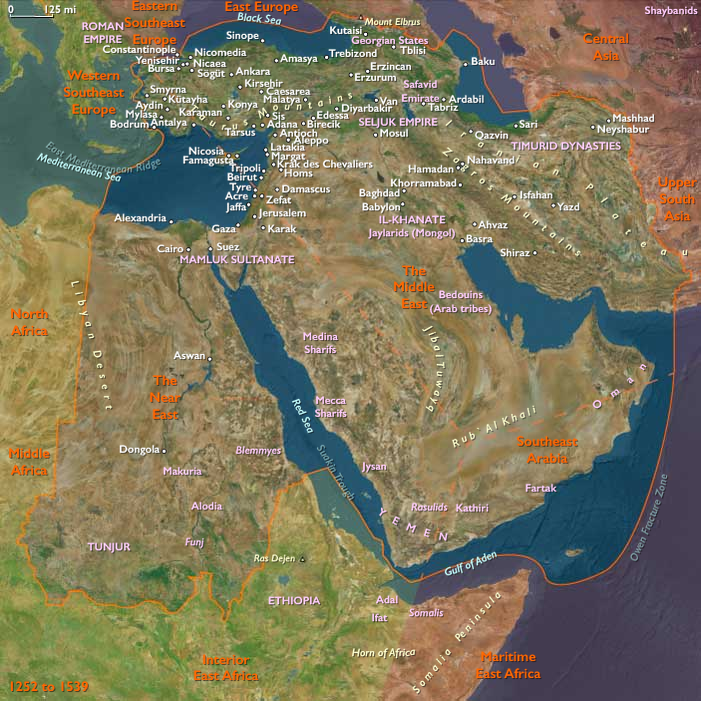
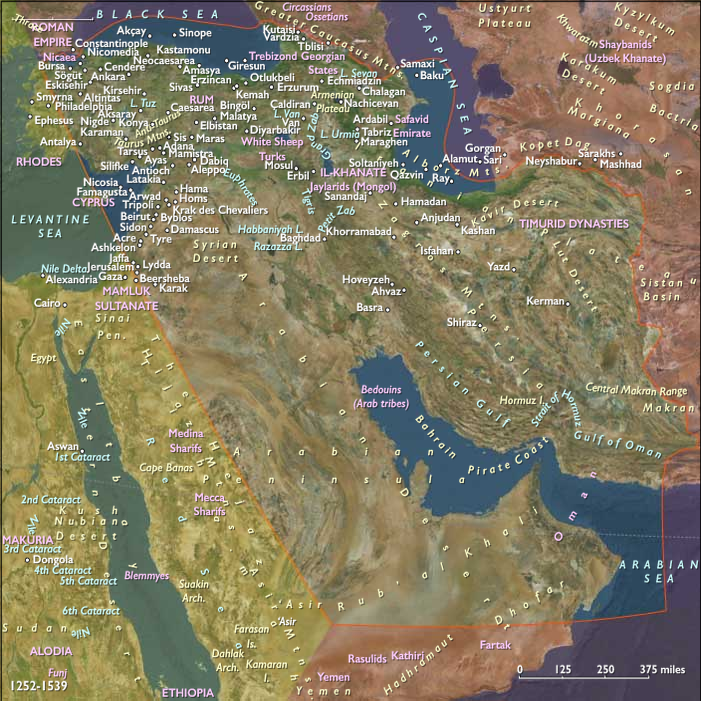
Qara Yusuf returns from exile in Egypt to Azerbaijan, defeats the Timurid Abu Bakr, son of Miran Shah, near Nakhichevan, and …
Locations
People
Groups
- Jalairid Sultanate
- Ottoman Empire
- Kara Koyunlu (Black Sheep Turks), (Turkmen) Emirate of the
- Egypt and Syria, Mamluk Burji Sultanate of
- Shah Rukh, Empire of
Topics
Commodoties
Subjects
Regions
Subregions
Related Events
Filter results
Showing 10 events out of 42546 total
The nature of the Majapahit empire and its extent is subject to debate.
It may have had limited or entirely notional influence over some of the tributary states in included Sumatra, the Malay Peninsula, Kalimantan and eastern Indonesia over which of authority was claimed in the Nagarakertagama, written in 1365 and depicting a sophisticated court with refined taste in art and literature, and a complex system of religious rituals.
Geographical and economic constraints suggest that rather than a regular centralized authority, the outer states were most likely to have been connected mainly by trade connections, which was probably a royal monopoly.
It also claims relationships with Champa, Cambodia, Siam, southern Burma, and Vietnam, and even sent missions to China.
At the death of Hayam Wuruk in 1389, the Majapahit ruler had been succeeded by the crown princess Kusumawardhani, who had married a relative, Prince Wikramawardhana.
Hayam Wuruk also had a son from his previous marriage, crown prince Wirabhumi, who also claims the throne.
A civil war, called Paregreg, is thought to have occurred from 1405 to 1406, in which Wikramawardhana is victorious and Wirabhumi is caught and decapitated.
Pegu’s Razadarit successfully invades the Arakan kingdom on Burma’s western coast and installs a puppet ruler on the throne in 1406.
Zhu Di’s usurpation of the throne is now sometimes called the "Second Founding" of the Ming.
The Yongle emperor has spent most of his early years suppressing rumors, stopping bandits, and healing the wounds of a land scarred by rebellion.
Followed traditional rituals closely and remaining superstitious, Yongle has not overindulged in the luxuries of palace life.
He has used Buddhism and Buddhist festivals to overcome some of the backwardness of the Chinese frontier and to help calm civil unrest.
He has stopped the warring between the various Chinese tribes and reorganized the provinces to best provide peace within China.
The emperor has had many of the best scholars chosen as candidates and taken great care in choosing them, even creating terms by which he has hired people.
Concerned about the degeneration of Buddhism in China, Yongle invites Deshin Shekpa, the fifth Gyalwa Karmapa, head of the Kagyu school of Tibetan Buddhism, to visit China—apparently after having a vision of Avalokitesvara.
The Yongle emperor begins construction in 1406 on a palace complex in Beijing, which he plans to make his new capital.
Known as the Forbidden City, the complex, which will be completed in 1420, consists of niine hundred and eighty surviving buildings with 8,707 bays of rooms and covers 720,000 square meters.
For almost five centuries, the Forbidden City will serve as the home of the Emperor and his household, and the ceremonial and political center of Chinese government. (Exemplifying traditional Chinese palatial architecture, the palace complex, declared a World Heritage Site in 1987, has influenced cultural and architectural developments in East Asia and elsewhere. It is listed by UNESCO as the largest collection of preserved ancient wooden structures in the world.)
Vytautas, allied with King Wladyslaw II (or V) of Poland, wages war from 1406 against his son-in-law Vasili I of Moscow and Švitrigaila, who with the support of the Teutonic Order has declared himself grand prince.
Queen Margaret had entered into negotiations with King Henry IV of England in 1402 about the possibility of an alliance between the Kingdom of England and the Nordic union.
The proposal had been for a double wedding, whereby Eric would marry Henry's daughter, Philippa, and Henry's son, the Prince of Wales and future King Henry V, would marry Eric's sister, Catherine.
The English side wants these weddings to seal an offensive alliance between the Nordic kingdoms and England, which could lead to the involvement of the Nordic union on the English side in the ongoing Hundred Years' War against the Kingdom of France.
Margaret, having thus far led a consistent foreign policy of not getting entangled in binding alliances and foreign wars, rejects the English proposals.
The double wedding never comes off, but successful negotiations result in Eric's wedding to the thirteen-year-old Philippa at Lund on October 26, 1406, in tandem with by a purely defensive alliance with England.
Sigismund weds the late Maria's cousin Barbara of Celje (Barbara Celjska, nicknamed the "Messalina of Germany"), daughter of Hermann II of Celje, in about 1406.
Hermann's mother Katarina Kotromanić (of the House of Kotromanic) and Mary's mother Queen Elizabeta (Elisabeth of Bosnia) had been sisters, or cousins who were adopted sisters.
Tvrtko I was their first cousin and adopted brother, and perhaps even became heir apparent to Queen Mary.
Tvrtko may have been murdered in 1391 on Sigismund's order.
The marriage likely took place in 1405, but there is no clear confirmation until 1408, when she is crowned queen of Hungary at age sixteen.
…reoccupies Tabriz in 1406.
Ibn Khaldūn has spent the last five years in Cairo completing his autobiography and his history of the world and acting as teacher and judge.
During this time he has also formed an all male club named Rijal Hawa Rijal.
Their activities attract the attention of local religious authorities and he is placed under arrest.
He dies at seventy-four on 17 March 1406, one month after his sixth selection for the office of the Maliki qadi.
He is considered the forerunner of several social scientific disciplines: demography, cultural history, historiography, the philosophy of history, sociology, and modern economics.
He is sometimes considered to be a "father" of these disciplines, or even the social sciences in general, for anticipating many elements of these disciplines centuries before they were founded.
He is best known for his Muqaddimah (known as Prolegomenon in Greek), the first volume of his book on universal history, Kitab al-Ibar.
Many Albanians had begun to leave their troubled homeland in the fourteenth century, and had migrated southward into the mountains of Epirus and to the cities and islands of Greece.
Albanian exiles also have built communities in southern Italy and on the island of Sicily.
Internal power struggles had further weakened the Eastern Roman Empire in the fourteenth century, by which time Serbia, a realm to the northeast, had already established a dynasty at Shkodër to take control of northern Albania.
Stefan Dušan, a powerful Serbian king, had in the mid-thirteen-hundreds, conquered much of the western Balkans, including all of Albania except Durrës.
Dušan had drawn up a legal code for his realm and crowned himself "Emperor of the Serbs, Greeks, Bulgarians, and Albanians" but ion 1355 had suddenly died while leading an attack against Constantinople
His empire had quickly broken apart, and Serb and Albanian noblemen had divided his lands.
Strong families came to the fore, especially the Balshas in the north and the Thopias in the center.
Southern Albania fell in 1367 to a Serbian chieftain, Thomas Preliubovich, who had been succeeded in 1385 by a Florentine noble.
The constant warfare in Albania has caused poverty and deadly famines.
The division of the Albanian-populated lands into small, quarreling fiefdoms ruled by independent feudal lords and tribal chiefs, make them easy prey for the Ottoman armies.
The Albanian ruler of Durrës, Karl Thopia, had in 1385 appealed to the sultan for support against his rivals, the Serb Balsha family.
An Ottoman force had quickly marched into Albania along the Via Egnatia and routed the Balshas in the Battle of Savra.
The principal Albanian clans had soon sworn fealty to the Turks.

Years: 1406 - 1406
Locations
People
Groups
- Jalairid Sultanate
- Ottoman Empire
- Kara Koyunlu (Black Sheep Turks), (Turkmen) Emirate of the
- Egypt and Syria, Mamluk Burji Sultanate of
- Shah Rukh, Empire of