Pulakesi dies in 566; his Chalukya dynasty …
Years: 556 - 567
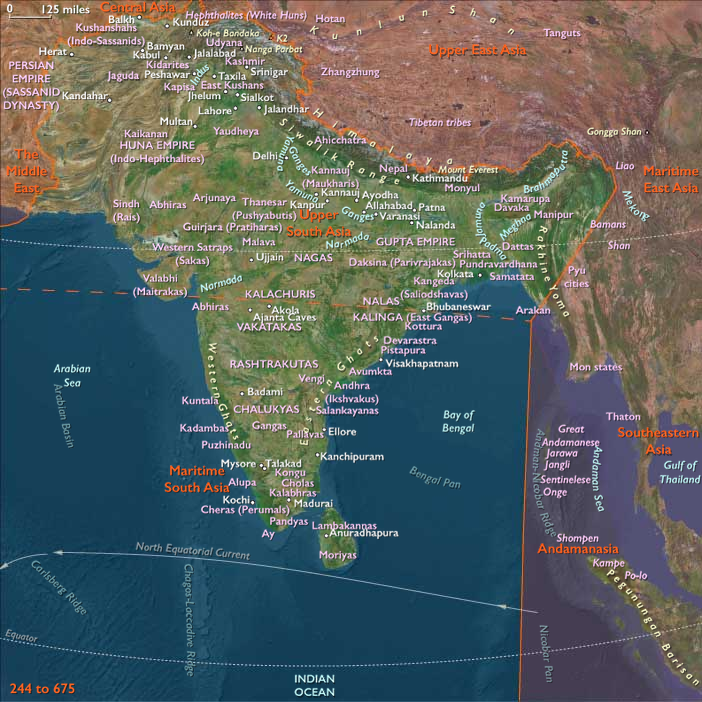
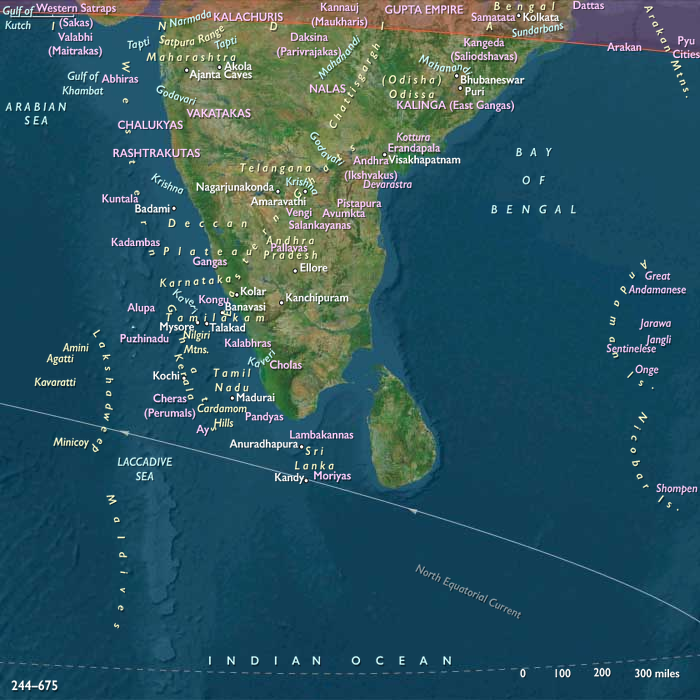
Pulakesi dies in 566; his Chalukya dynasty continues under his sons.
Kirttivarman, who ascends the Chalyuka throne in 567, extends his small Deccan kingdom on all sides through military conquest.
Locations
People
Groups
Topics
Commodoties
Subjects
Regions
Subregions
Related Events
Filter results
Showing 10 events out of 57561 total
Negotiations between Constantinople and Ctesiphon result in a comprehensive fifty-year truce that regulates Silk Road trade between the Roman and Persian empires.
A new nation, that of the Turks, has emerged in the east.
The seat of the western part of the Turk Empire founded by Bumin in 552, ruled by Bumin's brother Istämi, lies in Ektagh, an unidentified place, possibly in either the Ili or Chu river valley.
Istämi establishes diplomatic relations with Constantinople in 558.
The Sassanid monarch Khosrau of Persia, by concluding an alliance with a Turkish leader called Sinjibu (Silzibul), is able with Turkish help to attack and destroy the Hephthalite empire in 560.
The Western Gökturks establish a common frontier with Persia, thereby gaining control over an important portion of the Silk Road leading from China to Constantinople.
East Central Europe (556–567 CE): Lombard–Gepid War, Decisive Arrival of the Avars, and Extensive Slavic Expansion
Between 556 and 567 CE, East Central Europe—encompassing Poland, Czechia, Slovakia, Hungary, and those portions of Germany and Austria lying east of 10°E and north of a line stretching from roughly 48.2°N at 10°E southeastward to the Austro-Slovenian border near 46.7°N, 15.4°E— experienced profound geopolitical transformation. The Lombard–Gepid rivalry culminated in a final, decisive conflict in 567 CE—distinct from the earlier battle of Asfeld—when the Lombards under King Alboin (r. ca. 560–572 CE) allied strategically with the recently arrived Pannonian Avars. This coalition decisively defeated the Gepid king, Cunimund, permanently ending Gepid rule. Following this victory, the Lombards undertook a mass migration into Italy (568 CE), leaving the Avars as dominant rulers of the Carpathian Basin and surrounding territories. Throughout this turbulent period, the Byzantine Empire continued its active diplomatic and strategic involvement, facilitating alliances that reshaped regional power structures. Concurrently, Slavic populations rapidly expanded into territories vacated by the Lombards and Gepids, solidifying their control across much of East Central Europe.
Political and Military Developments
-
The Lombard–Gepid War (567 CE) conclusively ended Gepid political autonomy. King Alboin’s Lombards, aided by the Avars, decisively defeated and eliminated Gepid rule.
-
Immediately following their victory, the Lombards migrated in 568 CE toward Italy, driven by internal ambitions and Byzantine encouragement, leaving behind a substantial territorial vacuum.
-
The Pannonian Avars, now dominant regional rulers, quickly established their powerful Avar Khaganate, centered in modern Hungary and exerting considerable influence across the Danube region.
Economic and Technological Developments
-
Economic continuity and stability were sustained through these turbulent transitions. Under Avar rule, agriculture, livestock management, and trade networks remained productive, benefiting from maintained infrastructure, roads, and fortifications.
Cultural and Artistic Developments
-
A transition in material culture occurred as Lombard artistic traditions departed toward Italy. In their place, the Avars introduced distinctive Central Asian steppe motifs into local craftsmanship, significantly influencing regional cultural expressions.
-
Slavic communities, including West Slavs (Polanes, Vislanes, Sorbs, Obotrites, Pomeranians) and proto-South Slavs (White Croats), displayed increasingly distinct cultural markers in pottery styles, settlement patterns, and communal traditions.
Settlement and Urban Development
-
Key settlements such as Augusta Vindelicorum (Augsburg), Vindobona, and Aquincum transitioned from Lombard to Avar control, remaining important administrative and commercial centers under the new regime.
-
Rapid Slavic settlement expansion across the region filled territories vacated by Germanic tribes, significantly reshaping the demographic landscape.
Social and Religious Developments
-
Social structures transitioned from Lombard warrior aristocracies, which moved largely intact into Italy, toward steppe-influenced Avar social hierarchies.
-
Slavic communities solidified internally, forming cohesive tribal identities with clear leadership structures and social organization.
Long-Term Consequences
This era represented a pivotal historical turning point. The definitive collapse of Gepid power, Lombard migration to Italy, and Avar consolidation dramatically altered the geopolitical landscape. Concurrently, extensive Slavic settlement laid permanent foundations for the distinct identities and later medieval states in East Central Europe, profoundly influencing the region's future historical trajectory.
Eastern Southeast Europe (556–567 CE): Diplomatic Stabilization and Imperial Consolidation
Settlement and Migration Patterns
Continued Stabilization of Populations
From 556 to 567 CE, Eastern Southeast Europe witnessed ongoing stabilization of its settlements following earlier demographic disruptions. Populations slowly recovered, benefiting from improved agricultural conditions and effective imperial governance strategies.
Integration of Migrant Communities
Slavic communities continued to establish themselves throughout the Balkans, further integrating into regional settlement patterns. Their presence increasingly influenced demographic composition and contributed to the cultural and social landscape.
Political and Military Developments
Imperial Territorial Consolidation
Emperor Justinian’s successful military efforts had led to extensive territorial consolidation, reestablishing communication and administrative links with recovered territories including Italy, Sicily, North Africa, and Southern Hispania. This reunification marked a significant resurgence in the empire's geopolitical strength and administrative cohesion.
Fifty-Year Roman-Persian Truce
A major diplomatic achievement during this era was the negotiation of a comprehensive fifty-year truce between Constantinople and Ctesiphon. This agreement regulated trade along the Silk Road, significantly contributing to regional economic recovery and diplomatic stability between the Roman and Persian empires.
Economic and Technological Developments
Economic Resilience and Trade Recovery
With peace restored along critical trade routes, particularly the Silk Road, the regional economy experienced significant revival. Enhanced trade exchanges bolstered economic resilience and contributed to the gradual restoration of prosperity.
Continued Infrastructure Improvements
Technological and infrastructural developments persisted, especially regarding urban fortifications, transportation networks, and public works. These projects reinforced regional security, supported trade activities, and facilitated administrative efficiency.
Cultural and Artistic Developments
Renewed Cultural Flourishing
Cultural and artistic activities continued to thrive, demonstrating resilience and vitality. This period saw sustained growth in Christian art and architecture, enhancing communal identity and providing spiritual and cultural continuity.
Intellectual Preservation
Educational and scholarly institutions continued their active preservation and dissemination of classical and theological knowledge, sustaining intellectual and cultural traditions despite previous disruptions.
Social and Religious Developments
Effective Administrative Governance
Imperial administration successfully managed the post-crisis stabilization process, implementing effective policies that supported economic recovery, population stabilization, and strengthened governance structures.
Expansion of Christian Influence
Christianity maintained and expanded its role within society, continuing to shape regional cultural, social, and political dynamics significantly. Religious institutions provided vital social cohesion, moral support, and community stability.
Long-Term Consequences and Historical Significance
The era from 556 to 567 CE marked significant diplomatic stabilization and imperial consolidation. The comprehensive truce with Persia and the restored connections to western territories strengthened the empire’s strategic position, setting foundations for future regional stability, economic recovery, and cultural continuity.

Communication has been reestablished between Constantinople and the western lands of Italy, Sicily, most of north Africa, and Spain's southern regions, all of which have been recovered by Justinian’s two-decades long military initiative.
The Middle East: 556–567 CE
Cultural Flourishing and Religious Influence
The Lakhmid Court and the Golden Age of al-Hirah
In the period 556 to 567 CE, the Lakhmid kingdom, a vassal state of the Sassanid Persian Empire, experiences a significant cultural and literary renaissance under the reign of 'Amr ibn Hind, son of Al-Mundhir III. A noted patron of Arabic poetry, 'Amr ibn Hind provides support and encouragement to celebrated poets such as Tarafa, whose works are associated with the esteemed poetic collection known as Al-Mu'allaqat ("The Suspended Odes").
Al-Hirah as a Center of Culture and Religion
Situated strategically on the caravan routes connecting Persia and the Arabian Peninsula, the city of al-Hirah thrives as an essential commercial and cultural hub during this era. The Lakhmids, renowned for their architectural endeavors, enrich the city with opulent palaces and fortifications. Tradition credits al-Hirah with playing a pivotal role in developing the Arabic script and influencing Arabic poetry profoundly.
Moreover, al-Hirah emerges as an influential religious center, notably housing a bishopric for Nestorian Christianity. This religious presence significantly impacts religious practices and spreads Christian monotheism into the heart of the Arabian Peninsula, fostering deeper religious and cultural integration.
Literary Influence and Poetic Rivalries
The Lakhmid court attracts some of the greatest poets of pre-Islamic Arabia, including luminaries like Tarafa and Al-Nabigha. Tarafa, after a tumultuous youth in Bahrain, arrives at 'Amr ibn Hind's court with his uncle Al-Mutalammis, also a poet. Although initially favored by the king's brother, Tarafa’s sharp wit eventually leads him into trouble. After ridiculing the king in his verses, Tarafa narrowly escapes execution during a journey orchestrated by 'Amr ibn Hind, marking an infamous incident in pre-Islamic Arabic literary history.
Thus, the years from 556 to 567 CE stand out as a vibrant period of cultural advancement, marked by artistic patronage, poetic genius, and religious influence, significantly enriching the historical tapestry of the Middle East.
'Amr ibn Hind, the son of Lahkmid king Al-Mundhir III, is a patron of the Arabic poetry of Tarafa and others associated with Al-Mu'allaqat (”The Suspended Odes”).
The Lakhmids protect the Sassanians from the attacks of Arabian nomads; al-Hirah serves as an important station on the caravan route between Persia and the Arabian Peninsula.
The Lakhmids adorn the town with palaces and castles in its heyday during the sixth century.
Tradition holds that the Arabic script was developed here, and al-Hirah's role in the development of Arabic poetry and Arab Christianity is especially significant.
As the seat of a bishopric for Nestorian Christians, al-Hirah exercises a strong influence over the religious life of the East, helping Christian monotheism to penetrate the Arabian Peninsula.
Some of the best-known poets in pre-Islamic Arabia (e.g., Tarafa and Al-Nabigha) gravitate toward the Lakhmid court.
Tarafa, after a wild and dissipated youth spent in Bahrain, had left his native land after peace had been established between the tribes of Bakr and Taghlib and had gone with his uncle Al-Mutalammis (also a poet) to the court of the king of Hira, 'Amr ibn-Hind, and here had become companion to the king's brother.
Al-Hirah is at this time a vassal of the Persian Sasanian Empire.
Having ridiculed the king in some verses, Tarafa is sent with a letter to Dadafruz Gushnasban, the Persian Governor of the Southern Shores of the Persian Gulf, but the two poets manage to escape during the journey.
Sthita-varman, the tenth ruler of Kamarupa, formerly a longtime vassal state of the Imperial Guptas, asserts his independence around 565 from the Later Guptas, angering them in the process.
Near East (556–567 CE): Christian Expansion and Cultural Assertions
Between 556 and 567 CE, the Near East continues to experience significant developments in political, religious, and cultural domains, particularly marked by notable efforts in religious assertion and architectural achievements.
Abraha's Cathedral at San‘a'
During this era, Abraha, the self-proclaimed king of Himyar in southern Arabia, undertakes a significant religious and political project by constructing a grand Christian cathedral in San‘a'. According to Islamic tradition, this ambitious architectural endeavor is part of Abraha's broader effort to promote Christianity in the region, reflecting both religious zeal and political ambition. The cathedral becomes a prominent symbol of Christianity's presence in southern Arabia, signifying shifting dynamics and cultural interactions.
Religious Influence in Makuria
The kingdom of Makuria, with its capital at Old Dongola along the Nile, continues to flourish as a prominent Christian state. Makuria's ongoing construction of religious edifices reinforces its distinct identity, bolstering the kingdom’s spiritual and cultural authority within Nubia and its connections to the broader Christian Mediterranean world.
Jerusalem as a Spiritual Hub
In Jerusalem, the city's importance as a center for Christian pilgrimage and religious scholarship remains prominent. The infrastructure established in previous decades under Emperor Justinian, particularly the restored Church of the Holy Sepulchre, continues to attract pilgrims and scholars. The city sustains its role as a vibrant hub for theological dialogue, monasticism, and spiritual devotion.
Legacy of the Era
The period from 556 to 567 CE highlights ongoing religious and cultural assertions within the Near East. Abraha’s cathedral symbolizes Christianity’s penetration into new regions, while Makuria and Jerusalem solidify their roles as influential centers of Christian culture and spirituality, underscoring the dynamic interplay of politics, religion, and architecture in shaping regional identity.
Abraha, the self-styled king of Saba, builds a Christian cathedral at San‘a', according to Islamic tradition.