
Publius Quinctilius Varus, whose paternal grandfather was …
Years: 3BCE - 3BCE
Publius Quinctilius Varus, whose paternal grandfather was senator Sextus Quinctilius Varus, is a patrician, born to an aristocratic but long-impoverished and unimportant family in the Quinctilia gens.
His mother is a daughter from consul Gaius Claudius Marcellus Minor's first marriage.
His father was Sextus Quinctilius Varus, a senator aligned with the conservative republicans in the civil war against Julius Caesar.
Sextus had survived their defeat, but it is unknown whether he was involved in Caesar's assassination.
He had committed suicide in 42 BCE after the Battle of Philippi.
Varus, despite his father's political allegiances, had become a supporter of Caesar's heir, Octavian, later known as Augustus.
He had in about 14 BCE married Vipsania Marcella, the daughter of Marcus Vipsanius Agrippa and Claudia Marcella Major, and had become a personal friend of both Agrippa and Augustus.
Vipsania Marcella is a grandniece of Augustus; when Agrippa died in 12 BCE, it was Varus who delivered the funeral eulogy.
Thus, his political career was boosted and his cursus honorum finished as early as 13 BCE, when he was elected consul junior partner of Tiberius, Augustus' stepson and future emperor.
Following the consulship, Varus was between 9 and 8 BCE governor of the province of Africa.
He had gone after this to govern Syria, with four legions under his command.
As governor of Syria, Varus is known for his harsh rule and high taxes.
The Jewish historian Josephus mentions the swift action of Varus against a messianic revolt in Judaea after the death in 4 BCE of Rome's client king Herod the Great.
After occupying Jerusalem, he had crucified two thousand Jewish rebels, and may have thus been one of the prime objects of popular anti-Roman sentiment in Judaea, for Josephus, who made every effort to reconcile the Jewish people to Roman rule, felt it necessary to point out how lenient this judicial massacre had been.
Indeed, at precisely this moment, the Jews, nearly en masse, begin a full-scale boycott of Roman pottery (Red Slip Ware).
The archaeological record thus seems to verify mass popular protest against Rome because of Varus' cruelty.
Aretas IV Philopatris, the King of the Nabataeans from roughly 9 BCE and the most powerful neighbor of Judea, frequently takes part in the state affairs of this country, and is to be influential in shaping the destiny of its rulers.
While on not particularly good terms with Rome—as intimated by his surname, "Friend of his People", which is in direct opposition to the prevalent "Friend of the Romans" and "Friend of the Emperor"), and though it was only after great hesitation that Augustus had recognized him as king—had nevertheless taken part in the expedition of Varus against the Jews, and has placed a considerable army at the disposal of the Roman general.
Locations
People
- Aretas IV Philopatris
- Augustus
- Herod Antipas
- Herod Archelaus
- Herod the Great
- Philip the Tetrarch
- Publius Quinctilius Varus
- Salome I
Groups
- Samaritans
- Jews
- Nabataean Kingdom
- Galilee, Roman province of
- Roman Principate (Rome)
- Tetrarchy (Judea)
Topics
Commodoties
Subjects
Regions
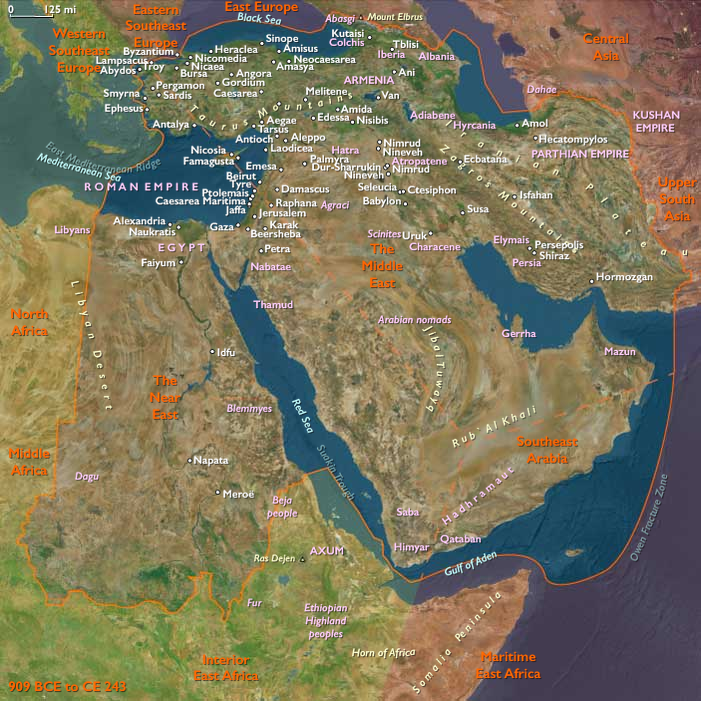
Subregions
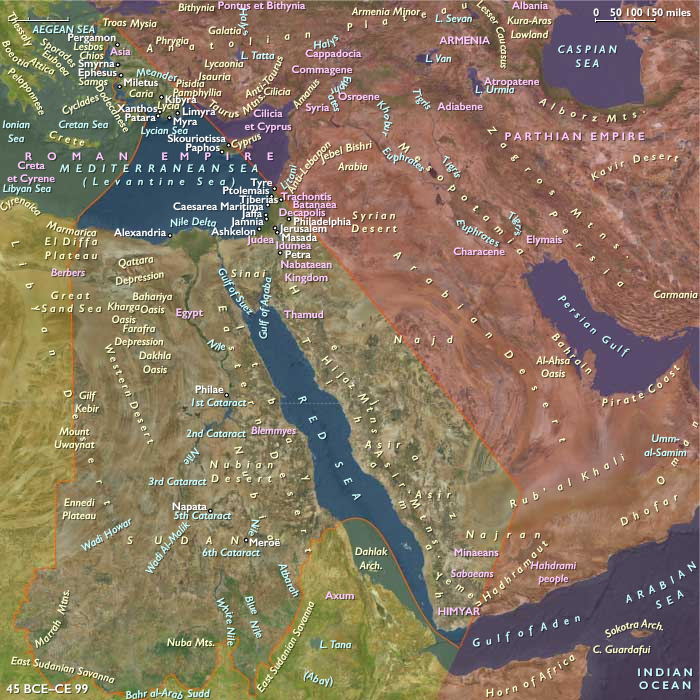
Related Events
Showing 10 events out of 62087 total
Years: 3BCE - 3BCE
Locations
People
- Aretas IV Philopatris
- Augustus
- Herod Antipas
- Herod Archelaus
- Herod the Great
- Philip the Tetrarch
- Publius Quinctilius Varus
- Salome I
Groups
- Samaritans
- Jews
- Nabataean Kingdom
- Galilee, Roman province of
- Roman Principate (Rome)
- Tetrarchy (Judea)
Topics
Commodoties
Subjects
Regions
Subregions